Open this photo in gallery:
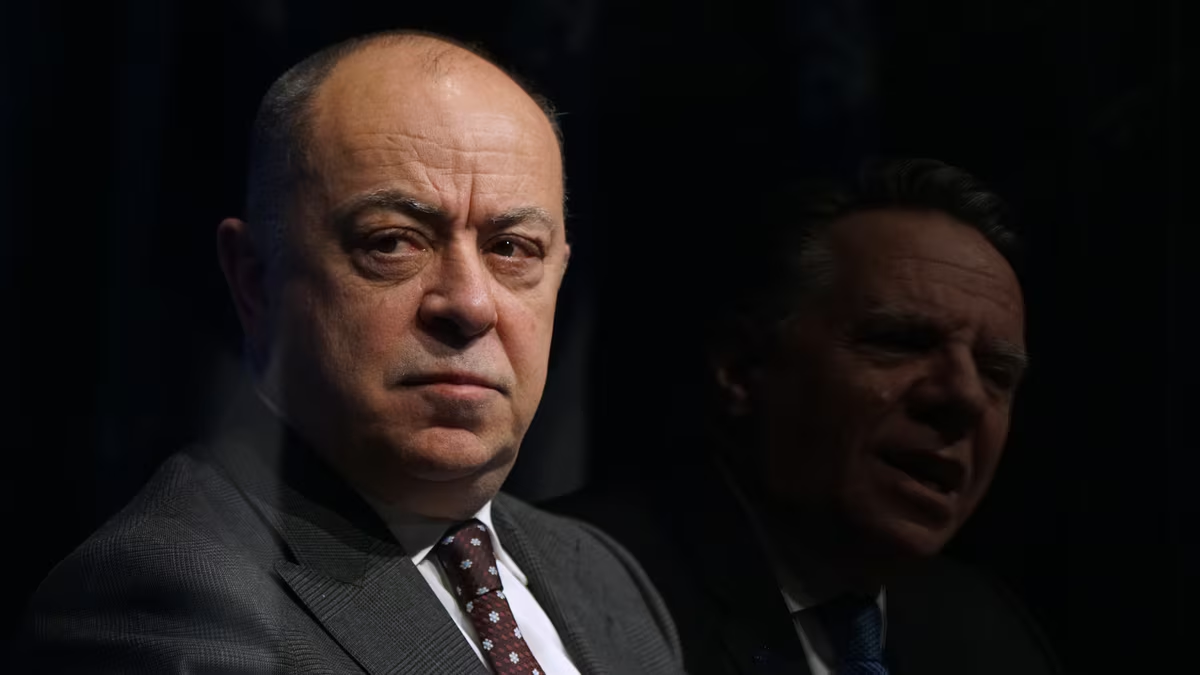
Toronto Police Deputy Chief Robert Johnson, left, and OPP Chief Superintendent Karen Gonneau speak at a press conference announcing a development in three cold-case femicides, in Toronto on Dec. 11.Sammy Kogan/The Globe and Mail
Toronto police say investigators used DNA evidence to identify a suspect they believe is a serial killer responsible for the murders of three women in the 1980s and 1990s.
Deputy Chief Robert Johnson said genetic genealogy has linked Kenneth Smith to the decades-old cold case murders of three Toronto women: 25-year-old Christine Prince in 1982; 23-year-old Claire Samson in 1983; and 41-year-old Gracelyn Greenidge in 1997.
Mr. Smith died in 2019 at the age of 72 in Windsor, Ont. Police said there was nothing connecting the women to each other or to Mr. Smith, describing the killings as crimes of opportunity. But he did have a violent criminal record, including, The Globe and Mail has confirmed, the rape and kidnapping of a 14-year-old Barrie girl in 1975.
Open this photo in gallery:
supplied/Toronto Police Service
“If he were alive today, the Toronto Police Service would arrest Kenneth Smith for the homicides of Christine Prince and Gracelyn Greenidge. And the OPP would arrest him for the homicide of Claire Samson,” Deputy Chief Johnson said at a press conference Thursday.
“His death means he will never be held to account in a court of law, and we recognize the impact that has on families who have waited so long for justice. On behalf of the Toronto Police Service and the OPP, I want to again extend our deepest condolences to their loved ones, who have carried an unimaginable burden for decades.”
Open this photo in gallery:
supplied/Toronto Police Service
Ms. Prince, 25, from Wales, was living and working as a nanny in Toronto when she was found dead in the Rouge River in Scarborough on June 22, 1982. She’d last been seen riding a streetcar on St. Clair Ave. West, after a movie and coffee date with a friend.
Open this photo in gallery:
supplied/Toronto Police Service
Ms. Samson, 23, was found dead on Sept. 2, 1983, in a remote wooded area in Oro Medonte, around 120 kilometres north of Toronto in an area that is under the jurisdiction of the OPP. She’d been shot. Ms. Samson – who the Toronto Star reported at the time was a sex worker, and also went by the name Casey – was last seen outside of a hotel on Jarvis Street, entering a beige vehicle driven by an older white man. Police said Thursday she had recently moved back in with her parents.
Open this photo in gallery:
Supplied/Toronto Police Service
Ms. Greenidge, 41, was found murdered in her North York apartment on Driftwood Avenue on July 29, 1997. Ms. Greenidge, who was originally from Barbados, had been working as a nursing assistant and was discovered by a co-worker after she failed to show up for work.
DNA was collected at the time of each killing but no suspect was identified, police said.
In 2001, the OPP launched Project Millennium with a goal of reviewing 17 unsolved homicide cases to determine whether modern forensic techniques could be applied to move them forward. Ms. Samson’s case was among them.
A break came in 2016, when Ontario’s Centre of Forensic Sciences flagged a connection between the sample uploaded to Canada’s National DNA data bank from Ms. Samson’s case, and one uploaded from Ms. Prince’s case. The two cases were confirmed as having the same unidentified offender.
From there, TPS and the OPP launched a joint investigation. A year later in 2017, the Centre identified another match – confirming the same offender was also responsible for the murder of Ms. Greenidge.
In 2022, the police services partnered with Othram, a Texas-based forensics lab devoted to law enforcement. Earlier this year, investigators identified familial relatives of the offender, and from there were able to home in conclusively on Mr. Smith as the killer in all three cases.
Det. Sgt. Smith said they were relieved to be able to provide some closure to families who’ve waited decades for answers.
“They may not know the why unfortunately, because he is deceased – but they know who committed these offences,” he said.
On Facebook, a woman who identified herself as Da’Moniqua Brathwaite posted that Ms. Greenidge was her aunt. She said the announcement brought mixed emotions and lingering questions. “Either way there is no true justice for our family,” she wrote.
Mr. Smith – who police said was born in South Porcupine, Ont., in 1946, but lived and worked in Toronto at the time of the murders – was not on investigators’ radars at the time of the murders. But he was known to police, and had a violent criminal record for “sexually based offences,” Det. Sgt. Smith said.
He was incarcerated at least once before the first two murders, and two more times before the third, he said.
In 1976, according to an archived news report unearthed by The Globe, Mr. Smith pleaded guilty to kidnapping and raping a 14-year-old girl the year prior. Though they did not share any specifics of his criminal history at the press conference Thursday, TPS later confirmed that this was the same Mr. Smith.
Police believe there may have been more victims who have not yet been identified. They are asking anyone with information about Mr. Smith or his whereabouts over the years to contact police, so they can cross-check for other unsolved cases in those areas.
Det. Sgt. Smith hailed the potential of investigative genetic genealogy, or IGG, saying it has been used to solve 68 cold cases in Ontario and more than 80 nationwide.
“It makes all the cases that have previously been unsolvable now solvable.”
The method came to prominence in 2018, when police used it to identify the Golden State Killer, who had committed dozens of rapes and murders in the 1970s and ’80s.
IGG involves submitting a DNA sample from a case to a sequencing company, which then creates a genetic family profile and uploads it to an online DNA testing database to figure out matches. This can yield a list of genetic relations – anywhere from a sibling to as distant as a sixth cousin. Genealogists then work on mapping out a family tree.
On Thursday, Det. Sgt. Smith said the Centre of Forensic Sciences needs to expand its capabilities, citing a current backlog of 64 cases.
“If we can expand their ability to test our cold cases, we’ll be able to make these connections much quicker,” he said.
With research from Stephanie Chambers and reports from Colin Freeze and Patrick White