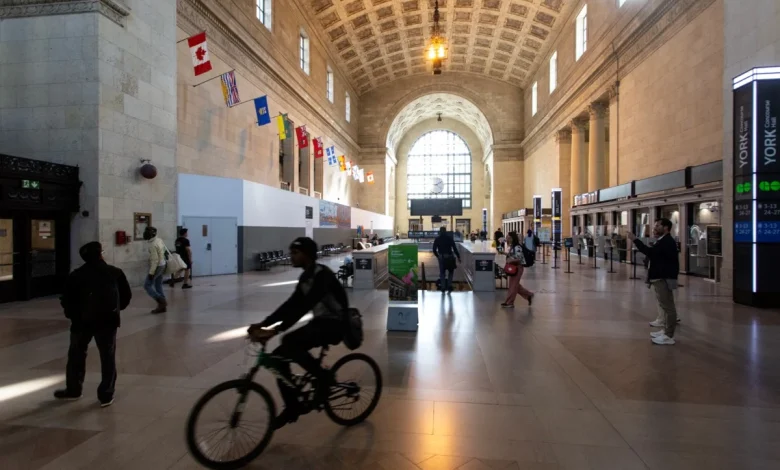
‘The objective would be to have a station in the vicinity of Union Station,’ said Martin Imbleau, CEO of the crown corporation tasked with delivering high-speed rail between Toronto and Quebec City
A high-speed rail corridor that promises to one day span from Toronto to Quebec City likely won’t connect to Union Station, according to the CEO of Alto, the crown corporation tasked with delivering the project.
During a meeting of the Senate’s transport committee, CEO Martin Imbleau said Alto is weighing several options for the location of a future high-speed rail station in Toronto.
“The objective would be to have a station in the vicinity of Union Station,” Imbleau said Tuesday. “We’re looking at options. It needs to be economical [and it] needs to be reliable.”
Imbleau didn’t definitively rule out Union Station, but reiterated to senators that the “intent” was to find a location nearby “if it’s feasible and we can make it affordable.”
Imbleau did not say why Union Station is not a front-runner to host the high-speed rail station.
As Canada’s busiest transit hub, Union Station would appear to be a natural choice as a terminus for the Toronto–Quebec City rail corridor. The station connects travellers to national and regional rail systems, including Via Rail and GO Transit, and offers quick access to Canada’s largest airport, Pearson International, via the UP Express.
In a statement to TorontoToday, Alto spokesperson Crystal Jongeward said the crown corporation is “currently in the development and pre-construction phase” of delivering the high-speed rail corridor and that it is “too early to speculate” on station locations.
“It’s important to note that whether in Montreal, Toronto, Quebec City, there are of course technical challenges to arriving downtown,” she wrote.
Trains running on the high-speed rail promise to reach up to 300 km/hour, roughly double the top speed of VIA Rail trains.
During the Senate committee meeting, Imbleau said Alto is collaborating with Metrolinx on the location of the Toronto high-speed rail station.
In a statement, Metrolinx, which jointly owns Union Station with the City of Toronto, said it is “working closely with Alto about various ways in which High Speed Rail can connect meaningfully to the network, including our other transit hubs.”
Senator Donna Dasko, who lives in Toronto, asked whether Alto intended to build the high-speed rail station in a suburb outside Toronto.
Vincent Robitaille, an assistant deputy minister of Transport Canada, suggested that wouldn’t be the case, noting Ottawa requested Alto build stations in downtown cores, including in Toronto and Montreal.
“We’re not talking about the station [being] very far in the suburbs,” he said. “But at this point, we want to let the experts do their work. We want the consultation to take place before any final decision is made.”
Sharing the rails
The high-speed rail project includes the laying of 1,000 kilometres of new passenger-dedicated track, meaning, unlike VIA Rail, the majority of the service won’t rely on the existing cross-country freight tracks owned by CN Rail and Canadian Pacific.
VIA Rail’s reliance on those private tracks — where freight trains have the right-of-way and are prioritized over passenger trains — is the cause of consistent delays.
Imbleau said the future high-speed train service may also need to share the rails in some locations, including Toronto’s downtown core.
“In city centres in Montreal and downtown Toronto we might need some collaboration by the host railway, including Metrolinx and others,” he said. “But the intent is to be independent, to be as reliable as possible.”
Imbleau acknowledged there are “reliability” concerns with the high-speed rail service using the existing tracks leading to Union Station, which are owned by Metrolinx and jointly operated by CN Rail and Canadian Pacific.
He didn’t rule out the possibility, however.
“We’ll have options to present at the proper time when we’ve done sufficient, diligent work in consultation,” he said.
The precise location of the high-speed rail line’s full corridor, including its Toronto stop, will be established in 2026, following extensive consultation, Imbleau said.
Former prime minister Justin Trudeau announced the $3.9-billion high-speed rail project in February.
The project is billed as one of the largest infrastructure projects in Canadian history and will span 1,000 kilometres between Toronto and Quebec City, with planned stations in Peterborough, Ottawa, Montreal, Laval and Trois-Rivières.
According to Alto’s projections, a journey from Toronto to Montreal on the rails could take just over three hours.
Alto is working with Cadence, a consortium of transport and infrastructure giants, to design the system. In the long term, Cadence will manage the network’s construction and operation.