ICE operation shows the difficulty of immigration arrests amid pushback in frigid Minnesota

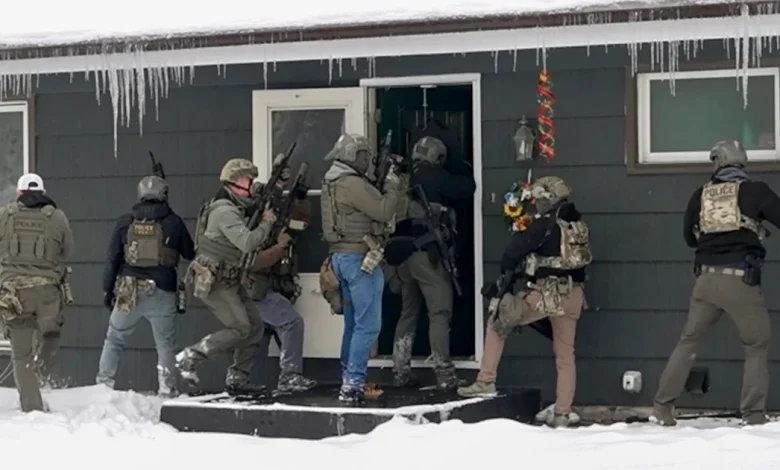
ST. PAUL, Minn. — In what’s become an increasingly volatile deployment, Immigration and Customs Enforcement agents have made more than 400 arrests in Minnesota since so-called Operation Metro Surge began this month, an ICE spokesperson said.
NBC News was granted exclusive access to the operation Wednesday in the frigid Twin Cities, where the wind chill dropped well below freezing.
“The frigid temperatures means that people aren’t out and about as much, so it makes it a little tougher,” said Marcos Charles, the acting executive associate director for ICE’s Enforcement and Removal Operations.
Details of the federal surge, which include around 100 ICE agents from around the country, had been sparse, prompting backlash, protests and threats. ICE requested that NBC News conceal the identities of most of its agents, who said protestors had tried to block in their vehicles at scenes and had aggressively tailed them, even attaching Apple AirTags to their vehicles to track their movements.
Throughout the day, NBC News witnessed multiple protestors going up to unmarked ICE vehicles and blowing whistles at the agents. One agent related an anecdote of an ICE agent’s evading a tailing car by using his military ID to enter a military base.
Trial and error
On Wednesday, agents left their staging area at a federal building in St. Paul by 6 a.m. The first target was a Somali immigrant who ICE said had been in the U.S. illegally since 2019 and had a previous conviction for criminal sexual conduct. The agents, in several vehicles, surrounded a home outside Minneapolis — and waited.
Within the hour, they made contact with someone inside the home: the man’s wife, who claimed he was staying elsewhere. Agents moved on to their next target, another Somali immigrant, but couldn’t locate him.
“It is not an operation targeting the Somali community,” Charles said. “We’re looking for people that are here illegally.”
Three hours later, after a burst of activity over the agency’s radio transmissions, another team, including agents from Florida and Texas, gathered around a residence, hoping to make an arrest and trying to determine whether their target was home. A crowd began to gather.
“Let’s get out of there,” an ICE official said over the radio with a curse and a sigh.
ICE agents enter a home outside St. Paul, Minn., looking for a suspect charged with criminal sexual contact on Dec. 10.Bill Angelucci / NBC News
The operation was a constant, unrelenting sequence of trial and error, using previously gathered intelligence about targets to make arrests. Ideally, officers said, a person is taken into custody without incident. Many attempts don’t pan out, the day’s events showed and agents said, either because the suspect isn’t home or because other obstacles get in the way, such as persistent protestors or property managers who restrict ICE personnel’s movements within any given area.
At one location, ICE agents surrounded an apartment building attached to a business on the ground level. They were searching for a 68-year-old Somali who’d been convicted of criminal sexual contact with a minor and who agents believed was upstairs. The property manager wouldn’t let the ICE agents enter, so they had to abandon the plan.
Around noon, the agents arrived back at their staging area to regroup while another transport team brought in three undocumented immigrants from Ecuador who had just been taken into custody.
In a brief interview, one of the men, 32, told NBC News that he’d been arrested while he was trying to find work shoveling snow. He acknowledged he’d been convicted of drunk driving three years earlier but insisted he remained in the country to work and care for his family. It wasn’t immediately clear whether he’d be deported or how soon.
Three men from Ecuador being processed at a federal facility in St. Paul, Minn., on Wednesday.Bill Angelucci / NBC News
By the afternoon, agents got word that another ICE team had tried to stop a man in his car near his home in Burnsville, Minnesota. He apparently escaped and ran inside the home. The agents consulted with a government lawyer and got a warrant allowing them to forcefully enter the home. About an hour later, a special response tactical team with a battering ram broke through the door.
The initial target had fled the home, but ICE said another undocumented immigrant from Honduras who had been staying at the home was taken into custody. During the operation, protestors gathered nearby. One of them rammed two ICE vehicles with his car, Charles said, and was arrested.
‘Filthy dirty, disgusting’
Even though ICE agents insist they’re not specifically targeting the Somali community, President Donald Trump has been ramping up his criticism of Minnesota’s Somali community, by far the largest in the country. The vast majority are here legally, and many are U.S. citizens. But that hasn’t stopped Trump from railing against their African homeland.
“We always take people from Somalia, places that are a disaster,” he said again Tuesday in Pennsylvania. “Filthy, dirty, disgusting, ridden with crime.”
Trump escalated rhetoric after convictions involving dozens of members of Minnesota’s Somali community who, during the pandemic, stole millions of dollars in taxpayer money, some of it from programs providing meals to low-income children. The majority of those charged in the fraud are U.S. citizens.
State and city leaders in Minnesota have strongly argued that the scandal shouldn’t be used to insult all Somali immigrants.
“The mistakes of a few individuals can never be used to generalize or stereotype an entire community,” said Imam Hassan Jamma, executive director of the Islamic Association of North America.
A top adviser to Trump, however, isn’t limiting his attacks to a few individuals. White House deputy chief of staff Stephen Miller — the administration’s immigration policy architect — was direct in an interview with Fox News on Tuesday in his xenophobic criticism of African countries specifically.
More on immigration enforcement
“You see with a lot of these immigrant groups, not only is the first generation unsuccessful — again, Somalia is a clear example here — not only is the first generation unsuccessful, but you see persistent issues in every subsequent generation,” Miller said. “You see consistent high rates of welfare use, consistent high rates of criminal activity, consistent failures to assimilate. This shouldn’t be a surprise.”
“There are people all over the world that are great people,” Miller added. “But you look at the society — if Libya keeps failing, if the Central African Republic keeps failing, if Somalia keeps failing, if these societies all over the world continue to fail, you have to ask yourself: If you bring those societies into our country and then give them unlimited free welfare, what do we think is going to happen?”
Growing backlash
“The biggest misconception is that we’re out there just randomly arresting people, which we’re not,” Charles said.
Firm numbers about how many “collateral arrests,” as DHS officials have described them, have occurred have been difficult to determine. During NBC News’ roughly eight hours with ICE, fewer than a dozen people were arrested despite not being the initial targets of the operation. They just happened to be at the scene when agents showed up.
In Minneapolis, as in other major cities where the Trump administration has surged resources, ICE has encountered concerted pushback from local leaders who have accused it of mistakenly taking U.S. citizens into custody.
On Wednesday, Minneapolis’ mayor and police chief alleged at a news conference that ICE agents wrongfully arrested a U.S. citizen because he looked Somali.
Standing alongside the city leaders, Mubashir, 20, who wanted to be identified only by his first name, said he was on his lunch break Tuesday when a masked man running full speed tackled him and pushed him into a restaurant.
“The agent then, at one point, he never identified himself, he didn’t say, ‘ICE, stop.’ I feel like I was getting assaulted, I was getting kidnapped,” Mubashir said.
DHS said ICE officers were speaking to someone nearby who they suspected was in the country illegally.
“At that time, a second male individual walked out of a nearby restaurant, turned around, and fled from law enforcement,” DHS spokesperson Tricia McLaughlin said in a statement to NBC News. “Having reasonable suspicion–as protected under the U.S. Constitution–officers gave chase and caught up with the individual, who violently resisted officers and refused to answer questions.”
She added that the officers “temporarily detained” the person because a large crowd had gathered, presenting a threat to the officers’ safety.
“Once officers finished their questioning, he was promptly released,” McLaughlin wrote. “Allegations that DHS law enforcement officers engage in ‘racial profiling’ are disgusting, reckless, and categorically FALSE. What makes someone a target for immigration enforcement is if they are illegally in the U.S.—NOT their skin color, race, or ethnicity. Under the fourth amendment of the U.S. Constitution, DHS law enforcement uses ‘reasonable suspicion’ to make arrests. If and when we do encounter individuals subject to arrest, our law enforcement is trained to ask a series of well-determined questions to determine status and removability.”
Mubashir said that after the officers saw his passport hours later and became convinced that he was a U.S. citizen, they told him he was free to go. He asked whether they could take him back to where he was arrested, and he said they told him he could walk home in the snow.
“I apologize that this happened to you in my city, with people wearing vests that say ‘police,’” Minneapolis Police Chief Brian O’Hara said. “That’s embarrassing.”