Last week, it seemed apt to revisit Johann van Graan’s tenure at Munster. This week, of all weeks, when Munster host Gloucester in their first Champions Cup game at SuperValu Páirc Uí Chaoimh, it seems even more appropriate to revisit The Miracle Match.
In the pantheon of greatest Munster games in the Champions Cup, the 33-6 win over Gloucester in January 2003 surely has to rank as the province’s most memorable day in the competition outside the finals of 2006 and 2008.
On those two days in Cardiff there were, after all, trophies on the line and, much like The Godfather I and Godfather II, one can argue about which ought to be ranked above the other.
But the Miracle Match has to be next best in any Munster top 10. They’d only met once before, in Kingsholm the previous October. When Gloucester routed Munster by 35-16, scoring four tries (these were pre-bonus point days) before a late consolation try by Peter Stringer, which Ronan O’Gara converted, provided a sliver of consolation.
It had shades of last Saturday’s beating in the Rec and as Liam Toland commented on Monday’s Off The Ball, it’s a shame Munster don’t have the opportunity to host Bath in a return match.
You think Munster would have no chance? The Champions Cup is littered with plenty of huge turnarounds and back in January 2003, Munster were given little hope of stopping the Gloucester juggernaut. Ala Bath, they were the runaway Premiership leaders and ultimately topped the table by 15 points (although Gloucester would lose the final to Warren Gatland’s Wasps, who would beat Munster in an epic European semi-final the following season).
But that week in January 2003, not for the first or last time, there were forecasts aplenty of Munster’s demise. The IRFU had co-opted Declan Kidney on to the Irish coaching ticket (whether he liked it or not!) to be replaced by Alan Gaffney and the previous weekend Munster had been beaten 23-8 by Perpignan.
“There was a lot of doom and gloom around that week, for certain,” Gaffney told The Irish Times years later. Players would later speak of feeling close to depression on the Sunday after the Perpignan beating. By Tuesday the ball was being dropped repeatedly in training, until a group huddle, when Anthony Foley told them that Gloucester players on television the previous Sunday had declared they were “looking forward” to coming to Thomond Park and seeking to end Munster’s unbeaten Heineken Cup record there. Munster love a sense of grievance, and no one harnessed it better than Axel.
That Monday, this writer had delved into the permutations and concluded that Munster had to win and score four more tries than Gloucester to finish above them in second and qualify for the knock-out stages or alternatively win and score at least five tries or more than the Cherry & Whites.
It received little traction. A regret remains not running the permutations in the same detail in Saturday’s paper, rather than just reference it in the preview, to make it abundantly clear. Not everyone quite grasped it. Not even the management and certainly not the players. Few, if any, thought there was the remotest possibility of the miracle happening. A win of any hue, thus retaining the unbeaten European record in Thomond Park and so preserving Munster’s honour, would have sufficed.
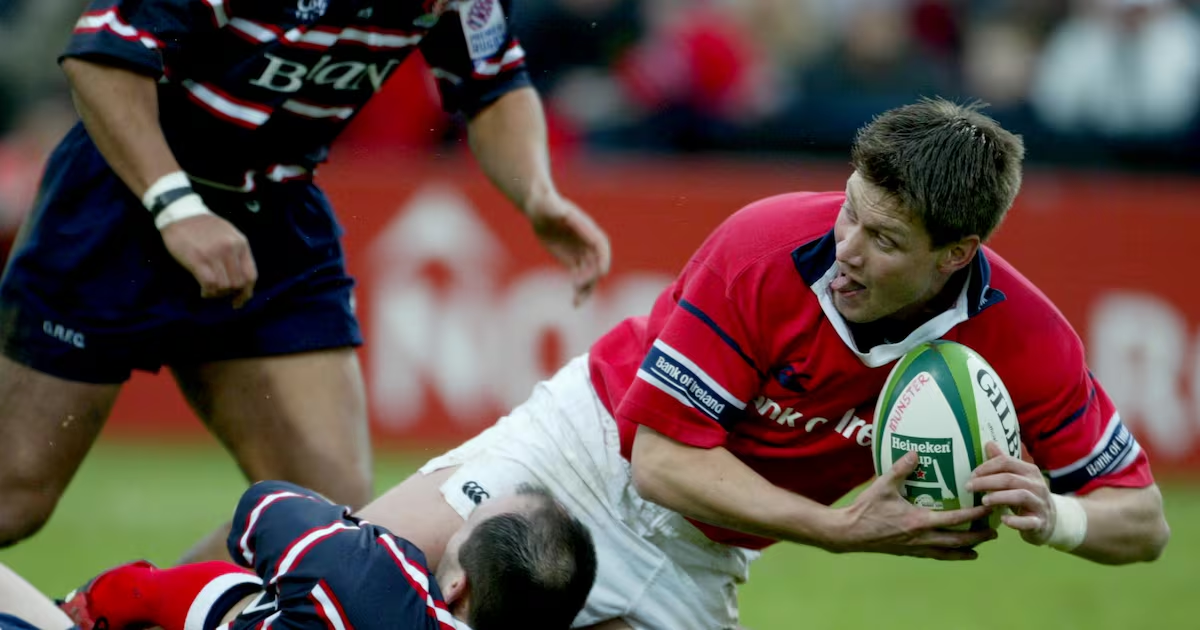
On vintage Munster days like this, they locate an oppositions Achilles heel, or take away the opposition’s key strength, or start a fight. In the sixth minute, O’Gara launched a towering up-and-under which Henry Paul, Gloucester’s rugby league convert at fullback, so misread that he swung his boot at it before gathering on the bounce. Cue 80 minutes of noisy, aerial torture.
The tries came virtually on the quarter. In the 19th minute, Peter Stringer put John Kelly over. In the 40th minute, Mossie Lawlor pounced on Jason Holland’s grubber. 16-6 at half-time.
Munster never let up but, in truth, Gloucester were not for wilting.
O’Gara and captain Jim Williams settled for a critical 54th penalty. Three minutes later Mick O’Driscoll scored from Holland’s crosskick. 26-6.
Entering the last quarter, RTÉ co-commentator Ralph Keyes confirmed that a 27-point/four-try winning margin would suffice. Nobody told Ludovic Mercier, the Gloucester outhalf, who tapped a penalty from in front of the posts 20 metres out which came to nothing. Only when his wife asked him afterwards did Mercier realise his mistake.
Entering injury time, the on-field Brains Trust called a move they hadn’t used in years, if ever. “The last try had nothing to do with me mate,” admitted Gaffney. Instead of setting up a traditional maul off a lineout, to gasps of astonishment they worked the ball to Mikey Mullins in midfield, and with Alan Quinlan on hand, set up the maul in midfield.
The drive was held up, so too Jeremy Staunton’s charge, before Donnacha O’Callaghan’s clear-out enabled Stringer and O’Gara to move the ball on for Kelly to dive over. Cue pandemonium. Many in the crowd (a 12,500 capacity, further putting this Saturday’s record attendance in perspective) thought that was enough. So too the players. Even O’Gara didn’t fully know the implications of his conversion with the game’s second last play.
Gaffney confirmed something which may or may not have been a copy of Gloucester’s gameplan had been found in the back of a taxi but was never shown to the players.
“We just adopted an attitude that we just had to go out and play well, and I remember Axel kept using the word ‘process’. It wasn’t the result, we just had to look after the process. But the 27 points and the four tries never entered the conversation.”
A miracle all right.