Published December 11, 2025 06:00AM
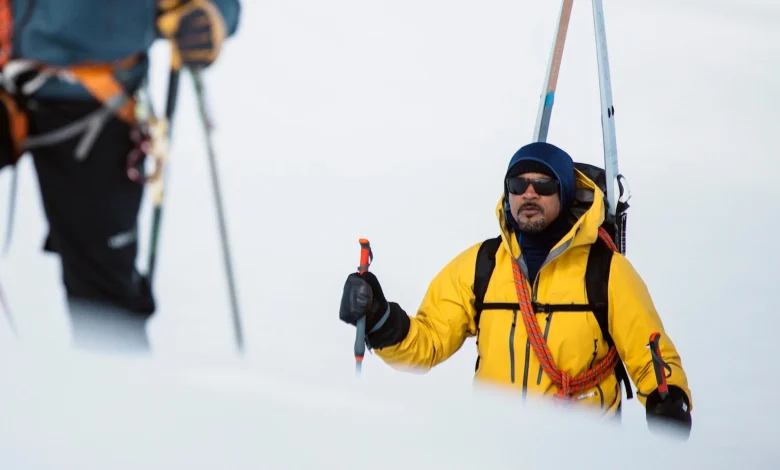
Will Smith is standing on a wall of ice as snow swirls around him. His bright yellow La Sportiva ice climbing boots are kicked into the snow. “Hey Will,” polar athlete Richard Parks shouts from the top of the 300-foot ice wall, “the wind’s picking up.”
“Oh my god,” says Smith. “It’s like a fricking hurricane.”
The wind grows intense and so does the snow, at some points blowing so much that even Smith’s boots and matching neon jacket become almost invisible. Smith keeps moving, swinging his left ice tool into the wall, then his right, then kicking in each foot, one at a time. It’s slow progress as Parks belays him from above.
In the first episode of Smith’s upcoming docuseries, Pole to Pole, the pair is in the Ellsworth Mountains of Antarctica, a 217-mile-long range, where Mount Vinson, the highest peak, reaches 16,050 feet. They’re traveling 700 miles from basecamp to the South Pole, and this is the first stretch of their journey. After this portion of the Ellsworth, they’ll reach a remote airbase from which they’ll fly to the Polar Plateau, an ice sheet that stretches on for more than 600 miles. Then, they’ll continue on skis to the bottom of the planet.
At one point during his ascent of the ice wall, Smith finds a small ledge and hangs his weight onto the rope. “I’m going to sit down for a couple of minutes,” he mumbles into his mic. “I can’t feel my lips.”
The screen cuts to a shot of Smith in a plain T-shirt, speaking directly to the camera. “I don’t quit a lot. I generally don’t give up,” he says. “But in Antarctica, you have that moment where you’re like, ‘Oh, Mother Nature is actually in charge.’”
And he doesn’t give up. He stands and starts swinging his ice tools again. He’s visibly exhausted, grunting as he inches up the wall. By now, Smith’s beard is white with snow. When he finally reaches the end of the pitch, it takes him four tries before he sinks an ice tool into the ground and pulls himself to the top of the wall.
He and Parks hug. “It was terrible down there,” says Smith. “But I loved it.”
Will Smith makes it to the top of a 300-foot ice wall. (Photo: National Geographic/Freddie Claire)
The ice climbing scene is an intense introduction to Smith’s new project, Pole to Pole, releasing January 13, 2026, on National Geographic and the following day on Disney+ and Hulu. In this National Geographic docuseries, Smith travels 26,000 miles in 100 days from the South Pole to the North Pole, exploring desert, jungle, mountains, and polar ice.
Throughout the series, Smith pushes himself physically and mentally. Challenging himself in this way, Smith told Outside in a sit-down interview in December, reminded him of something his grandmother used to say: “God placed the greatest things in life on the other side of your worst fears.”
“So I was exploring, just touching the edges of that discomfort,” Smith told Outside. “And we found glorious things.”
Each episode features a new stop along the way, where Smith tackles a physical adventure tied to the location and a cultural highlight. He functions as a host and student, learning about nature and different cultures with a sometimes earnest and often self-deprecatory approach. The actor isn’t shy about disclosing his fear of creepy crawlies in dark caves or ice-cold waters of the Arctic Ocean, which comes across as endearing to the viewer.
In episode two, Smith heads to the Amazon to climb a 200-foot tree with mountaineer and expedition leader Carla Perez and toxicologist and venom expert Bryan Fry. “Everything is alive in the Amazon,” Smith later told Outside. “And some stuff sounds like it’s alive and not happy.”
The trio scouts the treetops and delves into dark caves, looking for species—including spiders big enough to make you squirm as you watch Smith reach for them on screen—that could help with medical advances. Venomous creatures can contribute to some of the most effective drugs. (Captopril, for example, which is used to treat high blood pressure and other cardiovascular conditions, was developed from a peptide found in the venom of the Brazilian viper.) It’s Fry’s job to head into extreme environments to look for these venomous animals. “Over the last 25 years, I’ve had 27 snake bites, 24 broken bones, 400 stitches, 3 concussions, 2 stingray stings, and one near-fatal scorpion sting in the Amazon,” says Fry on the show.
In the sixth episode, Smith and San Bushman guide Kane Motswana go hunting with members of a San village, Indigenous hunter-gatherers of Southern Africa, who live in the Kalahari Desert. Early in the episode, Motswana leads Smith on a hike to see petroglyphs that are more than 80,000 years old.
In another episode, Smith visits Papua New Guinea to learn about marine life. “Papua New Guinea is how human beings should live,” Smith said to Outside. “We visited with these children, and their bedroom—this was a stilt house with the stilts in the ocean—they would be in their bedroom, and they’d wake up and jump out of their bedroom into the ocean.”
As a child, Smith, now 57 years old, wanted to be an explorer. Dr. S. Allen Counter, a Harvard neurobiologist and explorer, was his mentor. “I called him the Black Indiana Jones,” says Smith in the series.
Over the years, Counter invited Smith on many of his adventures, but the actor never found time to join him. He always wondered what his mentor wanted him to see, and Pole to Pole, says Smith, is his chance to find out.
The goal of the series, says Smith in the first episode, is to cross the seven continents to seek out some of the most extreme places on Earth. “To truly understand our planet, I’m stepping into the unknown, a journey to the edges of our world, to see it from pole to pole,” he says.
Will Smith descends 206 feet into La Cueva de los Tayos as they go to search for new
life. (Photo: National Geographic/ Kyle Christy)The Waorani people take Professor ofToxicology Bryan Fry, Will Smith, and Expedition Leader Carla Perez out on the water to track an anaconda to gather blood and tissue samples. (Photo: National Geographic/Kyle Christy)
Pole to Pole isn’t Smith’s first nature series. After three decades of Hollywood success, which began with the Fresh Prince of Bel-Air in 1990 and quickly expanded to blockbusters like Independence Day (1996), Men in Black (1997), and I Am Legend (2007)—not to mention a highly successful music career complete with four Grammy awards—Smith stopped playing the hero and began a different chapter. His career expanded into docuseries where he explored epic locations and asked big questions.
In 2018, he hosted the ten-episode One Strange Rock, which explored Earth through the eyes of astronauts. In 2021, he starred in Welcome to Earth, a series in which he traveled to extreme environments—kayaking rivers and rappelling into volcanoes—to see some of the most remote locations in the world. Both were produced by National Geographic.
Off-screen, Smith has participated in multiple environmental and conservation projects. He co-launched Just Water, a company that makes bottles from plant-based materials, with his son, Jaden. Smith partnered with Leonardo DiCaprio on a line of sneakers in 2019; proceeds went toward Amazon rainforest preservation. The Will and Jada Smith Family Foundation, founded by Smith and his wife, has a sustainability arm dedicated to combating climate change and preserving the planet. The list goes on.
But shortly after Pole to Pole was announced came the March 2022 Oscars, when comedian Chris Rock made a joke about Smith’s wife, Jada Pinkett Smith. Will Smith walked onto the stage and slapped him. The incident spurred backlash from fans and media, and clashed directly with the persona he’d spent decades shaping. Now, several years after production began, Pole to Pole arrives as Smith’s second major project, following Bad Boys 4 (2024), released since the slap.
Smith addresses this head-on in the fourth episode of Pole to Pole when traveling to Bhutan in the Himalayas. Bhutan measures the well-being of its residents through Gross National Happiness (GNH) instead of economic growth. The focus on GNH, which prioritizes psychological and spiritual well-being, has led many to call the country the happiest on Earth. In Bhutan, among monasteries and 24,000-foot peaks, Smith opens up. The result is one of the most compelling parts of the show.
“For most of my life, I’ve had absolute purpose,” says Smith in the series. “I was striving to be the biggest movie star in the world. I set very high standards for myself, signing every autograph and shaking every hand, and kissing every baby. I had a relentless focus on outward perfection. But it certainly didn’t turn out as I had planned.”
Smith sits with monks in a monastery, cross-legged on the ground. “I’ll never be a monk,” he later told Outside, laughing. “I just can’t sit there; my back was hurting so bad.”
Surrounded by brightly painted walls and intricately patterned rugs, the monks speak to how they define happiness. For them, says one, happiness is understanding that nothing is permanent and everything is changing. “We can be rich and poor,” he says. “Sometimes we can be popular and sometimes not.”
“I know about that, personally,” Smith interjects. “I tasted the top of my success, fame, money, and then watched it fall apart. I’m trying to find ways to stop worrying about that.”
Any attachment that Smith has, says the monk, will never lead him to happiness. “So if I’m trying to hold on to those things so hard, that becomes the actual source of my unhappiness. That’s pretty accurate,” says Smith as he wipes away tears.
“When we encounter a very bad moment or incident in our lives,” says the monk, “there is no other way to find happiness than within yourself.” He goes on to encourage Smith to think about death because, the theory goes, when we focus on dying, we are forced to confront what really matters.
The decision to include this vulnerable scene in Pole to Pole is in line with Smith’s desire to be forthcoming about his own obstacles as a way to possibly help others. According to Smith, some of the greatest experiences of his life have been when other people have dared to share their own challenges. “I have found a space in myself—in my spirit, in my heart—that is invincible, and you can’t cultivate that kind of trust and surrender in yourself without being tested in the fire, you know? I’ve had some fire in my life,” Smith said to Outside in an interview. “I think it’s super critical to be able to come out of the flames and talk people through Dante’s Inferno, to bring your inner Virgil out.”
Will Smith jumps off a bridge while his heart rate and breathing are tracked. (Photo: National Geographic/Kyle Christy)
Will Smith is standing at the edge of the ice, about to jump into the freezing water below the North Pole. He’s wearing a navy wetsuit, already donning his mask. As a crewmember in a yellow jacket double-checks Smith’s breathing tubes and oxygen feed, he says, “Hang on, guys. We’ve got a problem.”
He walks Smith back and points out that a valve has frozen over. “There’s ice in there, see?” he says.
Smith waits as the crew pours hot water over the tube, trying to thaw it.
Expedition Leader and Oceanographer Allison Fong prepares to dive under the Arctic Ice in search of samples. (Photo: National Geographic)
The actor and musician is at the final stop on his pole-to-pole adventure. He’s traveled 800 miles by icebreaker ship with oceanographer and sea ecologist Allison Fong. Together, they are supposed to dive below to collect a specimen to help with Fong’s climate change research. According to Smith, this was one of the most complex missions he had to train for as he filmed the new docuseries.
Because it’s saltwater, he explained to Outside during an interview, it’s actually below the freezing point of freshwater. The surface water, in which Smith and Fong were planning to dive, can hover at just under 29 degrees Fahrenheit at its lowest, according to the U.S. Geological Survey. Combining that cold water with a proper wetsuit and warm body creates a buoyancy issue, which Smith had to train to navigate.
Then, of course, there’s the fact that the pair was diving under 15-plus feet of ice. “It’s dangerous because you’re going into an environment where five to ten meters of ice are hanging over your head,” says Fong in Pole to Pole. “If you run into a problem, you can’t just go directly up. You have to find that hole in the ice to properly resurface.”
This was the point of filming Pole to Pole when Smith feared he’d bitten off more than he could chew. “The freak-out factor was real,” he later told Outside.
Will Smith and Expedition Leader Allison Fong prepare to dive under the Arctic Ice. (Photo: National Geographic)
As the final episode of the series plays, the weather has turned, and a snowstorm builds around Smith. The snow is blowing, the wind is howling. The sky is a dreary gray. It’s now or never. Fong and Smith’s team works to thaw the frozen equipment with warm water as Smith waits anxiously. “This was the highest fear point for me in the entire journey,” he says in Pole to Pole.
Quickly, Smith suits up once again and inches toward the ice’s edge. A team of more than 15 surrounds him, and other than a few warming tents in the background, there’s only white ice as far as the eye can see. It’s time for Smith to dive, and, by his own words, he isn’t one to give up easily.
Smith’s black flippers stand at the end of the ice as he overlooks the slushy opening that Fong is now somewhere below. There are bits of snow and ice bobbing in the water. Someone from the team counts down, “Three, two, one.”
Smith’s flipper rises from the ice as he steps off the edge and down into the dark water below.
Pole to Pole premieres January 13 on National Geographic and streams the next day on Disney+ and Hulu.
Correction: December 11, 2025: An earlier version of this piece stated that Pole to Pole was Smith’s first project to release since the 2022 Oscars slap. It is actually his second, following Bad Boys 4 in 2024. We regret this error.