Listen to this article
Estimated 6 minutes
The audio version of this article is generated by AI-based technology. Mispronunciations can occur. We are working with our partners to continually review and improve the results.
To illustrate the incredible upheaval that federal politics in Canada has experienced over the last 12 months, one could do worse than to simply look at the last two Liberal caucus holiday parties.
A year ago, the Liberal caucus — then numbering 152 members — gathered just a day after Chrystia Freeland’s stunning resignation from cabinet. Justin Trudeau tried to keep up appearances — “Like most families, sometimes we have fights around the holidays,” he joked — but the end of his time as prime minister was now clearly in sight.
A poll published by Abacus Data earlier that month showed Trudeau’s Liberals trailing Pierre Poilievre’s Conservatives by 23 points and leading Jagmeet Singh’s NDP by just one.
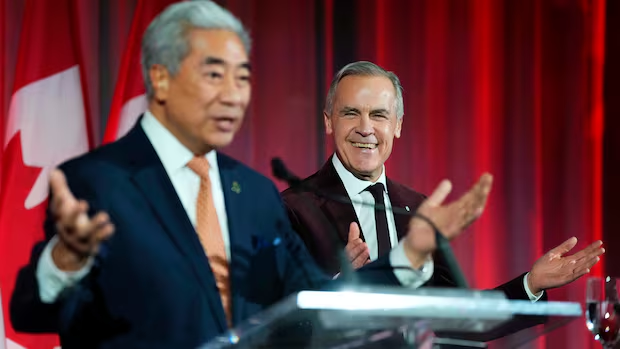
On Thursday night, Prime Minister Mark Carney addressed the Liberal caucus. It now numbered 171 members — indeed, partway through his remarks, Carney introduced the latest addition, Michael Ma, who until a couple hours earlier had been the Conservative MP for Markham-Unionville.
On its own, Ma’s arrival is obviously not nearly as seismic as Freeland’s departure. But for narrative purposes, their dramatic moves neatly bookend a remarkable year for Ottawa and the country.
And you may ask yourself, how did we get here?
The simplest answer is Donald Trump. Everything, to some extent or another, flows downstream from that.
‘A time for unity’
The spectre of Trump was part of the story in Freeland’s resignation and it was implicit in the statement Ma released on Thursday evening.
“This is a time for unity and decisive action for Canada’s future,” he said.
Trump’s arrival, in tandem with Trudeau’s exit, reframed the national discussion and changed the ballot question, at least for many Canadians.
The simple result of Trump’s arrival was a Carney government.
But even while Trump fundamentally reshaped the federal election, Carney’s Liberals still had to win that contest, and Poilievre’s Conservatives still had to lose it. And both deserve full credit for doing so.
WATCH | Carney introduces new Liberal MP:
PM Carney introduces new Liberal MP Michael Ma at holiday party
Prime Minister Mark Carney brings new Liberal MP Michael Ma onto the stage during the Liberals’ holiday party. Ma defected from the Conservatives earlier in the day.
The consequences of that election result are numerous and varied, but include the apparent fact that Carney has fashioned a government which at least two now-former Conservative MPs felt comfortable supporting. If many voters thought the election was about Trump, a lot of other voters thought the election was about change. And Carney seems willing to offer at least some measure of change.
And where Poilievre once seemed poised to lead the Conservatives to a smashing majority in the House of Commons, he is now apparently struggling to hold his caucus together.
Where does Poilievre go from here?
It is no doubt easier to hold a caucus together when you can hold out the promise of either victory or power. But the departure of another MP — bringing the total to three, if you include Matt Jeneroux — will renew questions about both Poilievre’s ability to win and his approach to political leadership — an approach that is not entirely unlike the approach of Trump.
Poilievre’s populist politics seemed to meet the moment of 12 months ago. But if the calculus flipped with Trump’s arrival, the Conservatives still seemed to come away from April’s election not believing that they needed to change much about what they were doing.
WATCH | Another Conservative joins the Liberals:
The Breakdown | Another Conservative joins the Liberals + At Issue
The latest on Conservative MP Michael Ma’s decision to cross to the Liberals, leaving Carney’s government just one seat shy of a majority. And as the House rises for the holidays, At Issue breaks down how much really got accomplished this sitting.
There was some logic to that. Poilievre’s Conservatives won 41.3 per cent of the vote, a bigger number than Stephen Harper ever managed. And perhaps, they could tell themselves, Carney’s coming to power was merely the product of a fleeting moment, his star destined to fade.
But that now looks like an increasingly risky bet. Not because Carney is proving to be perfectly successful at everything he touches — he isn’t — but because members of the Conservative caucus keep wandering away and the general public’s feelings about Poilievre don’t seem to be improving.
The threat posed by Trump — and the uncertainty he has created — is also unlikely to go away anytime soon, even assuming he relinquishes the White House in 2029. The world of 2016 — or December 2024 — is not coming back, at least not anytime soon.
The vibe shift
But that is a challenge for every political leader in Canada, not least the nominal winner of this year’s federal election.
In between adding two MPs from the Opposition side of the House this fall, Carney suffered his own resignation from cabinet — this time it was Steven Guilbeault, who 12 months ago was environment minister in Justin Trudeau’s cabinet. Not that Guilbeault’s departure was ever going to topple Carney the way Freeland’s exit knocked over Trudeau’s teetering administration.
But Guilbeault’s resignation was its own testament to how much has changed — motivated by the contents of Carney’s deal with Alberta, which is itself most easily justified as a response to the threat this country now faces from Trump. Guilbeault’s decision to resign in protest was also a reminder of how hard it can be to hold everything together.
Nonetheless, one might excuse the Liberals their Christmas spirit on Thursday night.
“It’s a special night. I mean, look … a year ago,” Liberal MP and caucus chair James Maloney said on stage on Thursday night.
Beside him, Liberal MP Mona Fortier jokingly cringed.
“How many people were at this event a year ago?” Maloney asked. “You remember the mood in the room last year? You feel the mood in the room this year? Eh? There’s good reason for that.”
After Maloney relayed a joke about the Liberals celebrating a resurrection in April, Carney later quipped that some of the Liberals in the room had come back from the dead.
But the last 12 months are a reminder that present circumstances should not be taken for granted.