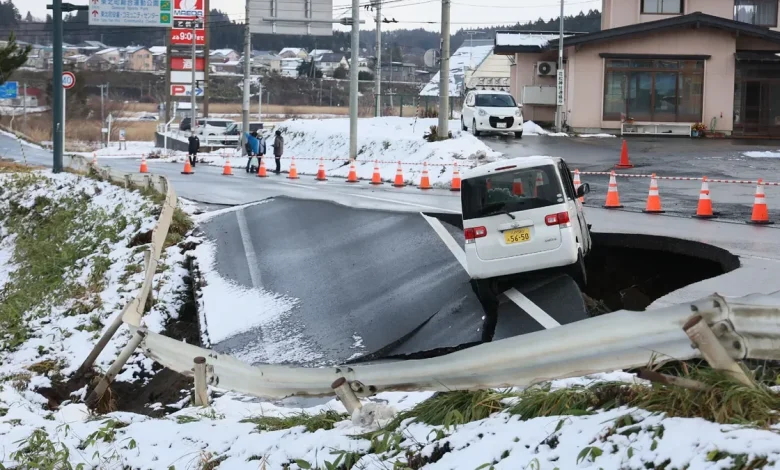
The earthquakes are not believed to be connected. But they are a reminder of lurking danger.
What you need to know about earthquakes
Every year, there are about 500,000 earthquakes – 100,000 of which can be felt on the Earth’s surface. But how do earthquakes work? We explain.
Just the FAQs
Two earthquakes of a 7.0 or greater magnitude have struck within days of each other in Alaska and Japan, prompting worries another big temblor could be on the way.
The first quake hit in Alaska on Dec. 6 with a magnitude of 7.0, a major quake capable of producing serious damage if it hadn’t happened in such a remote area near the Canada border. The second, a 7.6 mega-quake, hit northern Japan on Dec. 8, prompting tsunami warnings that were later lifted and causing at least 30 injuries. Tens of thousands evacuated their homes.
Aftershocks have been recorded for both earthquakes. On Dec. 8, Japanese authorities warned an even more powerful earthquake could strike within the next week and called on residents from the northernmost island of Hokkaido down to Chiba prefecture, east of Tokyo, to be on high alert.
The earthquakes were notable for their strength.
In an average year, the U.S. Geological Survey says about 16 major earthquakes are expected around the world, including 15 with a magnitude of 7.0 or higher and one 8.0 or higher. That’s based on records dating back to about 1900. For the last four to five decades, the long-term average number of major quakes in a year has been surpassed about a dozen times.
But having two such quakes in a short period of time happens from time-to-time and doesn’t necessarily signal another impending disaster.
“It’s not all the time, but it’s not that crazy,” said Brandon Schmandt, professor at Rice University and seismology expert.
It’s a reminder of an uncomfortable truth in earthquake science: Scientists know disastrous earthquakes are looming, but have no reliable way to predict when they will hit.
“No one can predict earthquakes. However, by investigating faults and past quakes, scientists can better assess the likelihood of future earthquakes and how intense their shaking might be,” the USGS said.
How strange is it for two big earthquakes to hit?
By “pure random chance,” it’s actually not uncommon for two quakes with 7.0 or higher magnitudes to hit this close together in time, according to CalTech seismologist Lucy Jones.
“We average about one magnitude-7.0 per month somewhere in the world,” Jones said.
The average of one per month is randomly distributed, Jones said. We might go several months without one, and then see multiple within a close span. Jones said she would estimate based on probabilities that paired magnitude-7 or higher earthquakes are likely to come within half a week of each other once every few years.
“It’s not like it happens all the time, but we’ve looked for and can’t find any physical correlation,” she said.
One earthquake can trigger another, as in an aftershock, but that’s not the relationship between the Alaska and Japan quakes, which appear to be wholly unrelated, Schmandt said. Aftershocks tend to happen in the same geographic area as the main earthquake.
Jones said there is about a 5% chance after any earthquake that another one will follow nearby within a few days that is bigger in magnitude. Though a 5% chance might not seem like much, it’s a much greater than the baseline chances, and it’s what’s driving Japanese authorities to stay on high alert for the time being, she said.
A recent example happened in 2019 near Ridgecrest, California, Jones noted. A 6.4-magnitude hit on the Fourth of July, and less intense aftershocks followed. Then, one day later, a 7.1 quake became the largest to strike Southern California in 20 years.
Is the US in danger of devastating earthquakes? What about ‘the Big One?’
Most of the United States is at risk for damaging earthquake shaking within the next century, according to the U.S. Geological Survey, which published a report last year that found hundreds of previously unidentified faults around the country.
People in 37 states have experienced earthquakes with magnitudes of 5.0 or greater in the last two centuries, according to the USGS.
The danger is most concentrated along the West Coast and the southern part of Alaska, where the most active tectonic plate boundaries are found.
Concerns of a so-called “Big One” event, a massive quake bringing untold devastation, have long rattled residents in these areas. It could happen at any time, or not for a long time, experts say. And there could be more than one “Big One.”
Schmandt said the Cascadia Subduction Zone that stretches from Northern California up through Oregon and Washington and into Canada has the potential for a lurking event that could be considered “the Big One.” The last known quake in this fault happened in January 1700, with an estimated 9.0 magnitude, according to the Oregon Department of Emergency Management.
“Currently, scientists are predicting that there is about a 37% chance that a megathrust earthquake of 7.1+ magnitude in this fault zone will occur in the next 50 years. This event will be felt throughout the Pacific Northwest,” the department said.
What do earthquake magnitudes mean?
According to Michigan Technological University, earthquake magnitudes can have the following effects:
- Below 2.5: Generally not felt
- 2.5 to 5.4: Minor or no damage
- 5.5 to 6.0: Slight damage to buildings
- 6.1 to 6.9: Serious damage
- 7.0 to 7.9: Major earthquake. Serious damage
- 8.0 or greater: Massive damage, can destroy communities
Contributing: Elizabeth Weise and Terry Collins, USA TODAY; Reuters