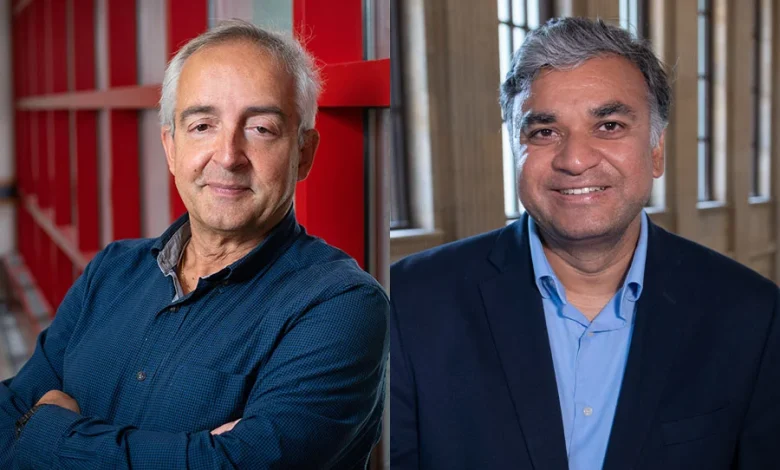
The National Academy of Inventors has announced the selection of two Fellows from the University of Minnesota Twin Cities College of Science and Engineering: Nikolaos Papanikolopoulos and Shashank Priya.
NAI Fellowship is the highest professional distinction awarded solely to inventors. Together, the 2025 class holds more than 5,300 U.S. patents and includes recipients of the Nobel Prize, the National Medals of Science and Technology & Innovation, and members of the National Academies of Sciences, Engineering, and Medicine, among others. This year’s 169 U.S. Fellows represent 127 universities, government agencies and research institutions across 40 U.S. states.
“The extraordinary accomplishments of Drs. Papanikolopoulos and Priya are exemplary of the strong commitment by our faculty to innovation that transcends disciplinary boundaries,” said Executive Vice President and Provost Gretchen Ritter. “Through research, collaboration and leadership, their work continues to break ground on the frontiers of technology innovation.”
Nikolaos Papanikolopoulos is the McKnight Presidential Endowed Professor and a Distinguished McKnight University Professor in the Department of Computer Science and Engineering. He is a scholar and inventor making significant contributions to the fields of robotics, computer vision and intelligent transportation systems. Papanikolopoulos is the Director of the Minnesota Robotics Institute, has authored or co-authored more than 400 papers and holds nine patents. He founded the company ReconRobotics Inc. with several of his students in the early 2000s, which translated into the production of the UMN Scout robot, which is based on three of his patents. More than 6,000 Scout robots have been deployed by military and police to increase the distance between humans and harm’s way.
Papanikolopoulos has received numerous awards that include the 2022 UMN Award for Outstanding Contributions to Graduate and Professional Education, the 2016 IEEE RAS George Saridis Leadership Award in Robotics and Automation, the 2016 CTS Research Partnership Award, the 2011 IEEE RAS Distinguished Service Award and the IEEE VTS 2001 Best Land Transportation Paper Award (with Osama Masoud). He is an IEEE Fellow.
Shashank Priya, a professor in the Department of Chemical Engineering and Materials Science, is the founding executive director of the University of Minnesota’s National Security Research Institute. He previously served as the University’s vice president for research and innovation, where he led a research enterprise exceeding $1 billion across all campuses and facilities and helped drive record growth in sponsored awards, research expenditures, and startup formation. An internationally recognized authority in materials engineering, bio-inspired systems, and energy harvesting, Priya has established himself as a visionary inventor, innovation strategist and ecosystem builder whose work continues to shape both scientific progress and societal well-being. He has published more than 500 peer-reviewed journal articles and holds 10 issued U.S. patents encompassing breakthrough advancements in piezoelectric materials, energy harvesting (process for converting locally available energy such as mechanical motion or heat or light into electricity), magnetoelectrics (materials that can convert magnetic field into electric field and vice-versa), perovskite photovoltaics (next-generation solar technology) and thermoelectrics (devices that turn heat directly into electricity). Many of these innovations—such as textured piezoelectrics—have been successfully transitioned to industry for applications such as underwater communication, while others, including biohybrid perovskites, have catalyzed the development of emerging products and technologies such as flexible solar cells and chemical sensors. Priya’s pioneering inventions—magnetoelectric composites that convert stray magnetic field emitted from common devices such as microwave ovens and refrigerators into electricity, to high energy density piezoceramics enabling generation of electricity from human motion and automobile vibrations, to biohybrid perovskites for generating electricity from indoor light sources—highlight his unique ability to marry scientific rigor with a bold translational vision.
Priya also founded and directed the NSF I/UCRC Center for Energy Harvesting Materials and Systems, a foundational platform for industry–university collaboration aimed at accelerating energy materials into real-world applications. He founded and chaired the Energy Harvesting Workshop for multiple years, creating a global forum that has enabled the international research community to engage, collaborate and advance the frontiers of energy generation and storage. Priya is a fellow of the American Ceramic Society.
The 2025 Class of Fellows will be honored and presented their medals by a senior official of the United States Patent and Trademark Office at the NAI 15th Annual Conference on June 4, 2026, in Los Angeles. The cohort includes 169 U.S. distinguished academic and institutional inventors and 16 International Fellows. Explore the full list of 2025 Fellows (PDF).