Manousos Oviedo is on a road trip. It’s an unusual one, insofar as he’s the only human being left alive willing to take one. A staunch enemy of everyone who succumbed to the Joining — the kinder, gentler apocalypse that unites (almost) all of humanity in one shared consciousness — Manousos (Carlos-Manuel Vesga) has decided to take his old car north, from his native Paraguay to as close to Albuquerque, New Mexico as it can go. From there he’ll travel on foot if he must, through a hot and impenetrable jungle filled with plants and animals that want nothing but to kill intruders in their territory.
The distance, the need to find food and water, the absence of any help he’s willing to accept, the heat, the prolonged isolation, the extreme physical pain: Our man Manousos is putting himself through a real ordeal here.
As such, he’s part of a grand tradition. Manousos’s segment of Pluribus Episode 7 (“The Gap”) is an example of a film and TV microgenre you’re probably familiar with but may never have named before: The Ordeal. An Ordeal is a film or television show in which the protagonist, alone or in a small group, must physically travel to a destination made difficult to reach by distance, terrain, personal injury or illness, and/or the actions of hostile forces. This takes them out of the world they know and inserts them deeper and deeper into a totally different one where they must survive or be consumed by whatever kind of no-man’s-land they’ve unwisely entered.
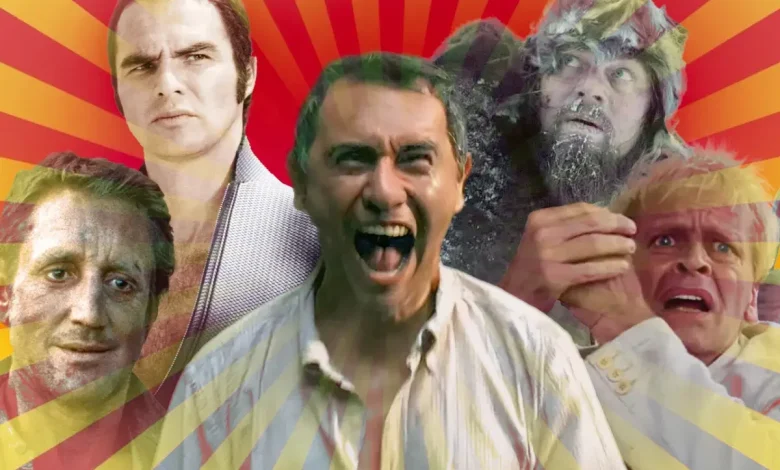
You may not have this definition in mind when you watch these movies, but as with the old Supreme Court definition of porn, I’ll bet you know it when you see it: Deliverance, Sorcerer, The Revenant, Apocalypse Now, Gravity, Aguirre – The Wrath of God, Stalker, Fitzcarraldo, The Descent, Valhalla Rising, Annihilation, Children of Men. These are movies where, when the closing credits roll, you feel like you just sailed down hundreds of miles of jungle river or trudged your way through a frozen wilderness. It’s an Ordeal for you as much as for the characters.
Unlike a quest narrative, which focuses on achieving a goal, the focus here is on the ordeal of the journey itself, which grows progressively more painful, physically and/or emotionally, as the end approaches. Even if pursuit is involved, Ordeals are not chases, they are slogs — a slow march through purgative suffering, from which the protagonist emerges fundamentally changed if indeed they emerge at all. (Seen in this light, Frodo and Sam’s portion of The Lord of the Rings qualifies, while the other guys’ storylines don’t.)
We don’t yet know how, or even if, Manousos will survive his encounter with the deadly chunga palm spines. But we’ve already seen him change since he decided to leave the cardboard-wrapped confines of his storage-unit rental office: As he goes farther away from his native Paraguay, he literally becomes bilingual thanks to his language instruction tapes.
Reaching Carol Sturka (with whom he’ll now be able to converse) and saving the world is his goal, but he’s far more focused on the gritty business of getting there from here: siphoning gas by sucking through a tube then spitting out what comes through, catching fish with a net, gathering rainwater with cans so he’ll have something to drink, and finally hacking and slashing his way through the jungle itself. The heat, the exertion, the sheer tedium of travel: This is the stuff of the Ordeal.
Usually — but not always: see The Descent, Gravity, Annihilation, and the Netflix series American Primeval — the protagonists of these stories are men, since the anxieties and desires they deal with tend to be male-coded: exploration, physical struggle, the conquest of territory, protecting the family. Some Ordeals tackle masculine anxiety directly: Deliverance, for example, only takes place because four city slickers decided to show off how rugged and capable they are in a world of men gone soft, and the sexually violent fate that befalls one of them is a core male fear. The outstanding AMC adaptation of Dan Simmons’s The Terror is a study of an entire crew of men forced into an Ordeal when their ships become stranded in the Arctic ice, studying their dynamics of rivalry and brotherhood as circumstances worsen.
Photo: Everett Collection
Manousos was given a name with the word “man” in it by Vince Gilligan and company. He’s traveling all on his own, with a handful of glove compartment maps and a little know-how about old cars. He refuses all help and directions. He decides to strike out on a hike well beyond his abilities. He carries a machete. It’s not the point of Manousos’s storyline that what he’s doing is pretty macho shit, but, well, it’s pretty macho shit. That suits the Ordeal to a tee.
But as the female-fronted Ordeals listed above indicate, the terror of being lost in a great hostile nothing that wishes to envelop and erase you is universal. So is our ability to relate to the kind of unceasing, thankless effort required to navigate such spaces successfully: Think of the rivers that so frequently figure in these stories, the way they inexorably carry us from home no matter what we do to fight the current. These circumstances are a reflection of our own experience of a world that seems designed to destroy us, whether through sociopolitical forces beyond our control or the simple fact of our own mortality. This is part of what makes the Ordeal such an engrossing subject for visual narrative.
The “visual” aspect is key here. Following from their need to situate their protagonists in the hostile environment they have unwisely invaded and their desire to show the sheer scale and scope of the journey, Ordeals tend to favor shot compositions that bring a full world of details into focus. They also want to make you, the viewer, feel the heat, the cold, the exertion, the exhaustion, the fear, the physical and psychological pain, resulting in closeups designed to draw forth and transmit the protagonist’s emotional state to the audience. As such, they’re full of haptic triggers, images that make the films and shows in question feel more real to us as viewers by setting off our senses. These movies and shows are full-body experiences.
Rooting you in the physical experiences of another person, one who isn’t even real, is one of the great magic tricks cinema is able to pull off. It’s especially hard when those experiences are unpleasant, enormously so when those unpleasant experiences drag on and on for an episode or a movie. Yet the Ordeal draws us in, because there’s catharsis to be found in physically connecting with someone who is suffering — the profound catharsis of empathy, which requires us to get out of our own heads just as the Ordeal itself requires its harried heroes to leave the comforts of the familiar world behind for parts unknown. As for Manousos, he’s still got a long way to go if he survives the spines. (The arrival of a hivemind helicopter is a good sign, right?) With any luck — ours, not his — his grueling, stunning Ordeal will continue.
Sean T. Collins (@seantcollins.com on Bluesky and theseantcollins on Patreon) has written about television for The New York Times, Vulture, Rolling Stone, and elsewhere. He is the author of Pain Don’t Hurt: Meditations on Road House. He lives with his family on Long Island.