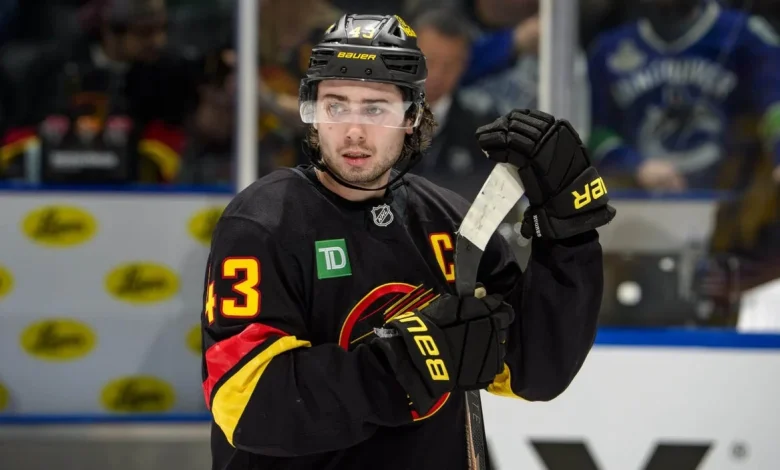
The Vancouver Canucks didn’t decide to trade Quinn Hughes.
That’s obvious. Hughes is the best defenseman in franchise history, a player who, at 26, has already built the type of resume during his time in Vancouver that his accomplishments will warrant the retirement of the No. 43 whenever he hangs up his skates, even though he’ll never play another game in Canucks colors.
This is, in no uncertain terms, a terrible day for the Canucks franchise. There’s no world in which this can be spun any other way.
Nonetheless, there are realities to consider. Across the past 18 months, without having this feeling grounded concretely, the Canucks have been preparing for a life without Hughes. Over the past couple of months, members of the organization’s leadership started wrapping their heads explicitly around the fact — and the club knew this as fact, by the end of the process — that Hughes wasn’t going to sign an extension and remain in Vancouver long-term.
The trade with the Minnesota Wild is a whopper — Marco Rossi, Liam Öhgren, Zeev Buium and a 2026 first-round pick for a transcendent defender in Hughes, a blueliner who impacts the game to a greater degree than any other defenseman in hockey (even if Cale Makar rightfully has the “best defenseman on the planet” belt) — and dropped on Friday night as an out-of-the-blue shock to the hockey world.
The Wild weren’t linked to Hughes in rumors but emerged as the front-runner in an auction that Canucks president of hockey operations Jim Rutherford had held across the past 10 days or so. It wasn’t, ultimately, an auction that involved all 31 other NHL teams. The Canucks, speaking regularly to Hughes and his CAA representatives, principally Pat Brisson, had tried to do right by Hughes — up to a point, in any event — by only engaging those teams that play in the Eastern Conference, closer to the Hughes family.
Once the determination was solidly made that Hughes wouldn’t be signing an extension in Vancouver, the timeline of this deal was accelerated significantly. Rutherford and his lieutenants felt strongly that their best opportunity to net the sort of return that the club required to make the best out of a catastrophically bad situation required the Canucks to do the deal now — or before the NHL trade deadline in any event — while the club had maximum leverage.
It seems Vancouver believed that if this dragged out until the summer, when Hughes’ willingness to sign an eight-year contract with whatever team was involved in trade talks would be a significant determining factor in the price that rival teams might pay for his services, they risked being held over the barrel by the New Jersey Devils. That wasn’t a tolerable scenario for Canucks management, which brought about one of the most stunning trades in NHL history.
As for the return, when the Wild, somewhat out of the blue, entered the process and anted up with an absolute bounty of assets — a young, productive NHL center under 25 in Rossi, an extraordinarily promising left-handed defender in Buium with a duplicative skill set to Hughes, a potential power forward in Öhgren who has built-in chemistry with Jonathan Lekkerimäki, and a first-round pick to boot — they immediately became the team to beat in the limited Hughes auction. To the point that the club began to counsel Hughes’ camp over the course of this week that they should prepare for the very real possibility that he might be dealt to Minnesota.
From the Canucks’ perspective, there was never any real way to win a Hughes trade. This deal is a loss for all intents and purposes, a deal in which the club lost a transformative elite player for a smattering of intriguing but clearly lesser assets.
The Canucks, however, have believed that they’ve been in a rebuilding mode — even if the word “rebuild” remains a complicated one in the halls of power off Griffiths Way — dating back to the J.T. Miller trade. Maybe there was a way to keep the band together and continue to build, which was the preference, but between the locker room dysfunction that led to Miller’s Vancouver exit and the injuries to Filip Chytil and Teddy Blueger, which detonated the Canucks’ functionality down the middle of their forward group, that path became untenable.
Dating back to mid-June, once management began to get a sense that they’d be hard-pressed to add any of Matt Duchene, Christian Dvorak or Mikael Granlund to the lineup in free agency, the club began to keep its powder dry to that eventuality. There was still hope that the club could compete in the short term, of course, but the organizational decision to keep and make its 2025 first-round pick continues to speak volumes about a half-pregnant posture in which the Canucks were intent on keeping their eyes on the club’s long-term needs.
Now that rebuilding mode is inarguable. The time has come.
On Friday, Vancouver dealt one of the biggest stars in the history of the franchise in a purely future-oriented deal. Organizationally, the club plans now to function to maximize its draft lottery odds and “rebuild,” whatever that term comes to mean internally, this roster.
Of course, because this is the Canucks, the club will hope to accomplish that goal as quickly as possible. This time, however, the expedited rebuild will occur with an understanding that a top-three pick in the next two draft classes would expedite that process.
And that, in and of itself, is a significant departure from how the Canucks have done business for the past 15 years.
On what was inarguably an awful day for the franchise, the club at least executed a trade that set itself up to have a chance at accumulating the talent volume required to support the next Hughes-level player the Canucks draft, in a way Vancouver failed to do with Hughes himself.