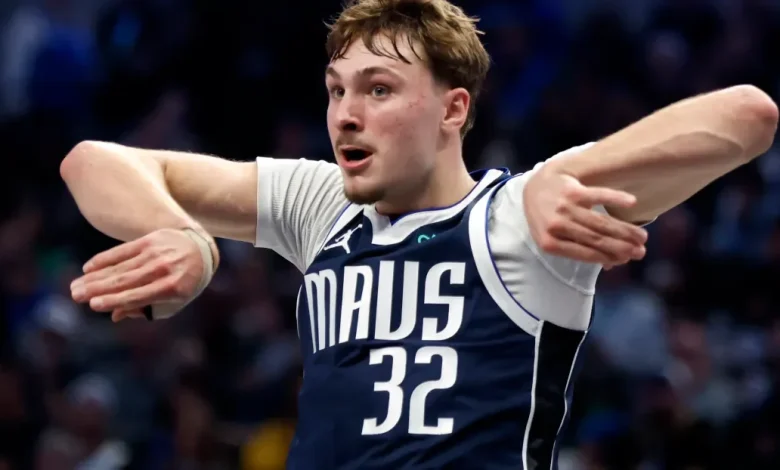
The Dallas Mavericks pulled out an ugly victory at home against the Brooklyn Nets on Friday night, winning 119-111. The Mavs were led by Anthony Davis, who had a monster 24-point, 14-rebound, 3-assist, 3-steal, 3-block night in 32 minutes. Cooper Flagg also had 22 points, five rebounds, and a career high of eight assists. Max Christie and Naji Marhsall each contributed 15 and 17 points, respectively. Michael Porter Jr. led the way for the Nets with 34 points and six threes.
Dallas spent the first quarter absorbing punches and firing right back, never allowing Brooklyn to turn short bursts into sustained control. The Mavericks set the tone by leaning into physicality, choosing rim pressure and interior defense over a jump-shooting contest, and that approach consistently swung momentum back in their favor. Flagg drove the early energy, repeatedly getting downhill for tough finishes and punctuating a Nets push with a transition dunk that flipped the feel of the game.
On the other end, Dwight Powell’s presence in the lane created several of the quarter’s most significant momentum shifts, as his timely blocks and contests erased Brooklyn possessions and turned stops into quick Dallas offense. Whenever the Nets tried to stretch the floor and regain rhythm, Dallas answered, most notably through Klay Thompson’s timely three-point shooting that punished help defense and steadied the offense. The score stayed tight at the end of the quarter. Still, the theme was unmistakable: the Mavericks controlled the flow by winning the paint, responding to every Nets run, and consistently reclaiming momentum through physical, connected play.
Dallas followed its first-quarter tone with a second period that was just as physical and just as volatile, but one where the Mavericks gradually began to assert control through persistence rather than separation. Brooklyn leaned on shot-making from Porter Jr., who repeatedly answered Dallas runs with difficult threes and free throws. Still, the Mavericks refused to let those shots flip the game. Flagg remained the engine, continuing to score by cutting, running the floor, and getting to the line. At the same time, Davis quietly stabilized the middle of the game with free throws, rebounds, and timely interior finishes that kept Dallas from slipping when Brooklyn briefly drew even.
Dallas’ most significant momentum swing came at the nine-minute mark. It started with Christie blocking Noa Traoré at the rim, which immediately turned into a sprint the other way, with P.J. Washington and Klay Thompson filling lanes before Thompson dropped off an alley-oop for Washington at the rim. On the very next possession, Washington stayed aggressive, jumping the inbound pass and pitching it ahead to a wide-open Thompson for a wide-open three. Dallas closed the half with similar poise, as Anthony Davis delivered back-to-back assists, first finding Flagg on a well-timed cut for a tough finish, then kicking the ball out to a wide-open Christie, whose jumper nudged the Mavericks ahead and sent them into the locker room with a narrow lead and the game firmly under control. By halftime, Dallas led 65–61.
The third quarter never settled, turning into a stretch defined by constant swings and slight separation. Dallas stayed afloat by leaning on defense and paint play, with Christie’s early block setting off another transition push and keeping the Mavericks steady when Brooklyn tried to surge. Davis and Powell protected the rim and finished inside, while Flagg continued to score through traffic to answer the Nets’ runs. Brooklyn kept firing back, but Dallas repeatedly found just enough, a stop here, a cut or second-chance finish there, to prevent the game from tipping. By the end of the quarter, the Mavericks had survived the chaos and carried a 104–101 lead into the fourth, momentum intact but the outcome still very much in play.
The game finally tilted for good in the final five minutes as Dallas turned a narrow edge into control by winning possessions and staying composed. Brooklyn briefly threatened behind Porter Jr.‘s finishing. Still, the Mavericks answered through Davis on the glass, where he stayed with a sequence long enough to tip in a second-chance bucket that settled the moment. From there, Dallas began to separate by stacking small wins. Brandon Williams knocked down a deep three off a Flagg kickout, Davis erased a Porter drive on the other end, and Washington continued to pressure the defense by scoring inside and drawing fouls. Each Nets miss was met with a Dallas rebound, and each push was answered with a patient possession that bled clock and nudged the lead further out. By the final minute, Washington’s trips to the line and Davis’s rebounding had closed the door, turning a tight finish into a controlled close and sealing a 119–111 win that reflected how comfortably Dallas handled the moment when the game was there to be decided.
Here are three thoughts from the game:
Cooper Flagg and Anthony Davis have some chemistry.
Dallas won this one, riding the growing connection between its two former number one picks, Davis and Flagg, a partnership that has quietly become the Mavericks’ offensive backbone. As Kyrie Irving remains sidelined, the offense has increasingly flowed through that pairing, and against Brooklyn, it showed again. In an uneven home win that rarely felt comfortable, Davis and Flagg were among the few consistent sources of clarity, repeatedly finding each other for finishes that kept Dallas steady when the game drifted. The two combined to connect for five assisted baskets, serving as the engine of the offense through the middle of the night, particularly in the second and third quarters when scoring was at a premium. For long stretches, the Mavericks’ attack was simply those two reading and reacting off one another, leaning on timing and trust rather than structure. If Dallas is going to keep stacking wins in the short term, that chemistry will have to keep accelerating. Whether that formula is sustainable, or even desirable, over the long run is a question that can wait.
Being dominant in the paint is the key to success
Dallas won this one by owning the paint from start to finish, turning the game into a battle that Brooklyn never truly solved. The Mavericks controlled the interior in every quarter, consistently beating the Nets to spots around the rim and finishing through contact, which showed up clearly in a 66–44 advantage in paint scoring. That dominance was driven just as much by defense as offense.
Dallas finished with 19 total stocks as a team, six of them from Davis alone, repeatedly forcing misses that turned into transition chances the other way. Those stops fueled a 24–16 edge in fast-break points and kept the Mavericks in rhythm even when perimeter shots weren’t falling. Brooklyn managed to shoot just 50 percent in the paint for the night and went 4-for-11 there in the fourth quarter, never able to generate easy looks when the game tightened. In a night where Dallas was outshot from three by a wide margin and played a nearly even turnover game against one of the league’s weakest teams, the Mavericks showed they could still dictate the outcome by leaning into physicality and control inside, pulling themselves out of a messy game by winning where it mattered most.
The Mavericks are too inconsistent not to tank eventually.
For all the positives that could be pulled from Friday night at the American Airlines Center, the larger picture was far less flattering. Much of the game was ugly from a Dallas perspective, marked by porous defense, uneven rebounding, careless fouls, and far too many possessions that ended in rushed or ill-advised shots. More concerning than any single mistake was the ease with which the worst team in basketball was allowed to hang around deep into the night, turning what should have been a routine home win into something far more uncomfortable. In that sense, the game served as a reminder of the Mavericks’ reality. This is a flawed team, one whose lack of guard depth and limited offensive creativity caps its margin for error and leaves its floor among the lowest in the league.
Between that and a depleted frontcourt that cannot realistically be expected to hold up, it becomes even harder to project consistency. With Derrick Lively now out for the season and Davis carrying his well-documented fragility, Dallas is operating with little margin for physical error as the schedule tightens and the wear accumulates. The Mavericks have now won five of six games since their final NBA Cup group-play loss and sit 10th in the Western Conference, a position that raises more questions than answers.
With control of only one pick across the next four drafts, including this year’s talent-rich class, and an aging Irving eager to return and compete, the organization is being pulled in opposite directions. The ceiling still exists on nights when things click against teams like Houston or Denver, but the floor remains uncomfortably low, hovering closer to Brooklyn or Washington than a contender should tolerate. That tension has made the direction of this season more complicated than ever, and nights like Friday only sharpen the dilemma.