For better and more often worse, American writer-director Rian Johnson’s whodunnit movies have served to channel a certain kind of liberal perspective on his homeland’s political landscape. Though rich with the pleasures of star Daniel Craig’s goofball Southern pantomime, both 2019’s Knives Out, with its daggers drawn against right-wing grotesques, and 2022’s Glass Onion, which ridiculed the excesses of tech bros, trafficked in the kind of self-satisfied satire beloved of their era. Narratively, the films were witty, but their various murder suspects felt less like characters than posts copied and pasted from social media’s so-called hellscape.
As if to concede that his nemeses have long transcended satire, Johnson has turned to a more modest, old-fashioned tussle between good and evil for the latest instalment in his comic detective caper. And wouldn’t you know it: third time’s the charm. A wicked little gothic whodunnit steeped in darkness and light, Wake Up Dead Man: A Knives Out Mystery is the best of the series to date, genuinely twisty, philosophically yearning, and with not one but two charismatic lead performers in Craig and the man of the moment, The Mastermind and Challengers star Josh O’Connor.
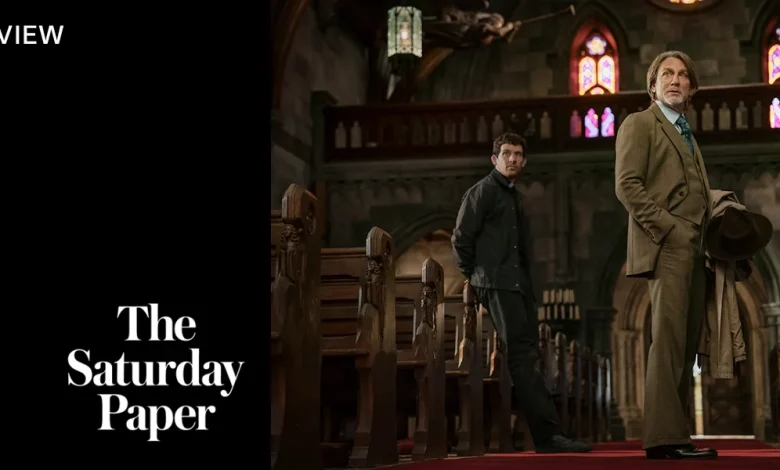
Looking as if he stepped out from one of those hunky priest calendars they sell outside the Vatican, O’Connor plays Reverend Jud Duplenticy, a former pugilist – he once killed a man in the boxing ring – whose temper has yet to be fully quelled by the life ascetic. After a scuffle with a fellow man of the cloth, Duplenticy is dispatched to a tiny upstate New York parish under the iron rule of Monsignor Wicks (Josh Brolin), a middle-aged priest whose unhinged homilies against the modern world seem determined to alienate his already diminished flock. With the church buried in secrets thicker than the fog in the surrounding woodlands – including a family scandal and a missing fortune – it’s to no one’s surprise when Wicks drops dead with a devil-headed spike buried in his back – and on Good Friday, no less. Notch one up for the dark lord.
With his windswept hair, three-piece flared suit and vintage Mercedes coupé, Craig has never looked more stylish on screen, nor more at ease in a role he truly seems to savour.
Among the usual Cluedo-board suspects: Wicks’s pinched, long-suffering assistant (a deliciously dry Glenn Close), who has a habit of popping up mid-conversation like a jumpscare; a boozy town doctor (Jeremy Renner) smarting over his recent divorce; a violin virtuoso (Cailee Spaeny) in search of a miracle for her chronic pain; and a fading pulp sci-fi writer – played by this millennium’s original hot priest, Andrew Scott – who’s moved to town to unplug his brain from what he calls the “liberal hive mind”. And then there’s Cy Draven (Daryl McCormack), a young, failed right-wing politician turned grifter influencer, whose quarter-zip-over-shirt-and-tie combination at the very least makes him guilty of the crime of being terminally online.
All eyes are on the progressive Duplenticy, whose clashes with Wicks over the best way to deliver God’s word – at one point he’s caught on video threatening to cut the older man “out like a cancer” – have condemned him in the court of public opinion. His one chance of clearing his name is superstar sleuth Benoit Blanc (Craig) – in town at the behest of puzzled local law enforcement – but even Blanc seems stumped by the crime. Just how did the murder weapon find its way into a church antechamber with no plausible access points? Why does Close’s character insist the priest will “rise again” on Easter Sunday? Might something supernatural be afoot?
“This is some Scooby-Doo shit going on here,” offers the exasperated local sheriff (Mila Kunis), as much a throwaway gag as an acknowledgement that these movies, with their dastardly plans and moustache-twirling final bosses, are about as clever as the average kids’ cartoon. Johnson’s penchant for smartypants conceits – an element of his filmmaking ever since his 2005 high-school noir, Brick – has served him well as an architect of plot, but the winking can only go so far.
This time, he gets the balance just right. The film feels less indebted to meta-narrative acrobatics than its predecessors, leaning instead on the classic locked-room mystery lineage of Agatha Christie, Edgar Allan Poe and especially John Dickson Carr’s The Hollow Man – all dutifully name-checked – while dialling down its writer-director’s more on-the-nose attempts at cultural and political satire. Not that Johnson isn’t immune to the odd clanger: “Before you know it, the idiot versions of us will end up on Netflix,” says one suspect, the filmmaker not so much biting the hand that feeds him as sticking it down our throats.
Still, they’re minor quibbles in a movie whose rewards are abundant. With his windswept hair, three-piece flared suit and vintage Mercedes coupé, Craig has never looked more stylish on screen, nor more at ease in a role he truly seems to savour. For once, he’s more than just the movie’s ace in the plot hole. Blanc, an avowed heretic, and Duplenticy, a man of sincere faith, make for a lovely double act, the two actors complementing and playing off each other in ways that elevate the more routine, caricature humour that surrounds them. Together they spar with an ease that’s charming, funny and gently philosophical, suggesting both a battle for the soul and the season’s menswear crown.
With its golden hues and misty surrounds, its gothic production design of carved eagles and spectral icons and skeletons in vats of green goo, the film generates its own kind of spooky magic, if not religious epiphany – whether intentional or otherwise. When, for example, an other-worldly beam of sunlight illuminates Blanc as he delivers his climactic exposition, the effect seems intended as comic, yet there’s something eerie, even graceful to the moment – as if this devout nonbeliever has been touched by the heavens themselves.
If Johnson, like Blanc, ultimately remains agnostic, it’s not for want of what feels like some sincere soul-searching. Wake Up Dead Man leaves the crypt door ajar for something these films would previously have shunned: a sense of grace and a willingness to accept the stories we tell, no matter the perspective. Whatever gets us closer to our faith, our truth, our own little bubble of belief.
For once, Johnson hasn’t let the facts get in the way of a good story. Perhaps it’s a fitting commentary on our time after all.
Wake Up Dead Man: A Knives Out Mystery is streaming on Netflix.
This article was first published in the print edition of The Saturday Paper on
December 10, 2025 as “Sharpest knife in the drawer”.
For almost a decade, The Saturday Paper has published Australia’s leading writers and thinkers.
We have pursued stories that are ignored elsewhere, covering them with sensitivity and depth.
We have done this on refugee policy, on government integrity, on robo-debt, on aged care,
on climate change, on the pandemic.
All our journalism is fiercely independent. It relies on the support of readers.
By subscribing to The Saturday Paper, you are ensuring that we can continue to produce essential,
issue-defining coverage, to dig out stories that take time, to doggedly hold to account
politicians and the political class.
There are very few titles that have the freedom and the space to produce journalism like this.
In a country with a concentration of media ownership unlike anything else in the world,
it is vitally important. Your subscription helps make it possible.
Send this article to a friend for free.
Share this subscriber exclusive article with a friend or family member using share credits.
Used 1 of … credits
use share credits to share this article with friend or family.
You’ve shared all of your credits for this month. They will refresh on January 1. If you would like to share more, you can buy a gift subscription for a friend.
SHARE WITH A FRIEND
? CREDITS REMAIN
SHARE WITH A SUBSCRIBER
UNLIMITED
Loading…