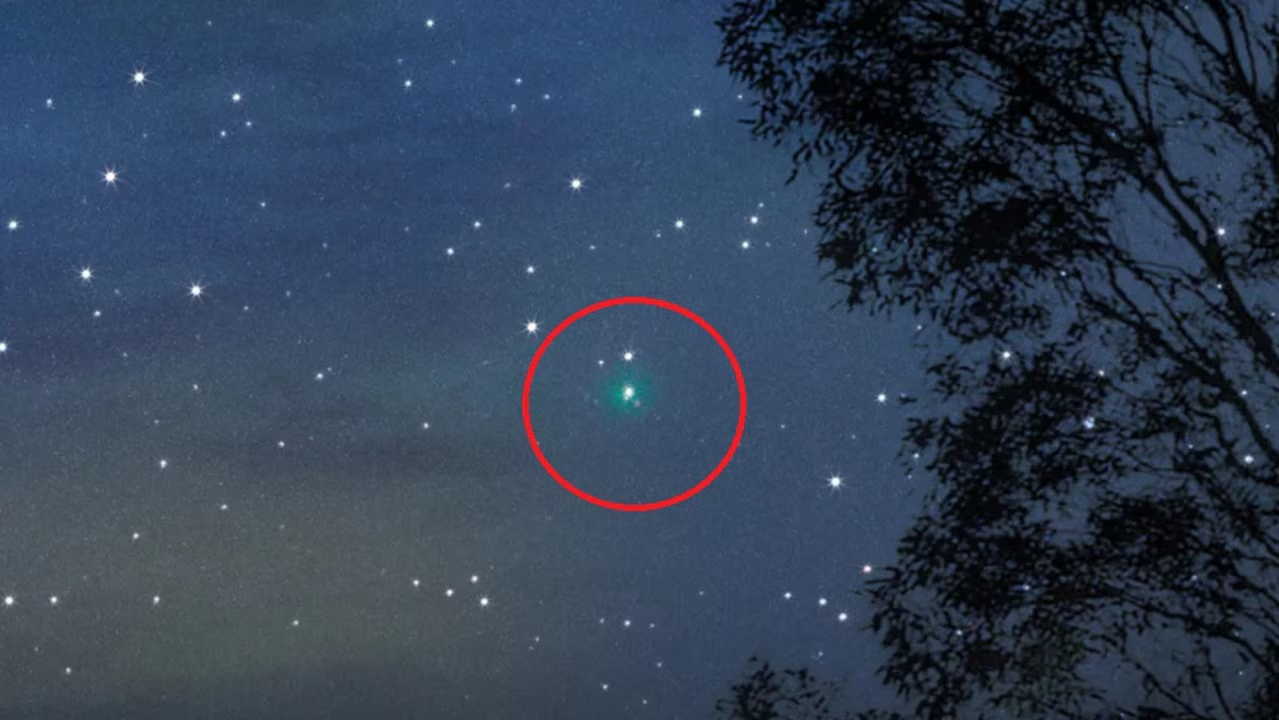
It was the Emerald of the Nile.
With 3I/ATLAS slated to fly by Earth in little over a week, hi-tech space telescopes and astronomers alike are scrambling to catch our interstellar visitor on camera.
Fortunately, an amateur photographer has managed to snap a close-up — a gorgeous pic of the interstellar anomaly glowing green over the Egyptian desert.
“From the heart of Egypt’s Black Desert, where volcanic hills rise like silent sentinels and acacia trees stand alone against the night, an object from another star system drifts through our sky: interstellar comet 3I/ATLAS,” photographer Osama Fathi told the BBC.
The photo, which was snapped on the night of November 29, shows the comet can be seen streaking across the desert sky with trees in the foreground.
It boasts a brilliant cyan hue, which Fathi attributed to “faint cyanide radical gas emission in its coma” — the halo of gas and dust that forms around the solid nucleus when the comet approaches the Sun.
The reason for the resplendent entity’s emerald tinge is yet unclear. Experts previously attributed the peculiar pigment to molecules of diatomic carbon (C2) absorbing ultraviolet sunlight, although researchers have noted that the object was nearly completely devoid of said gas, indicating that said reaction could be the result of another chemical process.
Fathi said he was able to capture the stunning spectacle using an “astro-modified Nikon Z6 camera paired with a RedCat telescope lens.”
He reportedly zoomed in at just the right angle to isolate the interplanetary pilgrim against the desertscape.
“To reveal the comet’s structure and faint gas halo, the scene was stacked from 60 exposures of 60 seconds at ISO 1500, then 60 exposures of 30 seconds,” he explained. “These long integrations allowed the comet’s delicate coma and motion against the background stars to emerge clearly, even under the extremely dark Saharan skies.”
The remote locale and absence of urban light pollution reportedly helped enhance the photo’s clarity. “In that still, beautiful scene, 3I/ATLAS appeared in the field of view: a faint visitor from another star system, crossing our sky once in a lifetime while the desert slept,” Fathi exclaimed.
The cometary cameraman was not the only one to snap the celestial snowball of late. On November 30, NASA’s Hubble Space Telescope captured a deeper look at interstellar comet 3I/ATLAS, with its Wide Field Camera 3 instrument as it rocketed through the solar system.
The cosmic photo-op showed ATLAS glowing blue while passing within 178 million miles of the planet.
Astronomers hope to get more (relative) close-ups of the object when it makes its closest approach to our planet on December 19, during which it will pass within 170 million miles of Earth, before continuing on into the cosmos.