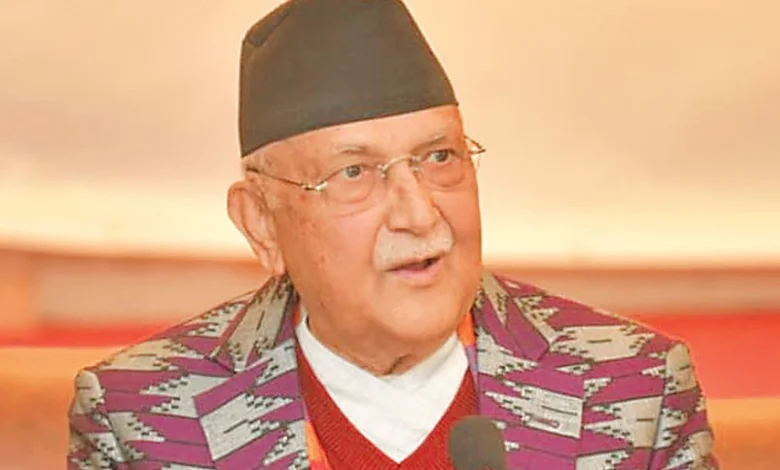
Two days ahead of the party’s high-stakes general convention, CPN-UML Chairman KP Sharma Oli spoke with the media on Thursday about party leadership and internal dynamics, but deliberately avoided questions on the March elections and the Gen Z movement that ousted him from premiership in September.
Oli elaborated on the differences between state and deep state but refrained from commenting on alleged foreign backing of the Gen Z movement, as claimed by some political circles.
Oli, who seeks a third constitutive term as party chairman at the 11th general convention that starts on Saturday in Bhaktapur, expressed confidence that he could be elected unopposed.
“Regarding whether I will stand [for election], I don’t see the situation heading in that direction right now,” Oli said. “I have some hope that no one will stand against me.”
Oli’s main challenger is Senior vice-chairman Ishwar Pokhrel, who is backed by former President Bidya Devi Bhandari. Both Oli and Pokhrel camps plan to field their respective panels for various party posts.
Oli stressed that leadership selection would be based on consensus wherever possible. Yet he clarified that if agreement cannot be reached, the leadership will be chosen through “clean competition without any coercion.”
“I don’t fall into the category of those [whose terms are] ‘extended’. My role can only be a continuation. If the representatives don’t trust me, I may have to step down. In a democratic party, insistence, stubbornness, and obstinacy don’t work. Even if an agreement is reached that I should step aside while pursuing consensus, a situation could arise where I must withdraw. Similarly if the representatives don’t support me, or don’t vote for me, there is a possibility of stepping down.”
On the possibility of reaching an agreement with Pokhrel, Oli said he would not negotiate under preconditions.
“I am not a person who works under pressure. He [Pokhrel] has been announcing his candidacy publicly, but he hasn’t spoken to me directly,” Oli said.
Oli also dismissed Wednesday’s agreement between the government and Gen Z, and called it a “drama” by an “unconstitutional” government.
“Their activities are completely unauthorised, inappropriate, unconstitutional, illegal, prejudiced, and motivated by revenge. The attitude of the government should not be like this,” he said.
He said the President had only mandated the government to conduct elections, and that after March 5, March 6 would inevitably follow, saying “it is just a matter of time”.
The agreement signed between the government and the Gen Z includes a provision to nationalise foundations, trusts, and centres operating in the names of political leaders if they are found to hold illegally acquired assets.
“Where did the government get the mandate? Is this a government elected by the people? There is no question of recognising such pointless papers. This is an inartistic, crude drama,” he fumed.
Oli also recounted the events of September 9, when he was forced to flee the prime minister’s office by an army chopper, which took him to an army barracks in Hetauda.
“I resigned, but I was still the caretaker prime minister. I was indeed the prime minister. The President was saying that the prime minister [Oli] formally recommended him to take action. If I was making a recommendation to the President in my capacity as the prime minister, how could I have run away? There was a conversation between the President, the prime minister [Oli], and the chief of army staff at the place where I was staying. Does that count as running away?”
He claimed that he left Baluwatar, the residence of the prime minister, to prevent casualties. “Isn’t it better to move from one house to another than to risk lives? Sometimes, when children chase you, you have to run. I was running the government; how did I run away? I simply changed location to save lives,” he added.
“When people ask why I didn’t return or live elsewhere, I explain that my house was burnt down. I couldn’t come out until I had found a place to stay.”
Oli currently lives in Gundu, Bhaktapur. His private residence in nearby Balkot was also burnt down by an angry mob on September 9, the day after dozens of unarmed youths were killed by police as they attempted to storm federal parliament.
In one context, Oli stated that it was a mistake to rely entirely on the state mechanism. “We relied completely on state protection. That was a mistake.”
“It seems the people have to protect themselves as well. We did not know where the state was when our house was being burnt. In this changed situation, if anyone tries to burn your house again, let us know immediately, and we will provide security. The UML will provide security. Just make a phone call,” he even told the reporters.