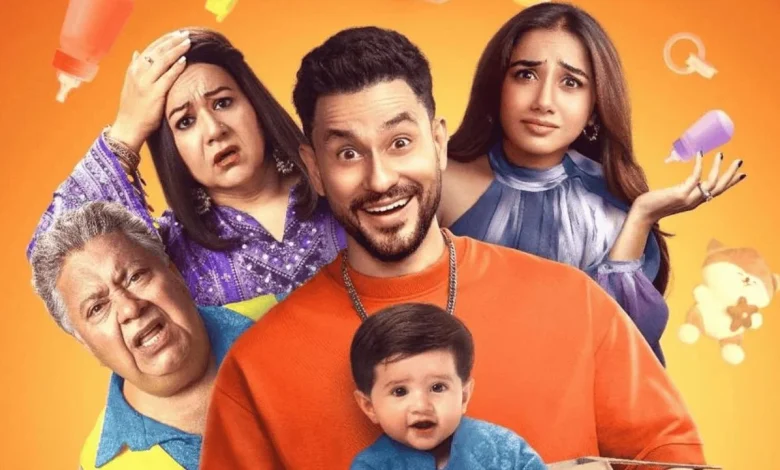
Given Hindi cinema’s long-standing relationship with hypermasculinity, it’s almost refreshing to come across a life comedy named Single Papa. Even the premise is a neat change — a single-parenthood story revolving around the kind of North Indian man-child character who would usually be the tortured hero of a romantic Bollywood film. The icing on this gluten-free cake is that Kunal Kemmu plays this man. For anyone who has followed Hindi film in the last few decades, it’s hard not to have a soft spot for former child star Kemmu — an underutilised, immensely likable and flexible performer who’s made a career out of not fitting into the conventional-star mold. I, for one, am always happy to see him on (or off) the screen. The vibes are just right, and there’s an authenticity about him that’s easy to enjoy.
Single Papa needs him more than he needs the show because of how rehashed and designed it feels. The 6-episode series opens with Kemmu as Gaurav “GG” Gehlot, a spoilt but good-natured Haryanvi brat who reaches the Delhi family court for his divorce. The narrative begins where so many love stories end: an independent and career-minded woman (Isha Talwar) is leaving her husband Gaurav because he wants a baby and she does not. Her feelings are no longer strong enough for her to compromise — whether it’s his molly-coddling parents, his lack of direction, or his ability to hide all his flaws beneath a cute personality. Yet she’s not the protagonist, he is. So the camera follows Gaurav on a familiar coming-of-age trajectory: his burning desire to be a father will make him a better and more responsible person. He goes from man-child to man of child, basically.
The problem with Single Papa, like many of its ilk, is that its one-liner chooses to be padded up with a television-plus template. The beats are very modern-streaming-era-coded; the feel-goodness is clinical, the humour is #quirky, the situations are glossy, the conflicts and resolutions have a conveyer-belt energy about them, and the commentary is stranded between levity and gravity. It’s ambient viewing at best, where a viewer can glance at the screen every few minutes while living. The writing tries too hard to make the theme palatable. Everything has a ‘catchy’ hook of sorts. For instance, a newly single Gaurav finds a baby abandoned in his car while hooking up with a woman. Since the infant is found in an Amul box, Gaurav names him Amul. The gags are predictable. When asked about the baby’s “sex” in the hospital, his prompt response is “it’s been a year or so”. When he sets out to adopt Amul, his nemesis becomes a social worker (Neha Dhupia), whose pronoun-spouting son is named Shlok so that Gaurav can call him “Woke Shlok”.
And is a show really a show anymore if there are no Bollywood and pop-cultural references? It doesn’t take long for his drunken dad (Manoj Pahwa) to be called “Haryanvi Devdas,” just as it doesn’t take long for the nosy parents to fret if Gaurav has a Shubh Mangal Saavdhan (erectile dysfunction) or a Shubh Mangal Zyada Saavdhan (queer love) issue. When Gaurav is surprised by how happy the orphanage looks — as opposed to cinema’s gloomy depictions of such places — he cites a Taare Zameen Par mood. The Gehlots do look like the kind of family who derive much of their truths from movie-watching, so the puns aren’t as jarring. But some of the humour is stretched, like when Gaurav’s Jatt and liquor-shop-owning father means to ask him if he’s “impotent” and Gaurav hears it as “important”. Most of these moments would land in isolation, but you can tell that the series is searching for colour to cushion a woke male-centric plot. The concept is fine, but it keeps falling into pockets of its own genre gymnastics.
It’s clear early on that all the entertainment will stem from the formalities of the adoption process. Gaurav has to prove he’s worthy, which involves a lot of white lies and jumping through legal hoops and over-the-top trickery. His decision affects each of the family members. There’s a been-there-done-that hangover about the predicaments: a father who threatens to disown him, a mother (Ayesha Raza Mishra) who turns to a godman prompting her husband to think she’s having an affair, a sister (Prajakta Koli) whose upcoming wedding is put on hold because the baby requires another single relative, an ex-wife who helps him get a job and maturity, and a society who sees Gaurav as a defective citizen for wanting a child without a partner. There’s a monologue for every thread that gets resolved; they are all wrapped up together in a perfect pink bow in the last episode. Even the fact that the sister’s fiance (Ankur Rathee) is not brave enough to tell his parents the truth about Gaurav is turned into a big relationship hump. It’s hard to feel the stakes when you know everything is going to work out. Particularly when the aesthetic goes all wedding-attire-core in the finale to complete the OTT package. It’s like that greedy traveler who wants to hit every single tourist spot in a single day (“paisa vasool”) instead of properly savouring a few for a week.
Single Papa does have a few good touches. Like Gaurav not really needing a love story or a marriage-is-the-solution arc; he is so besotted by Amul that he is determined to show that fatherhood is enough if done well. I’m not sure the message is entirely productive, but at least the show trusts in it in a cultural landscape where every second film weaponises an Indian mother’s influence. Gaurav has a fledgling romantic track with a doctor (Aisha Ahmed), but again it’s more colour than any real motive. The cast is watchable even in the flimsier portions. There’s also a sweet track of a bulky Bihari macho-man who is hired as a surprisingly sensitive nanny. Once the visual gimmick wears off, there’s still enough in the uncanny bond between Gaurav and his employee to sell their uphill task. But the fancy boxing of it all prevents the show from entering complex and human territory; I suppose that’s the content algorithm kicking in.
The irony, of course, is that the show gets so sidetracked by all the adult conflicts that the baby (I can’t keep typing ‘Amul’ without sounding like a product-placement bot) is almost incidental to the story. The implication is that Gaurav’s love is so strong that he makes the whole thing about himself. That’s pretty much a reflection of Indian society. Maybe the family will tell the boy during a bitter argument in the future that he’s not only adopted but also the reason everyone’s lives almost imploded years ago. I can imagine a “you have no idea what we did to secure you” or “you’re lucky you’re not in a garbage dump somewhere” thrown at his face if he dares to be ungrateful or oblivious to his privilege. I can also imagine Amul turning to his favourite milk drink when he’s sad, because alcohol consumption is injurious to health. If I wrote half a sequel here, it’s because Single Papa is the backstory of a troubled kid with an unhealthy dairy addiction. Perhaps it was about the baby all along.