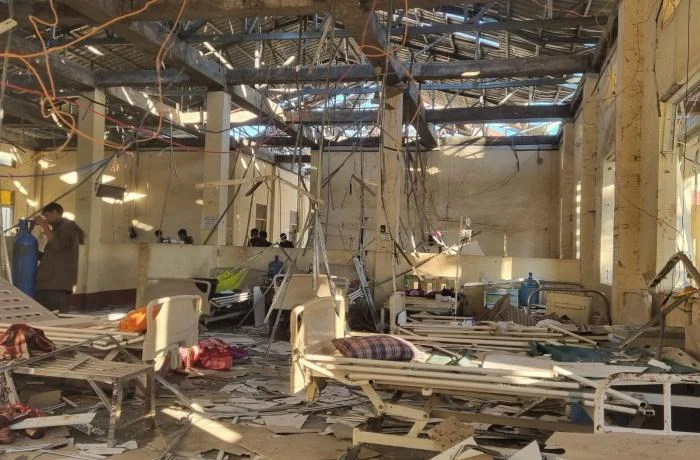
At least 33 people died and more than 80 were injured in the raid on December 10. Among the victims were patients, doctors, and even newborn babies. The United Nations and international groups believe it is impossible to hold elections amid growing tensions and hostilities. Meanwhile, the humanitarian crisis is also taking on ever greater proportions.
Bangkok (AsiaNews) – Myanmar is experiencing one of its most turbulent and complicated phases since the February 2021 coup that brought the junta back to power, with the military intensifying attacks on civilians while continuing with the electoral process with the vote at the end of December.
International governments, UN officials, observers, and human rights activist groups strongly reject the holding of elections that have long been branded as illegitimate, especially at a time of escalating conflict, systematic repression, and worsening humanitarian crisis.
This is a picture of increasing violence, as evidenced by the air raids carried out by army fighter jets on the night of December 10, which struck the Mrauk-U General Hospital in the western state of Rakhine. At around 9:13 p.m. local time, a military aircraft dropped at least two bombs on the 300-bed facility, killing at least 33 civilians and injuring 80 others.
Among the victims were patients, doctors, and even newborn babies, who died in one of the last functioning health facilities in an area where the health system is collapsing.
Analysts and observers consider the attack on the Mrauk-U hospital a symbol of the escalating humanitarian crisis, with the vote likely to fuel tension rather than open new avenues for justice, peace, or a return to democracy.
UN High Commissioner for Human Rights Volker Türk condemned the attack, stressing that the deliberate or indiscriminate bombing of medical facilities “may constitute a war crime.” The diplomat called for independent investigations, accountability, and an immediate cessation of hostilities.
World Health Organization (WHO) Director-General Tedros Adhanom Ghebreyesus called the air raid “horrific,” noting that it was the 67th confirmed attack on health infrastructure in Myanmar in 2025. “Every attack on health is an attack on humanity,” he warned.
In a statement published today by the state-run newspaper Global New Light of Myanmar, the military’s information office—effectively taking responsibility for the attack—responded by claiming that armed groups, including the Arakan Army and the People’s Defense Forces, were using the hospital as their base.
Data from the Armed Conflict Location & Event Data Project (ACLED) recorded 2,165 air strikes from January to the end of November 2025, up from 1,716 in all of 2024. The army has intensified operations in several regions, including Kachin, Shan, Sagaing, Chin, Karenni, and Rakhine.
According to UN reports, air strikes are responsible for nearly half of all civilian casualties since the coup, with women and children disproportionately affected. As of August 2025, UN observers estimated that approximately 7,100 people had been killed in army-related violence, a third of whom were women and children.
The junta plans to begin a gradual electoral process on December 28, which will continue until next January. However, UN Secretary-General António Guterres and High Commissioner Türk have both stated that a vote held in a context marked by “threats and violence” cannot be considered free, fair, or credible.
Human rights organizations report that in August there were over 22,000 political prisoners, including former State Counselor Aung San Suu Kyi and detained members of the dissolved National League for Democracy (NLD). At least 40 parties have been banned or dissolved in the aftermath of the military coup.
The United States, the European Union, the United Kingdom, Japan, Australia, and others have reiterated that they will not recognize the elections without an international guarantee force and assurances of a fair vote and broad participation.
International monitoring bodies have also stated that meaningful democratic processes require conditions that are currently completely absent in Myanmar.
At this stage, the humanitarian crisis is taking on ever greater proportions. UN projections estimate that 15.2 million people, almost a third of the population, will face acute food insecurity in 2025, compared to 13.3 million in 2024.
Economic collapse, displacement, and movement restrictions have left millions of people in need of assistance. More than 3.5 million people are internally displaced, many of whom are sheltering in informal camps or forested areas with limited access to clean water, food, medical care, and education.
Humanitarian agencies report severe access challenges caused by military restrictions, insecurity, and ongoing fighting. However, according to independent researchers, the junta controls only about 21% of the territory, while resistance forces control 42%, with the rest contested.