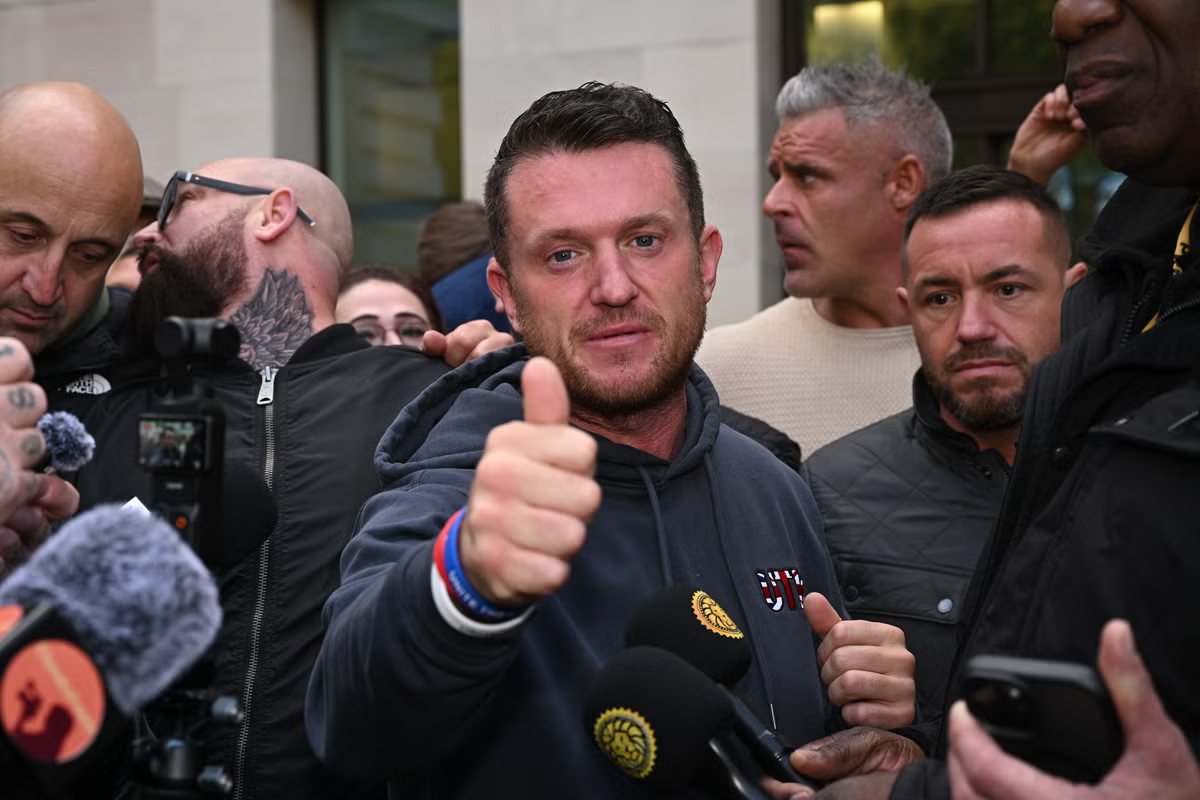
In early 2025, the far-right activist Stephen Yaxley-Lennon (known by his public persona Tommy Robinson), serving yet another short prison sentence – this time for making false claims about a young Syrian refugee – apparently found Jesus. And this weekend, he plans to return the favour by bringing Jesus to central London. He will be hosting a carol and speech “service” which, he says, will “mark the beginning of a new Christian revival in the UK – a moment to reclaim and celebrate our heritage, culture, and Christian identity”.
If you’re wondering about the parallels suggested here and when the “old” Christian revival happened (was it Methodism in the late 18th century? The Oxford Movement in the 19th?), you’re probably wasting your time. The point is to sound like something big is going on.
There has been a lot of excited media chatter in the last couple of years about a big religious reawakening among the young in Britain and America. Young men in particular are said to be pitching up in great numbers to services, particularly at churches where the performance element – incense, services in Latin, a bit of hellfire – is present. When examined carefully, the evidence for this great return to organised faith turns out to be weak, but it’s a fun meme for journalists.
At the beginning of Robinson’s platform rally, which was the culmination of his huge “Unite the Kingdom” demo in September, prayers were led by a cleric called Ceirion Dewar, subsequently described by the BBC’s religious affairs correspondent as a bishop in the “small, more conservative, traditionalist Confessing Anglican Church”.
It seems that almost no one in Britain is part of this Florida-based church: as witnessed by a Sky News journalist, Dewar recently presided over a “mass baptism” on the Welsh coast which attracted all of 20 people. Dewar’s own USP appears to be his association with Robinson, at whose previous rallies Dewar has thundered against “woke ideology” and talked of the nation being” under attack” by Muslims.
The use of religion in service of British nationalist politics is not an innovation. In the 1930s, Britain’s most successful far-right politician, Oswald Mosley, invoked martial heroes from the past, not religious ones. But today, when immigration is the great bogey and Muslims are depicted as the most dangerous migrant minority in the country, it becomes relevant to use the religious language of the crusades in support of British nationalism.
The jailhouse conversion of Robinson was witnessed by another man of God, pastor Rikki Doolan. This is a good place to remind ourselves that anyone can call themselves a ‘pastor’, just as anyone these days can describe themselves as a ‘journalist’ or ‘therapist’ (Getty)
Robinson’s argument seems to be that Muslims are plotting to impose a reverse colonialism and convert the Christians of Europe to Islam. So he must defend Christianity and, in order to lead that defence – like the Cid before the walls of Valencia – he must be a Christian knight.
Or is that just part of the story? The jailhouse conversion of Robinson was witnessed by another man of God, pastor Rikki Doolan. This is a good place to remind ourselves that anyone can call themselves a “pastor” just as anyone these days can describe themselves as a “journalist” or “therapist”.
Doolan recounted to Premier Christian Radio how he had visited Robinson three weeks before his release. “I had a two-hour visit,” recalled Doolan, “we spoke about the gospel, and he received Jesus Christ as his personal Lord and Saviour, right there in the prison.”
Doolan dresses like a modern male celebrity. He dyes his hair blond, wears it slicked back with the right length of beard, and dresses in leathers, quite often emblazoned with the union flag. He has his own YouTube channel – slogan: Gospel, Patriot, Politics – and apparently until last May was Ukip’s spokesman on culture and the arts. His purchase on faith and tradition can perhaps be gauged by his invitation for the faithful to join him and “patriot pastors” on 13 December in singing such favourite carols as “Come ye merry gentlemen” – a suggestive lashing together of two entirely different carols.
But what is Doolan a pastor of? Who ordained him? In 2012, according to Doolan, he was practically down and out in his native Middlesbrough, suffering from addiction and being a mediocre musician in nightclubs. Then the Lord found him, in the shape of the “Spirit Embassy”, an outfit later rebranded as GoodNews Church. It was this “church” which declared him to be a pastor.
Spirit Embassy was the creation of a British-Zimbabwean entrepreneur originally named Uebert Mudzanire, but who decided that “Angel” was a better surname for someone starting up their own Christian denomination. So Uebert Angel, founder of “Club Millionaire” and “The Millionaire Academy” and author of Provoking the Angels of Money, became a leading figure in what is known as “prosperity theology” – the American-born teaching that wealth is the path to godliness and a sign of divine favour. Doolan apparently split with Angel a year ago, after over a decade of cooperation.
Prosperity theology turns Christian teaching on its head. But it has proved hugely successful in making its proponents wealthy. You give money to the church and God will give money to you. You can give it by donation, by subscribing to YouTube and online sites, by buying godly merch or blessed health supplements. And if you can tap into the American market, it really doesn’t take much for you to become seriously comfortable.
I have no idea if Robinson has signed up to “prosperity theology”. However, there is not much evidence of Christian charity in Robinson’s past or present. In Robinson’s world, the meek and the peacemakers seem to be despised.
So you don’t have to be a prophet to predict that it won’t be Christianity that is being revived by Robinson’s activities. I think it is much more likely to be somebody’s bank account.