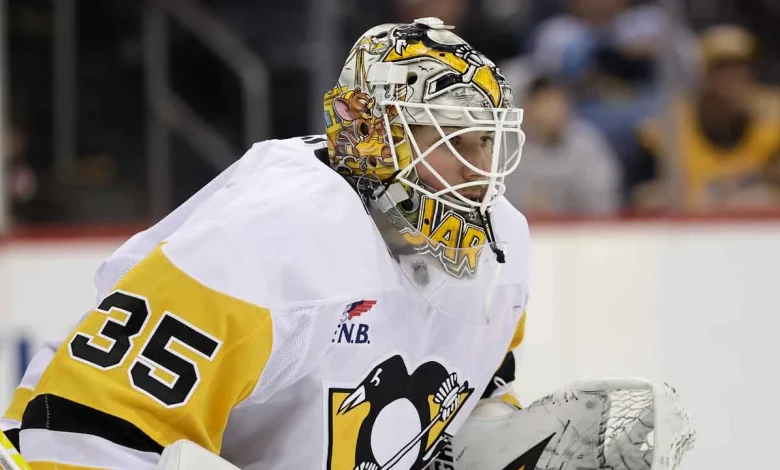
“I just felt it was time for something different. It’s not so much a comment on Stuart Skinner, it’s just really maybe time for something different here.” – Oilers GM Stan Bowman
After back-to-back trips to the Stanley Cup Final, but too much inconsistency and a lack of belief in the crease, the Edmonton Oilers finally ended their long search for another option in net. But while many may have been expecting the team to find a tandem partner for Stuart Skinner — an upgrade over Calvin Pickard — what instead transpired was a trade for his replacement.
In fact, it took two trades to make all the pieces fit.
Starting with the main trade, Edmonton sent Skinner to Pittsburgh along with depth defenceman Brett Kulak and a second-round draft pick in 2029, in return for Tristan Jarry and Samuel Poulin, an AHLer who was a first-round pick six years ago. It’s a money in, money out deal. The Oilers then also sent a 2027 third-round pick to Nashville for 25-year-old Spencer Stastney, a third pair defenceman who will be Kulak’s replacement.
There is no mistaking what this trade is about: Skinner had been the second-best goalie in two Cup Finals in a row, hadn’t been able to lift an Oilers team when it was struggling, and was not a netminder who would steal many games. Confidence had been lost. Even though Jarry has far less playoff experience, the Oilers see a longer and more successful regular season track record to give them the belief that Jarry will be able to put them over the top.
“I think that sometimes your playoff success or your record is in line with where your team is and their trajectory,” Bowman said. “Certainly, the Oilers have been in a good trajectory the past few seasons, probably a little different than where Pittsburgh has been.”
If Jarry is the goalie who backstops Edmonton to a Stanley Cup win, this trade will be looked back on as the key turning point, and the context of when and how it was made will fade away into irrelevance.
But in analyzing this trade today, that context does matter. Was this the best move the Oilers could have made to address their goaltending?
You may consider that Jarry could have been had for free, by anybody, when he was placed on waivers last season. But he was in the midst of the biggest struggle of his career, inspired confidence in no one, and was passed through to the AHL. There’s also the matter of his $5.375 million AAV — a capped-out team like the Oilers would have had to make quite a few other changes to simply absorb that for “free.”
If you want a better touchpoint, the Oilers perhaps missed out on it’s when another contender, the Colorado Avalanche, completely rebuilt their goaltending duo in a matter of nine days right around this same time last season. One year ago, on Dec. 1, they acquired Scott Wedgewood for Justus Annunen and a sixth-round pick, and on Dec. 12 they picked up Mackenzie Blackwood for Alexandar Georgiev, Nikolai Kovalenko, plus picks in the fifth and second rounds. Annunen is the only one of those players still in North America this season, while both Avalanche goalies are thriving.
Were the Oilers looking very hard for a goaltending upgrade at that stage after their first Stanley Cup Final loss? Perhaps not. But, perhaps, they should have been when you consider that Skinner already had two statistically subpar post-seasons.
So, until the Oilers win a Stanley Cup that will make this trade all worth it, the aspect of asset management has to be considered. Why was this trade made now, in the middle of a mini hot spell for Skinner, and days before the two teams play against each other next week? As we can see, the Oilers had a chance to find a better deal for a netminder before this and, perhaps, may have even been able to keep Skinner too.
But that window had passed and, the fact of the matter is, getting a bargain on a more reliable goaltender later this season was far from a certainty.
So maybe it was just time for something different, as Bowman described. But was it the best timing for this trade?
For more on the pieces moved on Friday, and Edmonton’s overall outlook, we turn to our scout Jason Bukala.
The Oilers have lost back-to-back Stanley Cup Finals to the Florida Panthers and clearly identified the need to upgrade their goaltending. Stuart Skinner and Calvin Pickard had provided the Oilers all they could, but it wasn’t good enough in the eyes of Oilers management.
But is the addition of Tristan Jarry an actual upgrade?
Only time will tell, so I’m taking a different approach with my analysis of the Oilers after the transactions they made Friday with Pittsburgh and Nashville.
And I have to admit I’m fairly underwhelmed overall.
Please bear with me as I explain.
Before the Oilers lost defenceman Troy Stecher to the Toronto Maple Leafs via waivers on Nov. 15, their choices on defence were as follows:
Mattias Ekholm – Evan Bouchard
Darnell Nurse – Jake Walman
Brett Kulak – Ty Emberson
Troy Stecher – Alec Regula
After today’s transactions, the Oilers pairings look like this:
Ekholm – Bouchard
Nurse – Regula
Stastney – Emberson
Note: Walman is currently out with injury. When he returns, I’m assuming he slides back into the second pairing alongside Nurse.
• Since being claimed on waivers, Stecher has averaged over 20 minutes per game of ice time in his first 11 games with the Maple Leafs. His primary minutes come at even strength and on the penalty kill. He’s being deployed on the middle-pairing alongside Jake McCabe and has contributed one goal and three assists and is a plus-8.
• Kulak was skating on the Oilers’ bottom pair and averaged nearly 18 minutes per game. He also was being deployed at even strength and on the penalty-kill in Edmonton. Kulak has only contributed two assists on the season and he exits Edmonton with a minus-7 rating.
• Spencer Stastney is a solid depth defenceman, but he’s never played a full season in the NHL. He has bounced back and forth from the Predators’ AHL affiliate in Milwaukee since turning pro in 2021. He’s played 30 NHL games this season, which already has surpassed a career high of 26 he played in last season.
• Stastney averaged just shy of 15 minutes of ice time in Nashville. His primary ice time also comes at even strength and the penalty kill, and he has contributed 1G-8A this season.
After today’s transactions, I’m asking myself the following:
Are the Oilers better equipped on defence without Stecher and Kulak? Does a bottom-pairing of Stastney and Regula have a chance to be more reliable than Stecher and Kulak?
Let’s pause for a second before coming to a conclusion and consider the pieces included in today’s transactions:
• The Oilers were searching for a more reliable, trustworthy, consistent goaltender to take over the number one role.
• Jarry arrives in Edmonton sporting a 2.66 goals-against average and a .909 save percentage. His season, on balance, has been more productive than Stuart Skinner’s. Skinner exits Edmonton with a 2.83 GAA and .891 SV%.
• Jarry’s save percentage in his last five starts is .903 and his goals-against average 2.60. Skinner’s last five starts resulted in a .937 save percentage and a goals-against average of 1.60.
• Skinner is on an expiring contract that counts $2.6 million against the salary cap. Jarry is signed for two more years after this season and counts $5.375 million.
• We should also note that Jarry could have been claimed by any NHL club last season when the Penguins placed him on waivers. He went through a faze of having to reset his career after a 12-game stint in the AHL and ended last year with a 3.12 GAA and .892 SV%.
• The addition of Samuel Poulin to the Oilers organization doesn’t move the needle for me. A first-round pick in 2019 (21st overall), he has spent the majority of his career in the minors and I don’t see him fitting into the Oilers forward group at the NHL level.
• For some reason, the Oilers had to include a second-round pick (2029) in the deal with Pittsburgh. It may seem like a technicality at this point, but second-round picks are highly valuable assets that historically have a decent chance at becoming NHL players in time.
So, what do we make of all of this?
The Oilers waived one defenceman who has so far played a significant role in Toronto. They also moved out Kulak and replaced him with Stastney, who played fewer minutes in the same role as Kulak with a struggling Predators team. They also (gulp) had to move out a future second-round pick.
All of this was done to finally address their goaltending, which ends up being Jarry, who costs twice as much as Skinner and has two extra years on his contract.
The Oilers might be marginally better in goal with the acquisition of Jarry. Who knows, the change of scenery and knowing how much the Oilers value him might motivate Jarry to become an even better version of himself. Especially with Edmonton believing they are still in their window to compete for the Stanley Cup.
But when I take a look at the entire body of work the Oilers front office has recently completed, I’d be lying if I said I wasn’t a bit perplexed. I can’t say that I trust their new bottom pairing more than the ones they iced in the last several weeks, and I’m also not yet convinced Jarry will provide the Oilers with better goaltending than Skinner.
The entirety of these transactions might work for the Oilers if Jarry does prove more stable, but I can’t say the team is any better today than it was yesterday, and they have less draft capital and cap space to work with going forward.