This article contains major character or plot details.
Rian Johnson decided to take Benoit Blanc, the Southern sleuth played by Daniel Craig, to church early in the process of brainstorming Wake Up Dead Man: A Knives Out Mystery. “Daniel and I sat down late one night over a cigar and were talking about what the third one might be,” says the Academy Award–nominated writer-director. “I thought a good way to bring it back down to Earth would be to attack something very personal. I told Daniel, ‘I want to make a movie about faith. I want to make a movie about the church.’ ”
With 2019’s Knives Out and 2022’s Glass Onion: A Knives Out Mystery, Blanc proved he could solve the most layered of cases. But for Wake Up Dead Man, Johnson penned a mystery so complicated that it gives even Blanc a run for his money. “This was the hardest script I have ever had to write,” says Johnson. “There is the intricacy of this mystery because it’s a locked-door mystery, but the bigger thing was the fact that this was so personal and meant so much to me.”
“I grew up very Christian,” Johnson explains. “I’m not anymore, but when I was a teenager into my mid-twenties, I framed the world around me through the lens of my relationship with Christ. It was a very important part of my life, so I have a lot of complicated feelings about all of it.”
The latest chapter takes place in a small parish in upstate New York, where the fiery and corrupt Monsignor Jefferson Wicks (Josh Brolin) has culled a flock of scared and angry townspeople played by Glenn Close, Jeremy Renner, Kerry Washington, Andrew Scott, Cailee Spaeny, Daryl McCormack, and Thomas Haden Church. “Wicks is at a place where he is looking for everybody’s weakest spot and exploiting it,” says Brolin, who plays the charismatic monsignor. “His philosophy is if you can get to your worst, most feral place, then you can climb toward the light from there.”
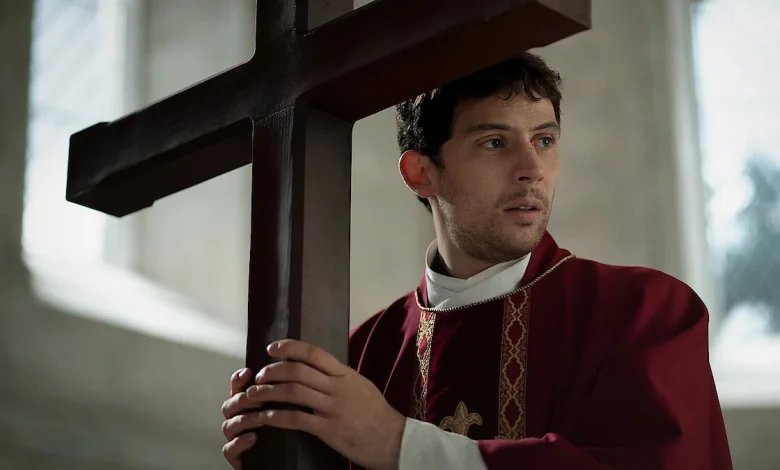
Father Jud Duplenticy (Josh O’Connor) is sent to the church as punishment for punching an asinine deacon, and soon after, he and Wicks clash over what purpose Our Lady of Perpetual Fortitude, and by extension, faith, should play in the community. “Jud’s goal is to be more Christ-like, and to serve the people who need it most. Wicks has a much more us-versus-them approach to faith, ‘Let’s fight the world and win it back for Christ’ type attitude,” Johnson describes.
When Wicks is found dead in a tiny closet in his own church over Easter Weekend, chief of police Geraldine Scott (Mila Kunis) and Blanc are called in to solve a crime that beggars belief. Wicks’s death is only the tip of the iceberg: read more about Wake Up Dead Man’s logic-defying mystery on Tudum.
“I have strong feelings about faith: both my own personal experience and how it intersects with our country’s cultural and civic life, and the ways that intersection touches all of us differently,” says Johnson. “So it felt like rich ground for a good story.” To understand Wake Up Dead Man’s many twists and turns, it’s important to familiarize yourself with the religious archetypes Johnson invokes. Keep reading to unpack this whodunnit of biblical proportions — and the director’s most personal installment yet.
What are the religious archetypes in Wake Up Dead Man?
The murder that takes place in Wake Up Dead Man: A Knives Out Mystery happens at a church over Easter Weekend, so it’s only natural that Rian Johnson’s latest Benoit Blanc mystery is steeped with references to the Bible. “I grew up very Christian, so the whole movie is rife with Biblical references because my head is full of them, even down to character names,” says Johnson. “Martha, who is Glenn Close’s character and the devoted servant of Our Lady of Perpetual Fortitude, comes from the story in Gospels. Martha is constantly serving, and is frustrated that she’s not getting recognized for it.”
The local watering hole and pizzeria is named Il Diavolo, which translates to the devil. “They started decorating the restaurant with devil stuff because of its name, and the guy who owns it, Nick (Noah Segen), is very popular in town,” says Johnson. “He doesn’t even like the devil, as he says in the movie.”
Johnson also wove parables into the narrative of Wake Up Dead Man. There is a critical set piece inspired by Lazarus’s tomb, Jud and Wicks’s stand-off is compared to David and Goliath’s, and Eve’s apple is at the film’s narrative and thematic core. “Throw a stone in this movie,” adds Johnson, “you’re going to hit a Biblical reference.” Catch up on any other Easter Eggs you may have missed on Tudum.
What are some other holy whodunnits?
With each Benoit Blanc mystery, Johnson pays tribute to and subverts the whodunnit genre. Wake Up Dead Man is steeped in a history of clerical mysteries. “Christie’s The Murder at the Vicarage is a classic, but my biggest influence for this film was G.K. Chesterton’s Father Brown mysteries. Father Brown’s a terrific detective because he’s a good priest, not because he understands God or is righteous, but because he understands how humans are corrupt and fallible, including himself. That gives him empathy and insight into crime,” says Johnson. “Themes of guilt, mystery, morality, and fallible humanity all feel right at home in a church, with a man of God at the center of the mix.”
With the genre steering Wake Up Dead Man, Johnson was able to maintain an open mind and sense of play (the two men of the cloth exchange more than one confession about excessive masturbation), exploring these heady themes without being didactic. “I wanted to get it right in terms of it feeling honest and not feeling fingerwaggy or messagey,” says Johnson. “I was doing what I have tried to do with myself, which is wrestle with these things and have the characters express these different points of view within myself. I don’t have a sense of faith as a self-serious thing, it’s a very human thing. That means there’s a lot of humor in it.”
How did they make Our Lady of Perpetual Fortitude’s ambo?
Much of the film’s action unfolds in the church, and Rick Heinrichs and the production design team built the entire interior, including its centerpiece: the ambo, which is what the Catholic church calls the pulpit. The ambo at Our Lady of Perpetual Fortitude was crafted to resemble the hull of a ship, which makes sense, as Rian Johnson and production designer Rick Heinrichs looked to Herman Melville’s Moby-Dick; or, The Whale for inspiration. Johnson drew parallels between Wicks and Melville’s Father Mapple, particularly the preacher’s sermon on Jonah and the whale. “Since it was the metaphor of control that I wanted to tap into,” says Heinrichs, “the ambo in Wake Up Dead Man is a ship’s prow in the form of a real pulpit. However, the imagery remains clear — avail yourself of faith in God and allow his sure hand to guide the ship of your life, through the darkest storm. We carved the words from the novel into its base: ‘Beat on, thou noble ship.’ ”
Heinrichs’s design plays into the theme with billowing waves and inscriptions about stormy waters etched into the podium’s base. Heinrichs also carved eagles, the United States’ national bird, across the ambo. “The book rest for the Holy Bible is supported by an eagle, a reference to St. John the Evangelist, representing the notion of flying high and spreading the Christian message to the world,” he adds.
What is the road to Damascus?
Another consistent archetype is the road to Damascus, which is used to describe the blinding revelations that both Blanc and Jud experience during the case. In the bible, the event takes place in Chapter 9 of the book of Acts (and then later in Chapters 22 and 26). “Paul [the Apostle] had originally been a persecutor of Christians. On the road to Damascus, he had a revelation and was blinded. When he accepted the Lord, scales fell from his eyes, and he could see again,” says Johnson. “So basically it’s become shorthand for having kind of a holy revelation. There’s a very pivotal moment where Jud realizes he’s been swept up in Blanc’s game of the investigation, and he has lost the plot of what he’s actually there to do as a priest. It just made sense to bring that reference in to illustrate what he’s going through.”