This year, Hanukkah will begin on Sunday evening, December 14, 2025, the 25th of Kislev, 5786, with the lighting of the first candle. The holiday will end on Monday evening, December 22, 2025, the 2nd of Tevet.
Hanukkah was instituted by the Jewish sages to commemorate the Hasmoneans’ victory in their revolt against the Greeks, the rededication and purification of the Temple from idol worship, and the miracle of the cruse of oil; according to tradition, a small amount of oil that should have lasted only one day kept the Temple menorah lit for eight days.
5 View gallery
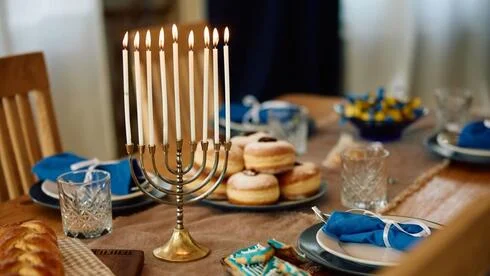
Hanukkah: candle lighting publicizes the Maccabees’ victory and the miracle of the oil
(Photo: Drazen Zigic / Shutterstock)
There are two main customs regarding the candle-lighting time:
1. At sunset (on the first night in 2025: 4:41 p.m. in Jerusalem, 4:38 p.m. in Tel Aviv)
2. At nightfall (on the first night: 5:00 p.m. in Jerusalem, 4:57 p.m. in Tel Aviv)
On Friday evening, the candles are lit before the onset of Shabbat.
On Saturday night, they are lit after the Havdalah ceremony.
Those who are unable to light the candles at the designated time may, according to Jewish law, still light with the blessings as long as people are still out in the street (“Ad she’tichleh regel min ha’Shuk”).
When lighting indoors, one may light with blessings until dawn, as long as someone in the house is awake to see the candles. Some permit reciting the blessings even if no one else is present.
1st candle: Sunday night, December 14 (25 Kislev)
2nd candle: Monday night, December 15 (26 Kislev)
3rd candle: Tuesday night, December 16 (27 Kislev)
4th candle: Wednesday night, December 17 (28 Kislev)
5th candle: Thursday night, December 18 (29 Kislev)
6th candle: Friday afternoon, December 19 (30 Kislev)
7th candle: Saturday night, December 20 (1 Tevet)
8th and final candle: Sunday night, December 21 (2 Tevet)
5 View gallery
(Photo: Tomertu / Shutterstock)
1. Baruch atah Adonai, Eloheinu Melech ha’olam, asher kid’shanu b’mitzvotav v’tzivanu l’hadlik ner (shel) Hanukkah.
2. Baruch atah Adonai, Eloheinu Melech ha’olam, she’asah nisim la’avoteinu bayamim hahem bazman hazeh.
3. Shehechiyanu (recited only on the first night)
Baruch atah Adonai, Eloheinu Melech ha’olam, shehechiyanu v’kiyemanu v’higiyanu lazman hazeh.
These lights we kindle to commemorate the miracles, wonders, salvations and battles You performed for our ancestors in those days at this time, through Your holy priests. During all eight days of Hanukkah, these lights are sacred, and we are not permitted to make ordinary use of them, but only to look at them — to offer thanks and praise to Your great name for Your miracles, Your wonders and Your salvations.
These lights we kindle for the miracles, the redemption, the mighty deeds, the salvations, the wonders, and the consolations that You performed for our ancestors in those days at this time, through Your holy priests. During all eight days of Hanukkah, these lights are sacred, and we are not permitted to make ordinary use of them, but only to look at them — to give thanks to Your name for Your miracles, Your wonders, and Your salvations.
In Mizrahi communities it is customary to read Chapter 30 of Psalms:
A psalm; a song of dedication of the House, of David. I will exalt You, O Lord, for You have raised me up, and You have not allowed my enemies to rejoice over me. O Lord, I have cried out to You, and You have healed me. O Lord, You have brought my soul from the grave; You have revived me from my descent into the Pit. Sing to the Lord, His pious ones, and give thanks to His holy name. For His wrath lasts but a moment; life results from His favor; in the evening, weeping may tarry, but in the morning there is joyful singing. And I said in my tranquility, I will never falter. O Lord, with Your will, You set up my mountain to be might, You hid Your face and I became frightened. To You, O Lord, I would call, and to the Lord I would supplicate. What gain is there in my blood, in my descent to the grave? Will dust thank You; will it recite Your truth? Hear, O Lord, and be gracious to me; O Lord, be my helper. You have turned my lament into dancing for me; You loosened my sackcloth and girded me with joy. So that my soul will sing praises to You and not be silent. O Lord, my God, I will thank You forever.
After the lighting of the Hanukkiah, the piyyut Ma’oz Tzur is sung.
Here is the first stanza:
Ma’oz Tzur Yeshu’ati, lekha na’eh leshabe’ach.
Tikon beit tefilati, v’sham toda nezabe’ach.
Le’et takhin matbe’ach mitzar hamnabe’ach.
Az egmor beshir mizmor chanukat hamizbe’ach.
O mighty stronghold of my salvation,
to praise You is a delight.
Restore my House of Prayer
and there we will bring a thanksgiving offering.
When You will have prepared the slaughter
Then I shall complete with a song of hymn
the dedication of the Altar.
On the first night only one candle is lit; each subsequent night, another candle is added until on the eighth night, eight candles are lit. Someone without enough candles fulfills the obligation even by lighting one candle.
According to Jewish law one should not benefit from the Hanukkah lights (use them as illumination), an extra candle, commonly called the Shamash (a “helper” candle) is lit, from which one may derive light.
5 View gallery
Lighting the Hanukkah candles: an additional candle is lit on each night of the holiday.
(Photo: Drazen Zigic / Shutterstock)
It is a mitzvah to light the Hanukkah candles at home. The preferred location is by the entrance facing a public place (street). It is also acceptable to light on a windowsill facing a public place.
In an apartment building, some prefer lighting at the building entrance, some by the window. If neither is possible, one may light inside near the door, and even then one fulfills the obligation.
It is also customary to light candles accompanied by the blessings in the synagogue, around the time of the evening prayer (Arvit). This synagogue lighting does not fulfill the household obligation and, according to Jewish law, one should light at home as well.
As it is customary to light candles in a synagogue, there is a ritual to light candles in communal venues to “publicize the miracle.” Some permit reciting blessings at such public lightings; many rule to forego the blessings and recite only “Hanerot hallalu” and “Maoz Tzur” after lighting.
Candles should be lit in a place where they can burn uninterrupted for at least half an hour. One should avoid lighting where there is wind that might extinguish the flames. Today, people lighting outside or on a balcony often use a glass “aquarium” to protect the flames, and candles can also be kindled within glass lanterns.
The candles should not be moved from their place for at least half an hour after lighting, which is the core period of obligation. Lighting candles while traveling (for example, in a moving car) can be done, but without reciting the blessings, as it does not fulfill the obligation, although some allow lighting for the sake of ‘publicizing the miracle’.
According to halacha, women are equally obligated in lighting the Hanukkah candles as men. The primary obligation is to use a single Hanukkiah for the entire family; therefore the Sephardic custom is that there is only one Hanukkiah per home.
Ashkenazi custom tends to have each person (men, women, children) light a separate hanukkiah, though some families choose a single hanukkiah per couple, or have only the husband light.
If many Hanukkiahs are used in one home, it is proper that each person will light it in a separate place, so that the number of candles per Hanukkiah is recognizable, and that the lights are visible at all windows, thus maximizing “publicizing the miracle.”
5 View gallery
8th light of Hanukkah at the Western Wall
(Photo: Western Wall Herigate Foundation)
Preferably, olive oil is used, but all oils, wicks, and even wax candles are kosher for Hanukkah lights. According to most opinions, electric lights do not fulfill the obligation; but if no other option is available, it is better to light an electric hanukkiah than not light at all.
Candles are arranged from right to left, but lighting always begins with the newest candle of the night (the one just added) from left to right. If a Shamash is used to light the other candles, it is placed distinctly in the hanukkiah. If using another candle to kindle the other candles, the shamash should be lit separately, so it is clear that it is not part of the commandment.
In the Amidah prayer and Birkat HaMazon (prayer after meals), the special prayer “Al HaNisim” is added every day of Hanukkah. Each morning’s prayer service includes the full Hallel accompanied by a blessing.
In the synagogue on each day of Hanukkah, a portion from the Torah is read, from Parashat Naso (book of Numbers), describing the offerings of the tribal leaders for the dedication of the altar.
Each day, a different leader’s offering is read, from the first through the seventh. On the eighth day continue reading from the portion the section about the lighting of the Temple menorah by Aaron the priest. These additions remain even when Hanukkah coincides with Shabbat or Rosh Chodesh.
There is no formal sabbatical on Hanukkah, which means that there is no prohibition on work during the holiday. However, some women refrain from household work for at least the first half hour after lighting, as a sign of their participation in the miracle. There is no mourning or fasting on Hanukkah.
There are no ritual foods required for the holiday, yet different Jewish communities developed their own food traditions. In Israeli custom and in holiday folklore, two oil‑rich foods dominate: latkes (potato pancakes) and sufganiyot (jelly doughnuts). Like the candles, the oil recalls the miracle of the cruse of oil.
5 View gallery
Sufganiyot and dreidel
(Photo: Tomertu / Shutterstock)
In some communities there was also a tradition to eat dairy foods, commonly linked to the story of Judith, who is said to have fed and then drugged the oppressor, Assyrian General Holofernes, with dairy‑based foods, to kill him in his sleep.
Two Hanukkah customs, each standing on its own but often practiced together, are “Hanukkah money” (gelt) for children and the game of the dreidel (a four-sided spinning top bearing Hebrew letters).
The custom of giving children money is probably a later form of an older practice, which involved collecting donations for the community’s educational institutions. Hanukkah is a celebration of the victory of Torah and spirit, perhaps that is why it became customary to strengthen Torah institutions during these days.
By contrast, the dreidel game was likely adopted from non‑Jewish Europe and “converted” by Jews. Originally, it was a gambling game — the Hebrew letters on the dreidel’s sides (Nun-Gimel-He-Shin) were later reinterpreted as an acronym: Nes Gadol Haya Sham (“A great miracle happened there”). When it was brought to Israel, the dreidel’s letters were changed to Nun‑Gimel‑He‑Pe — “Nes Gadol Haya Po” (“A great miracle happened here”).