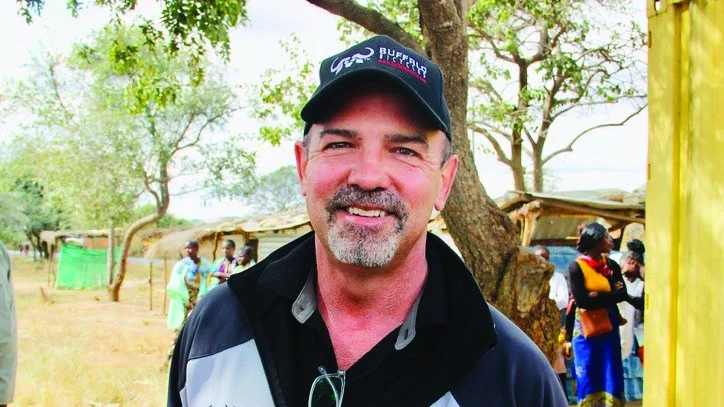
He was 37 and had a high-flying job at an investment bank in Washington but Dave Neiswander was becoming disillusioned with his work. Then, on a holiday in Africa, he met FK Day and Leah Missbach Day, the founders of World Bicycle Relief, and his life changed.
“I was just totally inspired by what they were able to do and that they were willing to shift their lives to go and help others,” Neiswander said.
• Donate to The Times and Sunday Times Christmas Appeal
Six weeks after the holiday, FK Day called and said: “I’m going to Zambia, come.”
“Now this is 2007. I was working in the financial services segment and so I saw a storm cloud coming [the financial crash] … So I walked into the head of the investment bank and said, I’m going off to Africa to do good things. He’s like, ‘Well, good for you’. And I got there and I was totally inspired by what I saw,” Neiswander recalled.
Aids-related diseases were raging in Zambia, and WBR had pledged 23,000 bicycles for community health workers who were travelling vast distances (10 to 15 kilometres on foot each day) to provide care and support children who had lost their parents.
On the ground, Neiswander saw the need as poor-quality local bikes were buckling under the workload. He asked FK Day how they would deliver so many reliable bicycles across a country larger than France with very little infrastructure. He looked at Neiswander and said: “That’s what you’re going to figure out.”
Neiswander took a sabbatical from his Washington job at FBR and Co (formerly the Friedman, Billings, Ramsey Group). He was expecting to take a year’s sabbatical but, 18 years later, he is WBR’s chief executive, after six years living in Zambia and three in South Africa, building programmes, operations and a social enterprise.
Those early months were challenging. But the need was clear: WBR’s needed to design a bicycle fit for purpose so they created the Buffalo Bicycle, engineered for rough terrain and heavy loads.
A non-profit organisation, WBR owns 100 per cent of Buffalo Bicycles, which it distributes and sells in the seven countries where it operates and in other developing markets. Today there are more than 100 Buffalo Bicycle shops and networks of mechanics trained by WBR to keep bikes moving for years.
World Bicycle Relief provides crucial access to healthcare in rural Malawi
Day said: “The fact that Dave was willing to come out of his business … He came on board and brought his business philosophy which exactly mirrored Leah’s and my business philosophy. You can be a humanitarian, it’s important, but if you don’t run it like a business based on economic impact, it’s a hobby.”
WBR turned its attention to education, partnering with Zambia’s ministry of education to design an initiative to help women and girls who face longer walks, household chores, cultural barriers and risks from predators (human and animal) on the road to school.
Seventy per cent of WBR’s education bikes go to girls. Neiswander said of the process of handing one over: “It is almost like an Oprah moment … The entire community gathers to witness what is happening and why these bicycles are going to students. They sign an actual contract … that this bike is to be used for that girl’s education.”
• The Times and Sunday Times Christmas Appeal 2025: Why we chose these charities
In many households, the bicycle is the most valuable asset they own. In that context, the contract changes the dynamics at home. “It shifts negotiating power and changes her locus of control, it’s unbelievably powerful. I get goosebumps just thinking about it because this is what we do … The power of bicycles to change a girl’s life,” Neiswander said.
The same bike that gets a girl to school can help transport food and water as well as sick family members to the hospital.
Co-founder Leah Missbach Day said: “All these chores that the girls were responsible for before they ever set off in the morning before their walking to school [it was] extraordinary … often they couldn’t get all that done and be at school in time. These children suffer when they aren’t on time, it’s rather brutal.”
“We’ve done a two-year randomised control trial study and it’s the first time that that’s been done with adults and bicycles. And it’s showing the impact that with a bicycle, a woman earned 50 per cent more, it’s sort of like a mic-drop situation,” Neiswander said.
As WBR approaches its 20th anniversary, it expects to cross the one-millionth bike milestone in the first half of 2026.
For Neiswander, the shift from banking to bicycles has been dramatic. There was disbelief when he first asked to take a sabbatical: colleagues thinking he was “nuts”, his mother questioning him. But he said his past career did give him a transferable skill: “What an investment banker knows what to do is to get things done.”
Find out more about the Christmas appeal and donate by calling 0151 286 1594 or by clicking the button below.