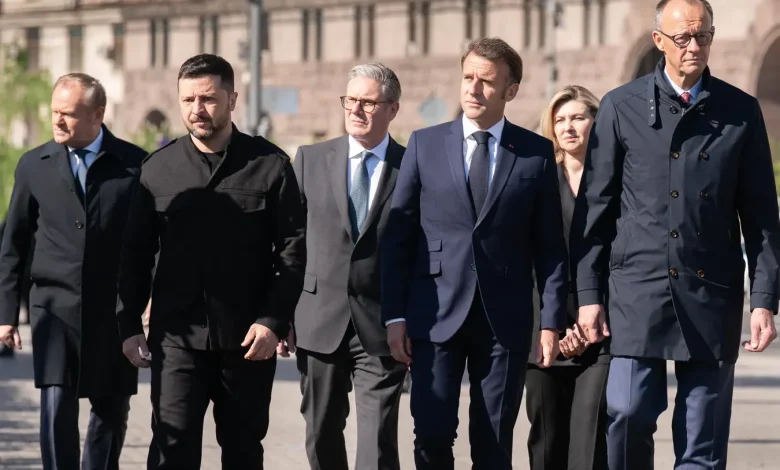
European leaders are about to meet in Europe to discuss further funding of Ukraine’s defence against the Russian invasion of that country. (Photo by Stefan Rousseau – WPA Pool/Getty Images)
Getty Images
Europe might have just eliminated one of the Kremlin’s most dependable leverage points, the matter of the fate of frozen Russian Assets, and in doing so, has pushed the West towards a crucial decision about the future world order. On December 12, 2025, the European Union decided to keep roughly $246 billion (€210 billion) in Russian central bank assets frozen indefinitely, instead of relying on the old system that required renewal every six months.
Until now, the underlying problem was procedural: sanctions had to be renewed on a timetable, inviting brinkmanship. The EU’s new approach relied on Article 122 of the EU treaty, an emergency provision that allowed the Council to adopt exceptional economic measures in crisis conditions without requiring unanimous agreement. In practice, Article 122 is now functioning as the EU’s legal tool to treat the immobilization of Russian sovereign assets as an extraordinary measure justified by extraordinary conditions—rather than as a routine sanctions item that could have been held hostage every six months.
Now, European governments will be weighing whether and how these frozen funds can support long-term financing for Ukraine. With projections warning that Kyiv’s current funding could run out by April 2026, European leaders are looking for ways to sustain Ukraine’s defense and basic state functions into 2026–27. The EU’s move is widely seen as a step towards a bigger issue: whether and how frozen Russian assets can support long-term financing for Ukraine and, eventually, reconstruction. The stakes are high.
Ukrainians from the diaspora demonstrate in front of Euroclear to advocate for Western nations to seize the frozen assets of the Russian Federation on April 11, 2024 in Brussels, Belgium. (Photo by Thierry Monasse/Getty Images)
Getty Images
Euroclear Legal Issues
Most of the immobilized funds are held at Euroclear, the Brussels-based central securities depository—bringing Belgium into focus. Belgium has repeatedly expressed concern about legal and financial risks if Russia retaliates through litigation or asset seizures. Those concerns are real. Russia’s central bank has already announced it is filing a lawsuit against Euroclear in a Moscow court, while Euroclear has admitted it is already dealing with more than 100 legal claims against it in Russian courts related to the seized Russian assets.
The result is a European policy dilemma: immobilisation is one thing; converting immobilised assets into usable financing—without triggering cascading legal risk—is another. European officials argue the risk can be managed under a structure where Russia remains the legal owner while the assets serve as collateral or the basis for loans to Ukraine.
Meanwhile In Washington
This European financial repositioning conflicts with what is planned in Washington, however. For example, point 14 of the reported Trump 28-point peace plan would have effectively ended Europe’s control over Russia’s frozen reserves. Instead, the funds would have been unfrozen and transferred out of European oversight, with most of the money returning to Russia. Trump’s plan would have allocated roughly $100 billion to be used, in practice, as U.S.-controlled capital invested in Ukraine for reconstruction, structured so that future net returns would be split evenly between the United States and Ukraine. That was a tough sell to European leaders who are trying to maintain leverage over Russia until it ends its war and compensates Ukraine.
European skepticism is justified based on experience with dealing with Russia and Trump’s support of Putin. Past decades have seen many agreements and “processes” with Russia, but no real enforcement. Which brings the discussion back to the key strategic question: what security framework would prevent a later renewed Russian attack?
Options include NATO membership, coalition-based defence guarantees, long-term military aid commitments, and even suggestions of Ukraine’s nuclear reinstatement. The bottom line is what exactly is going to stop Russia from further invasions of Ukraine and elsewhere?
Meanwhile Behind The Scenes
There is also a hidden undercurrent that Europe’s decision-makers understand well: this conflict rests on a strained macro-financial environment and fragile alliances with America. The United States’ gross national debt has now exceeded $38 trillion, a milestone widely reported by PBS in November 2025. Meanwhile, according to Reuters, foreign holdings of U.S. Treasuries have surpassed $9 trillion in 2025. Japan remains the largest foreign holder, with about $1.2 trillion in recent U.S. Department of Treasury data. Multiple European custodial hubs and countries—such as the UK, Belgium, Luxembourg, France, and Ireland—also appear among significant holders in Treasury’s country tables.
In May 2025, Le Monde reported on the political sensitivity of foreign Treasury holdings as a potential bargaining chip in a trade and security environment influenced by U.S. policy volatility. The main point was not that allies want to “weaponize” U.S. debt, since that would also harm the holders of the debt economically, but that the financial infrastructure of the alliance system is no longer shielded from politics because of America’s realignment with Russia.
U.S. President Donald Trump gestures while speaking during an executive order signing event. (Photo by Andrew Harnik/Getty Images)
Getty Images
Credibility Of Trump’s Statements Matters
In Washington, the debate has been muddled by President Trump’s exaggerated claims about the size of U.S. aid to Ukraine. But, there is a straightforward way to clarify the discussion.
Independent tracking offers a credible resolution of doubts. The Kiel Institute’s Ukraine Support Tracker estimated U.S. aid delivered to Ukraine through mid-2025 at around $134 billion. This U.S. aid pales when compared to Europe’s $195 billion actually delivered, and is far less than the $350 billion contended as delivered by President Trump. That does not even deal with the quality and types of aid being compared, a discussion that even further diminishes the value of U.S. aid that has been delivered.
All this matters for alliance politics. When Trump cites figures that aren’t backed by credible sources, allies are driven to conclude that America’s commitments are conditional, transactional, and subject to domestic reinterpretations. This uncertainty has become a strategic vulnerability, especially as Europe is being asked to bear a larger share of deterrence.
Europe’s Strategy
Europe’s decision to freeze Russian sovereign assets indefinitely is a strategic move. It involves maintaining pressure on Russia, ensuring Ukraine remains funded, and lowers the chances that the West will accept a settlement that normalizes conquest. It is also increasingly a safeguard against Trump’s policy unpredictability. If Washington swings between support and disengagement, Europe’s capacity to maintain Ukraine—and uphold deterrence—becomes the key concern. That reality impacts not only Europe and the U.S., but also allied democracies with direct stakes in whether Russia’s aggression is rewarded: Canada, Japan, and the other Five Eyes partners among them.
The Choice Is Not Abstract
The post-1945 system—imperfect, often unevenly enforced, and frequently violated—still relies on one fundamental principle: borders are not altered by force, and aggression does not lead to legitimate gains. If the West cannot uphold this principle in Europe, it becomes more difficult to defend it at home and elsewhere, especially in countries like Taiwan.
That is why the upcoming meetings about on long-term Ukraine support and the structure of any asset-backed financing, should be seen as a critical moment. A durable peace requires more than just paper. It also needs enforcement, deterrence, and a structure that does not reward the aggressor. Without these elements, the world does not become safer; it becomes more openly transactional—and more openly imperial.
Conclusion
The EU’s move against the frozen Russian assets isn’t the conclusion. Russia is contesting it. Belgium remains cautious. The legal framework is delicate and intricate. But the message is clear: Europe is turning frozen Russian assets from a recurring political vulnerability into a steady strategic tool—one that sustains Ukraine, keeps leverage, and ensures the basic rules of state sovereignty remain fundamental to the world we live in.