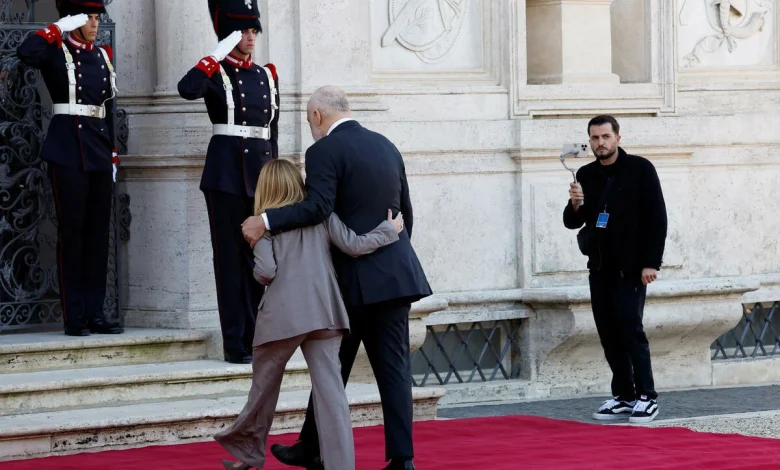
Rama and Giorgi Meloni ahead of the summit of the Italian and Albanian governments in Rome on November 13, Photo: Reuters
For Edi Rama, these are both the best and worst of times, but mostly the best. In May, the Albanian prime minister was elected to a fourth consecutive term. His country’s GDP has grown by 160 percent, expressed in euros, since he came to power in 2013. The war in Ukraine has accelerated Albania’s bid to join the European Union, which has long stalled, along with Ukraine and other candidates. European officials say negotiations could be completed as early as 2027, and Albania could become a member by 2030.
photo: REUTERS
At the same time, Albania’s population has shrunk from 2,9 million to 2,4 million during Rama’s rule. Corruption remains widespread, and SPAK, an independent anti-corruption body, has indicted several of his close allies. One former protégé, the mayor of Tirana, is running the city from a prison cell. There are also allegations that the ruling party used fines and administrative pressure to force citizens to vote for it in May.
“Nonsense,” Rama replies. The towering prime minister, in a black T-shirt, long jacket and a string of red bracelets, sips an espresso in a hotel in Vienna, where he is to speak at an international conference. Never before has an Albanian leader been so well-known abroad. Rama speaks warmly of “Viktor” (Orban), the right-wing prime minister of Hungary, and is on good terms with leftists like Pedro Sanchez of Spain and Metta Frederiksen of Denmark. He has worked with Giorgi Meloni, the right-wing populist prime minister of Italy, on her plan to relocate asylum seekers to camps in Albania. The two governments signed 16 agreements in Rome on November 13, ranging from energy to security.
Yet Rama is seething with anger. SPAK recently indicted Belinda Baluku, the deputy prime minister, for allegedly rigging a tender for an infrastructure project. She denies the charges. Rama says he does not know if she is guilty, but strongly condemns the court’s decision to suspend her from office: “This is unheard of in the history of Europe!”
After SPAK arrested the mayor of Tirana on corruption charges (which he denies), Rama tried to remove him from office. The courts blocked it, forcing the mayor to run the city from prison. Rami finds this absurd. He calls the anti-corruption body “inexperienced, sometimes overzealous, and sometimes just plain wrong. But it’s part of the process,” he adds. Albania, he says, is building an independent judiciary. If his allies expect to be saved, they are mistaken: “I am not married to them.”
One reason for Rama’s declarative commitment to the rule of law is the appeal of EU membership. However, that requires the consent of all 27 member states. Some skeptics question claims that the Albanian government has been purged of corruption. Many on the populist right, however, oppose the admission of what would be the first Muslim-majority EU member state for nativist reasons. Good relations with Orban and Meloni may not be enough. Rama says he is trying to reach out to the leadership of France’s National Rally, but that party remains staunchly opposed to enlargement.
Rama says he would be willing to temporarily waive Albania’s veto power on EU proposals and give up his right to a European commissioner if that would help win over skeptics. In the meantime, he is building other bridges. Jared Kushner, Donald Trump’s son-in-law, has been given approval to build a beach resort in Albania. Rama is also courting the Gulf states. “Their commitment to culture is amazing,” he says. “What Florence was to Europe in the Renaissance, they are to the world today.” When trying to get into a club, it’s wise to hint that you have other options.
Translation: NB
News