Philly’s school board will explore giving its vacant schools to the city, though some object

Philadelphia’s school board voted Thursday night — over some objections — to explore giving its surplus buildings to the city.
The vote does not bind the district to hand anything over, but it certainly opens the door to transferring properties in accordance with the wishes of Mayor Cherelle L. Parker, who has promised her administration will build or restore 30,000 units of housing during her first term.
Exactly how many vacant buildings the district is contemplating giving to the city is not clear; the board did not vote on a list of schools, though officials have said in prior months the number of surplus schools is about 20. A school board spokesperson has said the list is still subject to internal discussion.
» READ MORE: As it happened: live updates from the school board’s special action meeting
The resolution only covers the district’s current closed buildings, not any that might be closed in the upcoming facilities master planning process expected to wrap up before the end of the school year.
Board president Reginald Streater has said the city partnership makes sense, and would allow the district to focus on education, while relying on the city’s real estate expertise. The buildings all have carrying costs too, which the city would assume.
Six board members voted for the resolution authorizing Superintendent Tony B. Watlington Sr. and the district’s legal department to begin talks with the city. Two board members — Crystal Cubbage and ChauWing Lam — voted no.
Lam’s hesitation came, she said at Thursday’s special action meeting, because of the district’s budget issues.
The vacant-building portfolio was recently valued at $80 million, Lam said.
The mayor’s housing goals are laudable, Lam said, but “given the district’s structural budget deficit, which includes spending nearly half of our fund balance this year to balance our budget, I encourage consideration of additional opportunities before rushing into an agreement as set forth in this resolution.”
Cubbage, too, said she worried that the resolution “limits us to exploring the conveyance of our school buildings to the city without financial compensation when we are facing a $300 million structural deficit and are constantly underresourced.”
Instead, Cubbage said, she wished the board would delve into actions that could give short- and long-term revenue and still accomplish Parker’s housing goals by selling the properties “with deep restrictions and affordability requirements.”
Board member Wanda Novalés supported the resolution, but noted that the district needs to get the whole picture — including enrollment projections and long-term capital priorities — before it moves forward.
“I support the resolution as long as it calls for a thorough business plan that clearly outlines the benefit to the School District of Philadelphia,” said Novalés.
Watlington, in a statement issued after the vote, supported the move.
“By responsibly evaluating how to put these unused properties back into productive use, the district can stay focused on educating children while supporting broader city efforts that ultimately aim to strengthen neighborhoods,” Watlington said. “This exploration aligns with our commitment to both fiscal stewardship and community partnership.”
Parker, in a statement issued earlier this week, said the transfer would mean the buildings would improve residents’ quality of life.
Officials “cannot let blighted buildings in the middle of residential neighborhoods lie vacant — many of which have been vacant for many years — from two years to over 30,” Parker said in the statement. “It’s unconscionable to me that we are in the middle of a housing crisis and we have government buildings sitting vacant for years or even decades. That cannot continue.”
Chief Deputy Mayor Vanessa Garrett Harley said in a statement that the city looks forward to working with the board on this issue.
“This action will help the city to more effectively move blighted properties to productive use, addressing a longstanding concern of neighborhood leaders and residents across the city, and contribute to the mayor’s goal of creating or preserving 30,000 units of housing,” Garrett Harley said.
A potential buyer for at least one vacant school
Several speakers suggested it was a bad move to simply give buildings to the city.
Cecilia Thompson, a former school board member, said she’s OK with selling schools to the city. But “can we sell it to the city for market value, and not a dollar or something nominal, just to say it was a sale? Just to be respectful … for the worth of the properties?”
Several members of the community made it clear that there are potential buyers.
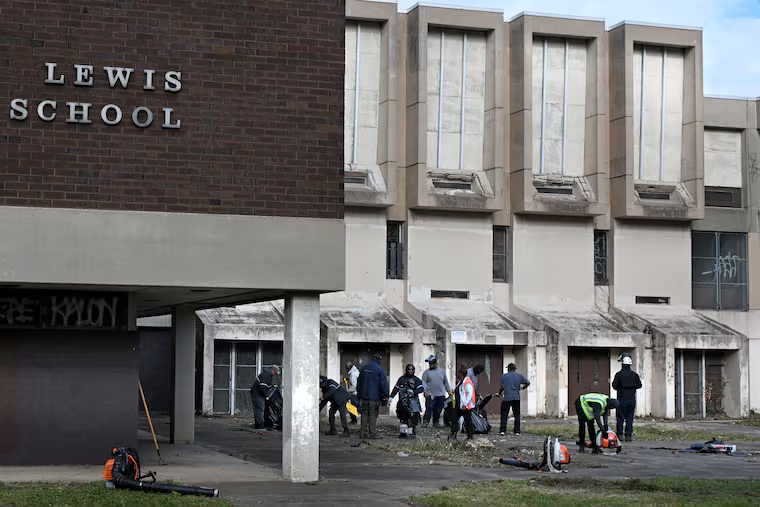
Angela Case, a staffer at West Oak Lane Charter, indicated that the school wants to buy Ada Lewis Middle School in East Germantown.
(Lewis is a prominent part of the potential portfolio — a large building on a sprawling campus and, this fall, the site where Kada Scott’s body was discovered.)
“Our school is growing, but our current space is limited,” Case said. “Ada Lewis would give our students safe classrooms, outdoor areas and room for strong academic enrichment programs. It would also return a vacant property to a productive use, and benefit the surrounding community.”