We have officially entered the Christmas season, and themed films are once again dominating the Top 10 — with no surprises there. Stories wrapped in snow, momentary loneliness, and that final gathering of families and friends, celebrating unity, reconciliation, and love. Honestly, an eternal cliché — and one that remains permanently in demand.
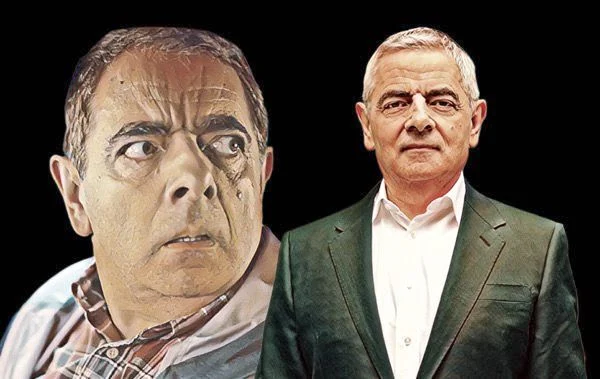
For the initiated, however, seeing Man vs Baby leading the weekly ranking comes as anything but a surprise. Even without being officially Mr. Bean, Rowan Atkinson once again takes center stage. The character is not called Bean, but he carries his DNA: physical comedy, domestic chaos, the ordinary man at war with the world. An icon of the 1990s who, decades later, remains perfectly functional in the streaming era. A legend that doesn’t need to announce itself, it simply appears.
Mr. Bean is one of those phenomena that seem to defy industrial logic. Created in the early 1990s, the character had only 15 original episodes and yet became one of the most recognizable figures in global pop culture. His strength was never in quantity, but in the clarity of the concept: an almost silent form of humor, grounded in the body, comic timing, and a cruel — and childlike — observation of everyday life.
What is often forgotten is that Bean is not born of naivety, but of an extremely well-trained actor. Rowan Atkinson is the product of a rigorous education that begins outside the arts — in electrical engineering — and is refined in the university theatre scene at Oxford in the late 1970s. There, he moved within the same creative ecosystem that produced Emma Thompson, Hugh Laurie, Stephen Fry, and Tony Slattery: an environment where satire, theatre, and technical precision coexisted organically. Yes, these geniuses were contemporaries — and if we add director Richard Curtis to the mix, the mind behind Love, Actually (arguably the defining Christmas film of recent decades), everything suddenly gains a new perspective, wouldn’t you agree?
Although Atkinson was not directly part of The Cellar Tapes — the production that would become the defining landmark of that generation — he belongs to the same historical and intellectual moment. What sets him apart is the path he chose: while many of his contemporaries built their careers primarily on language and literary irony, Atkinson went in the opposite direction, investing in physicality, silence, and the engineering of the gag. Mr. Bean emerges from this conscious choice: a character created by someone who fully masters language, yet deliberately chooses to abandon it.
Before Bean, British audiences were already familiar with another side of Atkinson. In Not the Nine O’Clock News, he demonstrated complete command of verbal and political satire. In Blackadder, he created Edmund Blackadder, one of the most sophisticated characters in British comedy, entirely dependent on text and rhythm. These works make it clear that Bean is not a limitation; it is a distillation. And I strongly recommend searching YouTube for clips from this era: they are laugh-out-loud funny. My personal favorite is Macbeth. Consider this a tip.
Throughout his career, Atkinson has been careful not to become trapped by a single character. This led to the Johnny English films, a self-aware parody of the James Bond myth, and later, to an unexpected turn as Jules Maigret, in a restrained, melancholic, and dramatically serious interpretation. Few actors move so naturally between broad physical comedy and classical introspection.
Still, the public never let Mr. Bean go. Films, animated series, endless reruns, and, more recently, viral clips on social media have kept the character alive — often independently of the actor’s own intentions.
It is in this context that Man vs Bee and its sequel, Man vs Baby, emerge as recent Netflix successes that reframe Atkinson’s legacy for the streaming era. In 2022, Man vs Bee debuted as a nine-episode miniseries in which protagonist Trevor Bingley wages an all-out war against a bee inside a luxury mansion — an absurd premise that generated millions of viewing hours globally in its first weeks and placed the show in Netflix’s Top 10, a notable achievement for a production built around classic physical comedy in an increasingly high-concept catalog.
Three years later, in December 2025, Man vs Baby arrives as a natural continuation: after the disastrous encounter with the bee, Trevor is hired to look after a luxurious London apartment and finds himself facing an even more unexpected opponent — a baby left at his door, one he neither asked for nor knows how to handle.
Early reviews and audience data indicate that the series launched strongly in Netflix’s year-end lineup, ranking among the platform’s most-watched titles at release. This reflects not only immediate audience recognition but also the familiarity viewers feel with Atkinson’s physicality and comic timing.
While critical responses to Man vs Baby vary — from praise for its Christmas charm to reservations about a more sentimental, less frenetic tone than its predecessor — audience engagement highlights something essential: fascination with Atkinson’s performance remains intact, even when shifted into a new narrative dynamic.
Bingley is not Bean — though the series deliberately plays with this confusion, including characters mixing up the names — but he is not his opposite either. He is a mature variation, slightly more melancholic, now placed within domestic, family-oriented Christmas settings. The humor remains physical; chaos is inevitable. What changes is the context — and the way it speaks to different generations.
Perhaps this is Atkinson’s most impressive achievement: speaking simultaneously to audiences who grew up watching Mr. Bean on broadcast television, younger viewers who discovered him through viral clips, and families who now encounter him through streaming. His humor does not rely on period references or fleeting irony. It relies on something far more basic and enduring: the human discomfort of wanting to belong — and failing.
Interestingly, the creator of one of pop culture’s most silent characters also delivered one of the most forceful public defenses of freedom of expression in recent British cultural history. From 2012 onward, Atkinson spoke out against laws that expanded the definition of “hate speech,” arguing that satire — and comedy more broadly — depends on the right to offend.
For him, freedom of expression exists not to protect comfortable speech, but uncomfortable speech. This is not about defending prejudice, but about preserving space for critique, irony, and exaggeration — structural elements of British humor. His remarks reveal the intellectual behind Bean’s silence: someone acutely aware of comedy’s political role.
In a streaming landscape saturated with complex narratives, Rowan Atkinson offers something almost archaic — and precisely for that reason, universal. Every stumble, every awkward silence, every sideways glance is calculated, not improvised. He has always treated comedy as structure, mathematics, and emotional engineering.
In the end, Atkinson found an elegant solution to the trap of his own success. He does not officially resurrect Mr. Bean, but he does not abandon him either. He creates echoes, variations, adjacent characters — and accepts that, for audiences, all of them carry something of that silent man from the 1990s.
More than a character, Rowan Atkinson has become a rare point of contact between generations. An actor trained in British university theatre who has crossed broadcast television, global cinema, the DVD era, the internet, and streaming — always guided by the same principle: making people laugh without having to explain why.
Related Posts
Descubra mais sobre
Assine para receber nossas notícias mais recentes por e-mail.