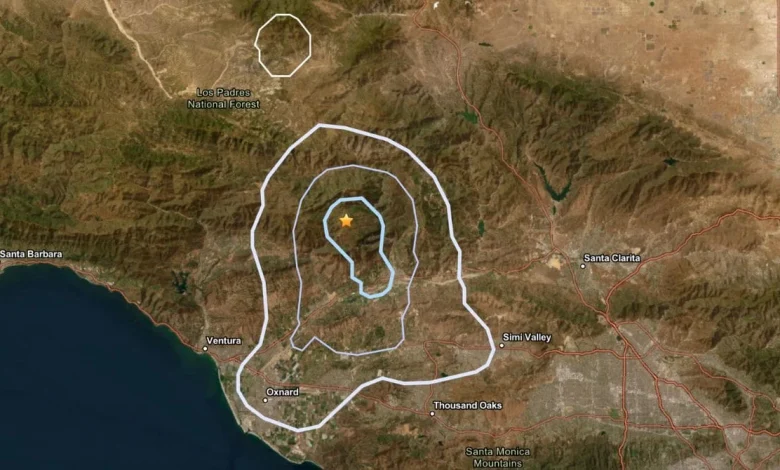
A series of small earthquakes struck in Ventura County on Thursday, December 11, 2025, according to the U.S. Geological Survey (USGS).
According to the USGS, at least six earthquakes were detected northwest of Fillmore within minutes of each other. All events were centered about 13 to 14 km northwest of Fillmore, at depths ranging from approximately 8 to 11 km.
Most of the earthquakes occurred around 10:30 a.m., with magnitude ranging from 2.5 to 3.1.
The strongest, a magnitude 3.1 quake, occurred slightly earlier at 10:27 a.m. Initially, it was reported to be 3.3 magnitude, but was later downgraded to 3.1. It was located about 13 km northwest of Fillmore and originated at a depth of 10.6 km.
The USGS received 29 “felt” reports for the magnitude 3.1 event and one for the magnitude 2.7. No injuries, structural damage, or disruptions have been reported.
Events of this size are generally considered common in Southern California and typically do not cause structural harm. These closely spaced quakes are characteristic of what scientists classify as an earthquake swarm.
What is Earthquake Swarm?
The USGS describes a swarm as a sequence of small earthquakes with no single dominant mainshock. Unlike a typical pattern where a large quake is followed by predictable aftershocks, swarms have irregular timing and magnitudes.
They may slow, intensify again, or continue at low levels for days, weeks, or even months. Many swarms recur in the same geographic areas and can be linked to geothermal activity or underground fluid movement.
The 2015 Fillmore Swarm
The latest earthquake swarm in Fillmore comes a decade after the region experienced similar activity in 2015.
The 2015 event occurred about 6 km west of Fillmore beneath the eastern Ventura Basin. That sequence produced more than 1,400 earthquakes, with the largest reaching magnitude 2.8, according to the USGS.
Researchers found the 2015 swarm showed unusual temporal patterns, including migrating seismic activity and varied fault orientations that differed from a simple planar fault structure.
Studies suggest the swarm was likely influenced by fluid movement, possibly due to metamorphic dehydration processes or fluid migration along a detachment zone. The activity eventually tapered as pore pressure dropped, increasing effective stress on faults and slowing the rate of slippage.
Safety Measures During Earthquake
During an earthquake, the USGS emphasizes safety protocols: if you are indoors, stay there, take cover under sturdy furniture, or brace against an interior wall. Avoid windows, heavy objects, and anything that could fall.
Going outside during shaking can be dangerous. If you are outdoors, move to an open area away from buildings, trees, and power lines.
Drivers should slow down, pull over safely away from bridges or overhead structures, and remain in the vehicle until the shaking stops. In mountainous areas, watch for falling rocks or potential landslides.