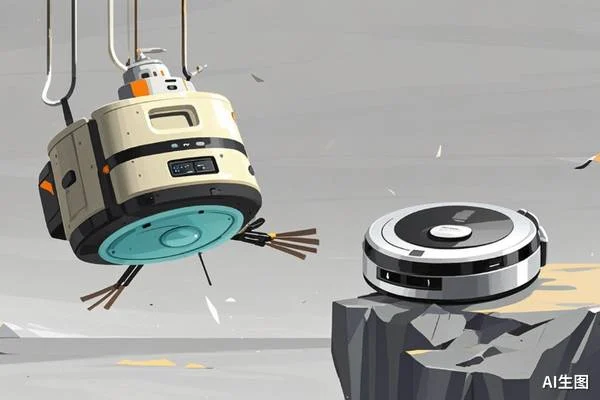
This scene has finally arrived.
Recently, in a document submitted to the SEC, US robotics company iRobot admitted for the first time that the company’s cash flow is almost exhausted. Its total liabilities exceed $350 million (approximately 2.5 billion yuan), while the cash on hand is only $24.8 million. If it fails to reach a debt extension or refinancing agreement with creditors before January 15, 2026, the company will have to file for bankruptcy protection.
Founded in 1990, iRobot is one of the world’s earliest companies to introduce robots into household life. At its peak, it held over 80% of the global market share, and its market value once exceeded $4 billion. However, with the aggressive expansion of Chinese robot vacuum brands such as Roborock, Yunjing, and Dreame into the global market, this pioneer in the industry has struggled. In recent years, its performance has continuously deteriorated, and it has even fallen into a situation of insolvency.
Surprisingly, iRobot’s largest creditor is now its contract manufacturer – Shenzhen-based Shanchuan Robotics Co., Ltd. (hereinafter referred to as: Shenzhen Shanchuan). After all these years, Chinese manufacturing remains the most formidable competitor.
The pioneer of robot vacuums has hit a snag
iRobot was once a prime example of how technology can transform lives.
The story dates back to 1990 when Rodney Brooks, the director of the Artificial Intelligence Laboratory at the Massachusetts Institute of Technology (MIT), founded iRobot with his two protégés, Colin Angle and Helen Greiner, with the ambition to create their own robots.
In the early days of the startup, to keep the company afloat, the founders had to rely on bank loans and credit card financing. Colin Angle, the CEO, led the team to look for outsourcing projects everywhere. They successively developed robots for lunar exploration and mine clearance, and secured stable government orders, which helped the company start to gain recognition.
In 2002, iRobot officially launched the Roomba, a household robot vacuum. This product turned the concept of “robots entering households” into a reality, and iRobot was thus hailed as the “pioneer” of robot vacuums. Priced at $199, 50,000 units of the Roomba were sold in its first year on the market, and by 2005, the sales volume exceeded 2 million units.
Also in 2005, iRobot successfully went public on the NASDAQ, with its stock price soaring by over 20% at the opening. In an era when hardware companies were not the mainstream, such performance was truly remarkable. In 2016, iRobot opened an office in Shanghai, expanding its global business to China.
For a long time, the Roomba was almost synonymous with household robot vacuums, dominating the robot vacuum market in the US and around the world. The stock price of its parent company, iRobot, also climbed accordingly, reaching a peak of $133 in 2021, with a maximum market value of over $4 billion (approximately 28 billion yuan).
However, beneath the peak, there were already undercurrents. As global market competition intensified, iRobot’s position was gradually shaken by new entrants. Since the second half of 2021, its gross profit margin has been on a downward trend, and its financial performance has become increasingly dismal. It started to report losses in 2022.
To alleviate the crisis, iRobot has made several attempts to save itself. It once pinned its hopes on being acquired by Amazon – in August 2022, Amazon planned to acquire iRobot at $61 per share, with a total price of approximately $1.7 billion (approximately 12 billion yuan). During the regulatory review period, seeing iRobot’s deteriorating situation, Amazon strongly lowered its offer. Eventually, the deal fell through.
With its hopes dashed, the performance of this pioneer robotics company continued to decline. It laid off half of its employees, and even CEO Colin Angle chose to leave. Facing near – bottom performance, iRobot had to admit in its financial report that it had suffered losses for 11 consecutive quarters and had “significant doubts” about its “ability to continue operations.” Its stock price plummeted, almost dropping to $2 from its historical high, and its market value evaporated by over 96%, leaving the company in a precarious state.
On the verge of bankruptcy, iRobot is now facing a class – action lawsuit, being accused of misleading investors about its business prospects. It’s truly regrettable to see the once – great pioneer of robot vacuums end up in such a situation.
Why did it decline?
The situation is far more serious than expected.
Recently, a document submitted by iRobot to the SEC revealed that on November 24, 2025, iRobot’s main contract manufacturer, Picea, through its subsidiary Santrum, acquired $191 million of iRobot’s outstanding loans (principal + interest), becoming iRobot’s main creditor.
Additionally, as of the same period, iRobot still owed Picea/Santrum $162 million in product manufacturing fees, of which $90.9 million was overdue. The total of these two debts amounts to $352 million (approximately 2.5 billion yuan).
However, iRobot’s situation is extremely dire. As of the end of the third quarter of this year, iRobot’s cash balance was only $24.8 million, and its operating cash flow was – $104 million during the same period. At this stage, the company’s total assets were $481 million, while its total liabilities were $508 million – that is, iRobot’s debt to Picea/Santrum accounted for over 70% of its total liabilities, and its shareholders’ equity was – $26.8 million. Technically, it is insolvent.
Picea/Santrum is actually Shenzhen Shanchuan Robotics Co., Ltd. from China.
Founded in 2016, Shenzhen Shanchuan is a technology and service provider for robot vacuums. In 2020, it was selected as a “specialized, refined, distinctive, and innovative small and medium – sized enterprise” in Guangdong Province, and in the following year, it was recognized as a headquarters enterprise in Nanshan District. There is a saying in the industry that three out of every ten high – end robot vacuums in the global market are from Shenzhen Shanchuan.
Since its establishment, Shenzhen Shanchuan has been targeting the global market. According to its official website, its annual production capacity of robot vacuums exceeds 8.5 million units, and the cumulative historical delivery has exceeded 20 million units. In 2025, it ranked first in the field of robot vacuum solutions. Its partner brands include well – known brands such as Xiaomi, Haier, and Philips, as well as iRobot, which is at the center of this storm.
In other words, Shenzhen Shanchuan is not only iRobot’s contract manufacturer but also its largest creditor, with the initiative to initiate default remedies or bankruptcy liquidation at any time.
The seeds of failure may have been sown long ago.
Recalling iRobot’s early success model, it mainly relied on high – priced hardware sales and continuous replacement of consumables (such as side brushes and filters) to obtain high profits. Gradually, it was always one step behind in terms of product innovation. Since the launch of the Roomba in 2002, there has been no revolutionary new product, and it has only made minor iterations on existing products.
What’s more, in terms of technology, this pioneer of robot vacuums has been conservative. While Chinese brands such as Ecovacs, Roborock, and Dreame adopted the “lidar + AI obstacle avoidance” technology early on to improve cleaning efficiency and intelligent experience, iRobot still adhered to its own visual navigation technology and was slow to respond to new user demands.
Lacking corresponding technological advantages but still positioning itself in the high – end market, the imbalance between price and performance has led to a significant loss of users, and its once – dominant market share has been gradually eroded. As of now, this “veteran” in the robot vacuum industry only holds 7.9% of the global market share, has long been squeezed out of the top five, and is standing on the edge of a cliff.
Lessons from being outperformed by Chinese competitors
The most fatal blow comes from competitors across the ocean.
Recalling many years ago, when iRobot first created the Roomba, the Chinese robot vacuum market was almost non – existent. It wasn’t until after 2018 that Chinese robot vacuum companies represented by Ecovacs, Roborock, Dreame, Yunjing, and Xiaomi’s ecosystem brands rose aggressively. With faster product iteration, more innovative technology applications, and more competitive prices, they not only blazed a new trail in the domestic market but also reshaped the global robot vacuum market landscape.
A report released by the International Data Corporation (IDC) shows that in the first half of this year, the cumulative global shipments of robot vacuums reached 11.263 million units, a year – on – year increase of 16.5%. Among the top five brands in the global robot vacuum market share list, four are Chinese brands. Among them, Roborock ranked first with a 20.7% market share, followed by Ecovacs, Dreame, and Xiaomi – these four Chinese brands account for half of the global robot vacuum market.
Behind this is the strong support of China’s industrial chain and supply chain, especially in the Pearl River Delta and Yangtze River Delta regions known for their cluster effects. Multiple complete industrial clusters such as sensors, batteries, and motors are booming. For example, in Shenzhen, a robotics company can basically complete the closed – loop from design to mass production within a 30 – kilometer radius.
This deeply integrated industrial ecosystem has greatly reduced logistics and communication costs, enabling the speed from technological concept, sample trial production to large – scale mass production to far exceed that of overseas competitors. Thus, the efficiency advantage of the supply chain is directly translated into the speed advantage of product iteration and market response. For example, iRobot may take 2 – 3 years to launch a new product, while Chinese brands usually iterate every 6 to 8 months.
This scenario is not limited to the robot vacuum category. Looking at the global market, whether it’s the popular pool cleaners, intelligent lawn mowers, or the increasingly popular 3D printers and educational companion robots, there is a shadow of Chinese manufacturing behind more and more intelligent hardware products.
That’s why a group of Chinese brands represented by DJI, Insta360, Anker, and Bluetti have risen and stood at the center of the world stage. They have removed the labels of “knock – off” and “cheap” from Chinese hardware and completely reshaped the world’s perception of “Made in China.”
Recalling the latest sharing of Zhou Kexiang, the general manager of China Merchants Capital, at this year’s Zero2IPO Annual Conference, China has the natural endowment to develop the manufacturing industry: a complete supply chain system, strong engineering capabilities, large – scale production advantages, cost – control capabilities, and a huge domestic market. These factors determine that manufacturing giants will inevitably emerge in China.
The narrative of the global technology arena is being rewritten.
This article is from the WeChat public account “Investment World”, author: Zhou Jiali. It is published by 36Kr with permission.