‘IT: Welcome To Derry’ Executive Producers & Cast Talk Bloody Face Off With Pennywise In Finale

SPOILER ALERT! This post contains details from the finale of HBO‘s IT: Welcome to Derry.
All is quiet in Derry, Maine, after the town endured one last massacre at the hands of IT in the finale of HBO’s prequel series Welcome to Derry.
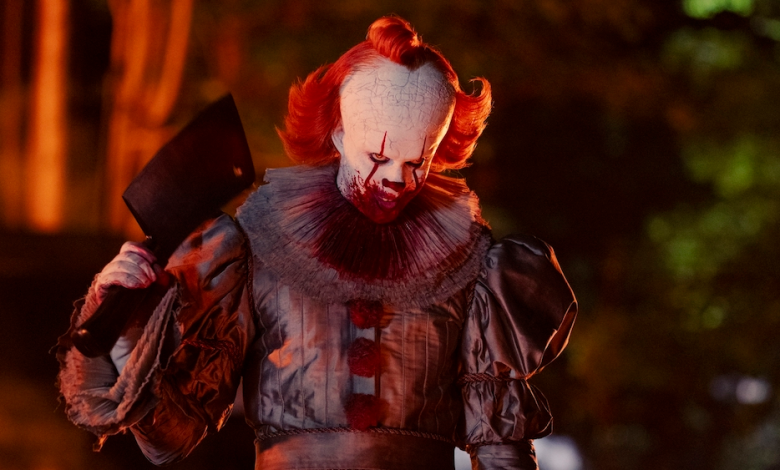
Episode 8, titled “Winter Fire,” began with a dense fog sweeping through Derry after the military successfully destroyed one of the pillars that had been containing the supernatural monster. IT immediately targets the rest of the kids, marching their entranced bodies through the icy storm beyond the town’s border. Lily (Clara Stack), Marge (Matilda Lawler), and Ronnie (Amanda Christine) set off to stop Pennywise (Bill Skarsgård), following the trail of blood he left behind. Meanwhile, the adults are hatching their own plan to find and defeat the monstrous force.
Since the military is willing to go to great lengths to ensure that IT is unleashed on the world, what ensues over the course of the episode is a massive, carnage-riddled showdown that executive producer and director Andy Muschietti called “haunting and magical and spectacular.”
In figuring out how to “illustrate the advance of this expanding force that is IT, which is a new idea in this show that is not in the book,” Muschietti adds that the idea of a fog felt like it was already within the DNA of the story he’s been telling.
“When you see the star crashing, the talons are surrounded by this smoke. What is that smoke? That’s part of the physicality, body of this thing,” he said. “And in order to see how this thing expanded, we created the fog…and the whole Pied Piper thing with IT, taking the kids for [a] travel snack.”
The massive set piece was designed on a soundstage, with multiple cameras simultaneously shooting the action as it happened across the ice.
“We were probably on that thing for a month,” laughs Stephen Rider, who plays film projectionist Hank Grogan.
Leading into the showdown on the ice, Hank had been on the run after escaping from prison. He’d been falsely accused of mutilating several kids at the movie theater, one of the first acts that IT commits upon reawakening after being dormant for the last 27 years. The murder sends ripples through the community, putting everyone on edge, including the kids, as Ronnie blames Lily for her father’s imprisonment, because the latter didn’t outright deny the possibility that Hank was at the theater that night for fear that she would be sent back to an inpatient mental health facility.
In reality, Hank was in prison because “white people never saw him,” Rider says, adding: “it’s easy to point the finger when you don’t perceive someone as being human in the first place.”
While the finale certainly offers some of the bloodiest imagery of the series, the penultimate episode is responsible for the most horrific moment — when several white men, hell bent on exacting revenge on Hank, set fire to the Black Spot, a safe haven for Black airmen that had been offered to Hank as a refuge, killing numerous people.
Richie (Arian S. Cartaya) dies saving Marge, who barely makes it out alive alongside Hank, Ronnie, Charlotte (Taylour Paige) and Will (Blake Cameron James).
“The Black Spot is really inspired by the book and Stephen King’s vision,” Andy Muschietti tells Deadline. “What he’s trying to tell us is basically that we are capable of doing things that are as bad or worse than the monster that he created. We are capable of inflicting pain and hurt to each other in a way that is worse than the monster. Bigger picture, the monster is a bit of a metaphor of how fear is utilized and people are manipulated and hurt, and fear is weaponized.”
Paige considers Episode 7 the scariest of the season, explaining it’s “just a horrific thing to see, and it was all too jarring, the reality of a bunch of people being burned alive, a bunch of Black people, and how often this happened, It’s just a little too real.”
“What could be darker than racism, and people being murdered for the color of their skin, and children being burned alive, and just hatred?” she continued. “And what that does, and what that reflects about the human spirit, and how relentless racism is, and how insidious and insane it is, the banality of evil — I have so many things I could say. It’s just gut-wrenching, it’s yuck.”
Charlotte was directly responsible for assisting Hank in getting to the Black Spot in the first place. The plan was to hide him there until he and Ronnie would have the opportunity to get out of town. So, when Will goes missing in the finale, at the hands of Pennywise on his final tear, Hank is quick to drop everything to risk himself to retrieve the young boy.
“When nobody else stood for him, Charlotte stood for him, and it’s the first time in their very short relationship where he has the ability to stand for her, and if that means that he has to die in the process of doing that, he’s willing to do that because she did that for him, you know?” Rider says.
While the kids do manage to plant the last remaining pillar in the ground and contain IT once more, putting it to sleep for another 27 years, the finale offers major hints as to where the series may be heading, should it be renewed — and it doesn’t look good.
The finale reveals that Marge will one day have a son, and that boy will be none other than Richie Tozier. She learns from Pennywise that he will be responsible for the monster’s downfall one day, and he’s on a journey through time, intending to stop those events (which unfold in the IT films) from ever occurring. The suggestion is that, having been foiled now in 1989 and 2016 and now 1962 as well, he may go after the Losers ancestors during his last murderous cycle in 1935.
Muschietti tells Deadline that he pulled the idea directly from the source material, in which Stephen King floats the idea that IT doesn’t experience time in the same manner as humans.
“His experience of time is non-linear. How is that and why, that’s a whole exploration that we intend to flesh out during the next two seasons, but that was pretty much [the idea] from the beginning,” Muschietti says. “The pitch to Stephen King was we’re going to tell a story backwards, and it has to do with that hint.”
At this point, Muschietti expects the audience to still be asking some pretty fundamental questions about how that all might work. in particular, he says that later seasons would attempt to answer the question: “Is he going backwards in a linear way, or is he omnipresent, and how does that affect the story that we already know?”
Welcome to Derry has now drawn several threads between the characters introduced in Season 1 of the prequel series and the Losers. Will is intended to be the grandfather of Mike Hanlon, and in the finale, it’s revealed that Bob Gray’s daughter Ingrid (Madeleine Stowe), who has been provoking IT since he ate her father and took a liking to his clown alter ego decades ago, had an interaction with Sophia Lillis’ Beverly Marsh in the moments after her mother died by suicide.
In an ominous scene at the end of the finale, Ingrid stumbles into the Marsh’s room as Beverly and her dad grieve over a hanging body to remind the girl that that no one in Derry ever really dies.
“I thought, let’s jump forward in time all the way to ’88 or ’89, which is when [the first film] happens. Ingrid would still be there, and Beverly would still would be there, because her mom was struggling with mental issues, and we know that she committed suicide. What if those paths cross?” Muschietti explains.
Muschietti tells Deadline the scene was a late addition to the finale. Without it, he says, he felt “something missing.”
In fact, had he gotten his way, the epilogue would’ve been even longer and connected even more threads between the prequel series and the two films. “I had a bigger epilogue. I thought of four little scenes that connected all of the characters [to the prequel],” he revealed.
He adds that there is “much more” to explore about Bob Gray and his daughter in what he hopes will be a three-season arc for the series.
“There’s so much. We’re going to learn a lot of things about it. We are going to know more about the Bob Gray of things, and we are going to know more about Ingrid, because Ingrid was around in the 30s. Our second season happens in 1935, in theory,” he says. “I think it’s a pretty tragic character. She’s a very specific, very unique character, because she’s a victim, but she’s a perpetrator too. She’s tricked into thinking that her dad is still there somewhere in the shadows of that monster, and she wants to liberate him, but the only way to see him and try to liberate him is by creating all these baits [and] all this pain, because she knows that he will show up.”