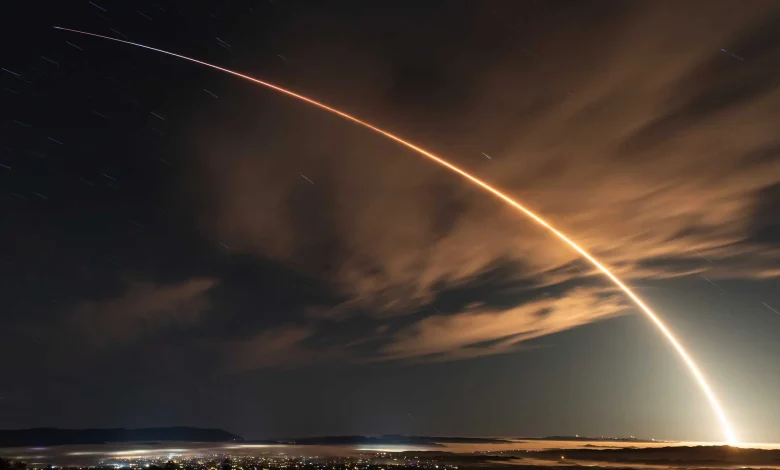
A fifth Falcon 9 launch for December from Vandenberg Space Force Base on Saturday night ended up being a mission heard, but not necessarily seen, thanks to dense fog that shrouded but didn’t halt the latest liftoff for the busy SpaceX rocket.
With a heavy blanket of fog covering the Central Coast, the rocket blasted off at 9:49 p.m. from Space Launch Complex-4 on South Base, followed by the first-stage booster landing on the droneship in the Pacific Ocean.
The 27 Starlink satellites on board the rocket successfully deployed approximately an hour after liftoff, SpaceX confirmed.
Falcon — named for the Millennium Falcon from “Star Wars” — leads the world’s launchers as the most prolific by far.
One key reason: Reusability.
The liquid-fueled rocket stands 229 feet fall and with its nine Merlin engines generates 1.7 million pounds of thrust at liftoff.
Once the first-stage booster, or lower two-thirds of the launch vehicle and the most expensive part, completes its part of the chores its engines shut down before the segment separates from the rest of the rocket.
“A staged rocket like Falcon 9 sheds that booster so that stage two and the payload can keep climbing faster and more efficiently,” Cori Brendel, a senior software engineer for SpaceX, said during a livestream of a mission earlier this fall from Vandenberg.
Without the weight of the first-stage booster, the rocket’s second stage, powered by a single Merlin vacuum engine, carries the payload higher into space.
With its task done, the first-stage booster returns to land at Vandenberg or on a droneship, clearing the way to be recycled for another mission.
That helps cut costs and trim time between missions, allowing a busy launch pace.
Likewise, SpaceX retrieves the two pieces of the payload fairing, or nose cone.
“This is a 17-foot wide carbon composite shell that protects the payload during the uphill trip through the atmosphere,” she said.
A few minutes after liftoff the two halves fall away and parachute back to Earth, she added.
“If recovery goes to plan, the fairings will be pulled from the ocean and prepared to fly again,” Brendel said.
“This reusability is exactly what makes the Falcon 9 such a remarkable vehicle.”
Traditionally, rockets and missiles have dumped their first-stage boosters and payload fairings into the ocean with each mission, meaning a brand-new vehicle that often took years to build and prep for liftoff.
The demand for frequent launches stems from the number of satellites needing to be placed in space as commercial companies and government agencies build constellations of small spacecraft for internet access, communication and other purposes.
Vandenberg’s busy launch rate — two months this fall each saw eight liftoffs alone— has both fans eager to see liftoffs and foes upset at the noise and other aspect.
The mission marked the 69th rocket launch and missile test of 2025 from Vandenberg and at least one more liftoff is planned. While Falcon flights make up most of the year’s liftoffs others rockets and missiles also have launched from the base this year.
The West Coast’s sixth Falcon 9 rocket launch of December is planned for Tuesday between 7:24 and 11:24 a.m. to deliver 27 Starlink satellites into space.