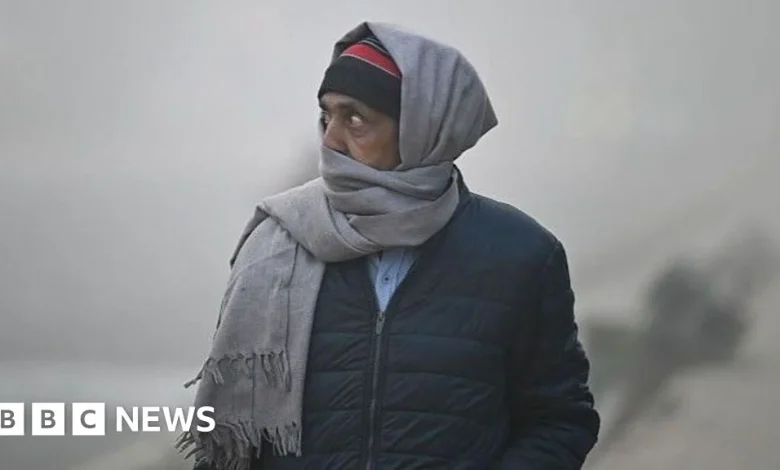
Watch: Toxic haze envelops Delhi as air quality turns severe again
Schools in Delhi and surrounding areas have moved classes online and construction has been banned as the Indian capital grapples with hazardous air quality.
On Monday morning, a toxic haze engulfed the city, affecting visibility and delaying flights and trains.
The city’s air quality index (AQI) – which measures PM2.5, fine particulate matter that can clog lungs, and other pollutants – was more than 30 times the limit recommended by the World Health Organization. Exposure to this level of pollution can cause serious health problems, especially in children and elderly people.
Toxic air is a recurring problem in Delhi and its suburbs, especially during winters.
The problem is attributed to a mix of factors such as industrial emissions, vehicle exhaust, dropping temperatures, low wind speeds and the seasonal burning of crop stubble in neighbouring states.
Average AQI in Delhi early on Monday was 471, according to the government’s Safar app.
India’s pollution watchdog classifies AQI levels of 101–200 as moderate, 201–300 as poor, 301–400 as very poor, and anything above 400 as severe. Government-backed apps cap readings at 500, even though private and international monitors often record much higher levels.
The sudden dip in air quality levels since Saturday came after the capital had shown some improvement over the past week – when it oscillated between “poor” and “very poor”.
Getty Images
A thick haze has engulfed Delhi over the past few days
On Sunday, India’s Commission for Air Quality Management (CAQM) invoked the highest level of its graded response action plan (GRAP) to tackle pollution, scaling up from “level III” to “level IV” of the plan.
As a result, older diesel trucks have been barred from entering Delhi, construction activity has been halted, and schools have been told to switch to hybrid classes, with younger children required to study online.
India’s top court also issued a circular on Sunday advising lawyers and litigants to appear virtually for hearings.
The CAQM said the latest deterioration was driven by high moisture levels and a change in wind direction, which reduced the dispersion of pollutants and encouraged smog formation.
Authorities have warned residents, particularly children and people with heart or respiratory conditions, to stay indoors and advised wearing masks if going outside.
Prolonged exposure to severe AQI can cause respiratory problems even among healthy people.
More than 200,000 cases of acute respiratory illnesses were recorded in six state-run hospitals in Delhi between 2022 and 2024 as the capital struggled with rising pollution levels, the federal government told parliament earlier this month.
Follow BBC News India on Instagram, YouTube, Twitter and Facebook.