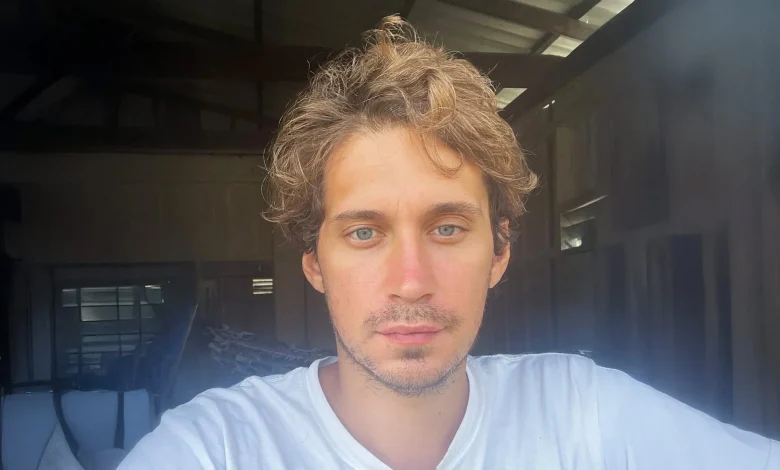
Earlier this year, in the heavily saturated world of commentary about the Israeli-Palestinian conflict, a new name started to appear everywhere, though it seemed to come out of nowhere: Adam Louis-Klein, an anthropology Ph.D. student at McGill University. Until this past spring, he had hardly said anything about Israel publicly. He was too busy studying a remote Amazonian tribe.
But then Louis-Klein, 32, built a platform and started writing — first on Facebook and X; then in Times of Israel blog posts; on podcasts, including one from the American Jewish Committee, and a show hosted by the Israeli journalist Haviv Rettig Gur; and in articles published in The Free Press and Tablet.
Anywhere he could, Louis-Klein was making the bold claim that American Jews need to stop arguing about when anti-Zionism crosses a line into antisemitism. In fact, he thinks they need to give up on their efforts to convince people that anti-Zionism is an antisemitic movement.
His thesis — the idea he is trying to get out into the world everyday, alternating between attention-catching social media graphics designed to go viral and lengthy posts using the dense academic jargon of anthropology — is that anti-Zionism should be considered a hate movement, something that is worthy of condemnation on its own, regardless of whether it is deemed antisemitic or not.
“When someone’s marked as a Zionist, anti-Zionists treat those Zionists differently. They treat them in unequal ways. They advocate for violence, or they advocate for discriminating or boycotting them, or excluding them or purging them. Anti-Zionists stigmatize Zionists. They spread libels about Zionists. They call Zionists slurs,” Louis-Klein told Jewish Insider in an interview last week. “It’s its own way of discriminating, and it’s hiding in plain sight. It’s there for everyone to see.”
The perpetual fighting over whether anti-Zionism should be considered antisemitism misses the point, Louis-Klein said — and it might actually make things worse for Jews.
“You’re going to get this continual problem across the line of turning it into some endless debate over ‘is it really antisemitic or not?’” Louis-Klein stated. “This is something that fuels anti-Zionists, because they can tell the Jewish community is not clear and is not setting a clear boundary against anti-Zionism, and is saying, ‘Well, anti-Zionism may be legitimate,’ and so that’s leaving an open space.”
Louis-Klein is the last person who expected that he would be contributing to the highly contentious public discourse surrounding Zionism.
As a Jewish anthropology student, he chose to focus his studies on a tiny Amazonian tribe in the Colombian rainforest. He devoted his research to understanding the Desana people and their relationship to Christian missionaries. It was work that occasionally involved Jews, insofar as Jews, of course, appear in the Bible. Otherwise, though, Judaism did not factor heavily in Louis-Klein’s academic research — and Israel even less so.
The Jewish state was a topic to be avoided if you were a budding anthropologist with an eye toward a successful career in academia, and Louis-Klein was quickly progressing down that path. He earned a bachelor’s degree at Yale and master’s degrees at The New School and the University of Chicago before enrolling at McGill.
He had visited Israel with his family when he was in college, but later drifted away from feeling connected to the country when he became a self-described “radical leftist” after graduating. But Louis-Klein didn’t entirely abandon Israel. And when he walked out of the Amazon on Oct. 9, 2023, after three months living with the Desana tribe, he quickly discovered that the world had changed two days earlier, when Hamas attacked Israel.
“Am Yisrael Chai,” Louis-Klein wrote on social media, unknowingly drawing a line that split his life as an academic into a before and after. His peers were shocked that he was not using the opportunity to distance himself from Israel.
“I’d never witnessed anything like this in my life. Just the way in which people were talking to me was something I’d never seen before. The aggression, the hostility, the gaslighting from people I thought were my friends,” Louis-Klein said. “I was removed from WhatsApp groups. I was bullied, people just being like, ‘Shut up, you’re white,’ kind of thing. I mean, it’s not a story that’s uncommon. now. There are so many Jewish students at universities who’ve experienced this.”
What came next for Louis-Klein was a newfound connection to his Jewish identity and to Israel. But the identity crisis also brought about an intellectual shift, too, one in which Louis-Klein decided that he could use his academic background to investigate the roots of the hatred he was experiencing. His dissertation is now more of a comparative project, looking at both the Desana people and the Jewish people. He has already experienced pushback from colleagues.
“The reaction is obviously extremely negative, and I don’t have any expectations of being able to have an official career within anthropology, but so far, I expect to be able to complete my dissertation,” Louis-Klein said. “Trying to make Jewishness visible, trying to make the experience of antisemitism or anti-Jewish oppression and discrimination visible, was perceived as violent and aggressive to others.”
Louis-Klein founded an organization this fall called Movement Against Anti-Zionism to put forth a more organized push for his message that a stronger campaign against anti-Zionism is needed to make life better for American Jews.
Alongside more than 1,000 health-care professionals, the organization signed onto an open letter last week decrying the reach of anti-Zionist ideology in the medical field. Louis-Klein told JI he wants to see legacy Jewish organizations like the Anti-Defamation League “launch a full-scale campaign against anti-Zionism.”
“Educate about anti-Zionist libels as their own libels and tropes. They are the ‘colonizer,’ ‘apartheid’ and ‘genocide’ libels. They’re used to stigmatize and attack Jews who are marked as Zionists,” he explained. His social media accounts attempt to make these points in the snappy, bright graphics that are now the touchstone of social media activism.
“Antizionism is a hate movement,” one faded pink image says, meant to be liked and shared for an audience that will scroll past it in no more than a second or two.
“If someone is an anti-Israeli racist, let’s put it this way: they hate Israelis for their national identity. That’s clearly a bigotry. And if someone else says, ‘Well, they don’t hate all Jews, it’s not antisemitic.’ … That’s basically a way of legitimizing anti-Israeli racism,” Louis-Klein explained. “The need to prove that something is antisemitic [in order] to prove that it’s bad is a way of legitimizing a bunch of racism.”
Even with a ceasefire in effect in Gaza, Louis-Klein does not anticipate university campuses to go back to business as usual from before Oct. 7.
“What we can do is recognize the historical moment we’re living in and recognize that the only way out is through, so to speak,” he said. “We have to talk about anti-Zionism.”