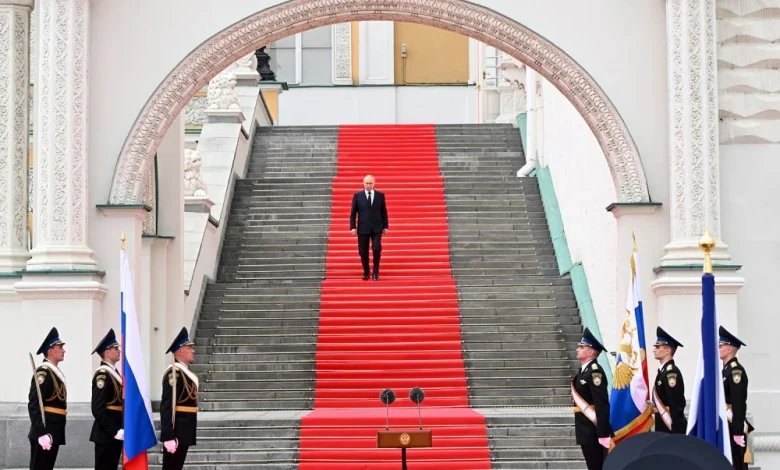
For a guy who’s lost hundreds of thousands of soldiers and barely moved his front lines forward in a war that’s already lasted longer than U.S. involvement in World War II, Vladimir Putin is looking pretty smug and self-satisfied these days.
It has become commonplace for Western strategists to say that, no matter what he tries now, the Russian dictator will come out of his Ukraine adventure a loser. In nearly four years of horrific bloodshed, Putin has captured barely 20 percent of Ukrainian territory and failed completely in his goal of denying Ukrainians the right to statehood. Meanwhile, NATO has grown, bulking up its defenses and adding Finland and Sweden to its formidable front line.
But seen from another perspective, Putin has good cause to look so confident: He appears to be succeeding in his larger goal of dividing and weakening what is loosely called the “West”—the nations that make up NATO. And this is a large part of what the Russian dictator has been trying to achieve in the first place, many Russia watchers say.
Nothing has made that clearer than the debacle of the last few weeks as negotiations orchestrated by U.S. President Donald Trump dissolved into a cacophony of confused finger-pointing across the Atlantic, with Americans and Europeans offering up wildly incompatible peace proposals and angrily blaming each other for undermining the talks.
In recent days that gulf has grown dramatically wider, with Trump dismissing Western Europe as “weak” and “decaying” in an interview and suggesting, yet again, that Ukraine would have to cede its Donbas region to the aggressor, Putin.
Those remarks appeared to echo the administration’s just-released National Security Strategy, in which the Trump administration suggested Europe was in danger of losing its “Western identity” and said the president’s emphasis now is to “reestablish strategic stability with Russia.”
For Putin, all this amounts to an early Christmas present—a very big one. “This was Putin’s motivation from the get-go with the invasion: He thought NATO wouldn’t hold together,” said Bruce Jentleson of Duke University, a former senior foreign-policy advisor to the State Department.
“The Biden administration and key European leaders get credit for countering this, and for NATO expanding to Sweden and Finland. Now with Trump as enabler, Putin has another and even better chance to divide the West.”
U.S. President Donald Trump, right, greets Putin as he arrives in Anchorage, Alaska.
U.S. President Donald Trump, right, greets Putin as he arrives in Anchorage, Alaska, on Aug. 15.Andrew Harnik/Getty Images
Perhaps what’s most striking is that after nearly four years of war—actually more than 10 years, if one includes Putin’s 2014 annexation of Crimea and stealthy takeover of Russian-speaking parts of Ukraine’s Donbas region—far more unanimity of opinion exists on the Russian side in support of the invasion than on the Western side against it.
Since Trump’s election, there’s been increasingly rancorous disagreement not only between the United States and Europeans but within the Trump administration and the Republican Party itself about how to resolve the war. Not so in Russia, where surveys consistently show support for the war among Russians has remained fairly stable at 70 percent to 80 percent, even though there remains a lot of disagreement about specific war aims, according to Maria Snegovaya, a Russia scholar at the Center for Strategic and International Studies.
Snegovaya said politicians and policymakers in Washington and Western Europe are deceiving themselves that the Russian public is beginning to tire of the war.
“Four years into the war we don’t see major anti-war protests, even in the Russian diaspora abroad,” she said. Citing a wide variety of polls taken in the last several years, she added that while a majority of Russians polled don’t fully buy the Kremlin’s official reasons for the war, such as “denazifying” Ukraine—by which the Kremlin means regime change in Kyiv—younger Russians as well as the older, more conservative generation remain “unusually united” in blaming the West for provoking Putin into war.
Though Putin is an autocrat who brutally suppresses dissent, these polls can’t be dismissed. Contrary to Western perceptions, Putin does ensure that his autocracy is supported in regular public opinion surveys, said Thomas Graham of the Council on Foreign Relations, a former senior director for Russia on President George W. Bush’s National Security Council. “For a person that theoretically doesn’t have to worry about public opinion, the Kremlin does a hell of a lot of surveying. They’re really worried about what people might do if dissatisfied. They keep their pulse.”
What lies behind this support of the war? “For many Russians, to lose Ukraine completely would be almost like what losing a part of the American Southwest would be for Americans,” said Peter Eltsov, a Russia expert at National Defense University, who noted that even esteemed intellectuals such as Nobel Prize-winning author Aleksandr Solzhenitsyn have endorsed Putin’s claims on Ukraine. A great many Russians agree with Putin’s 2021 statement that “Russians and Ukrainians were one people—a single whole” and his characterization of “Kievan Rus”—the kingdom ruled more than a thousand years ago by Vladimir the Great in present-day Kyiv—as “the cradle of Russian civilization.”
People take part in a funeral ceremony to bury the remains of service members of the Russian Armed Forces in Luhansk, in Russian-controlled Ukraine.
People take part in a funeral ceremony to bury the remains of service members of the Russian Armed Forces in Luhansk, in Russian-controlled Ukraine, on May 18, 2023.Alexander Ermochenko/Reuters
Moreover, Russian casualties in the war have had less impact on public opinion than expected because of Putin’s policy of relying heavily on volunteers and mercenaries (often those with criminal records or no prospects). Nor have Western sanctions deterred Moscow as much as hoped; even with the recent imposition of sanctions on Russian producers Lukoil and Rosneft, countries such as China and India are still purchasing substantial amounts of Russian oil and gas, in part by using tankers with altered IDs and intermediaries, though they’ve cut back..
“The economic situation in Russia is worsening, but recession doesn’t equal crisis,” Snegovaya said. “Unfortunately, it’s sustainable for them so far.” To emphasize his international leverage, Putin flew to India shortly after meeting with Trump envoys Steve Witkoff and Jared Kushner last week and struck a series of economic and military deals with its prime minister, Narendra Modi.
Bottom line: In the West, almost nobody seems to be on the same page any longer; in Russia, most people still appear to be. And conditions on the ground, including the oncoming winter, favor the Russian military—as opposed to Ukrainian President Volodymyr Zelensky’s manpower- and munitions-strapped forces, which suffer from regular power outages, according to many military assessments.
Read More
-
An illustration shows the large face of Vladimir Putin. A red wedge cuts across one of his eyes. Inside the wedge is a walking Donald Trump giving the thumbs up sign.An illustration shows the large face of Vladimir Putin. A red wedge cuts across one of his eyes. Inside the wedge is a walking Donald Trump giving the thumbs up sign.
The Enduring Mystery of Trump’s Relationship With Russia
After years of government investigations, we still don’t know if the former president is actually in Putin’s pocket.
-
Marble statues of Socrates seated in thought and a standing Athena atop a tall column, set against a bright blue sky.Marble statues of Socrates seated in thought and a standing Athena atop a tall column, set against a bright blue sky.
What Is ‘the West’?
The idea of a cohesive West is fading, but a new book finds that the concept endures.
-
Joe Biden, in silhouette, walks up stairs to board a plane, with ominous dark clouds in the background.Joe Biden, in silhouette, walks up stairs to board a plane, with ominous dark clouds in the background.
Biden’s Long Shadow Over Ukraine
His administration failed Ukraine at almost every turn, shaping the war to this day.
“I don’t think Putin feels under tremendous pressure to make a compromise that would sacrifice any of what you might consider his vital interests,” Graham said. Indeed, Putin may be much more worried about the reaction from right-wing militarists in the Kremlin if he makes any serious concessions at all.
All these divisions provide a window into a deeper crisis: In the last 10 months since Trump took office, it’s become clear that not only is there no common ground over Ukraine, there may no longer be much of a common West left at all. This relates partly to the meaning of the Ukraine invasion: Europe sees it as an existential threat, while many Trump officials think the U.S. should avoid the war altogether.
But the divide goes way beyond that, extending to the seeming contempt that Trump, Vice President J.D. Vance, and other MAGA-aligned officials have openly expressed for Europe in terms of the continent’s values, which they regard as too liberal and progressive (even as Europe itself is struggling over its own identity). Vance and many in MAGA embrace a Christian nationalism that the European Union has long since left behind. Vance, in particular—who should now be seen as Trump’s heir apparent and is perhaps the administration’s leading Euroskeptic—likes to compare EU officials to Soviet-style “commissars.”
All of this fits into what for Putin has been a long-term goal—what one well-known British Russia scholar, Mark Galeotti, described to me as “a core element in Russian efforts to disrupt the West, to exploit the way a constellation of democracies will constantly generate disagreements and disputes.”
Indeed, in the Trump administration the Russian leader may have created a fifth column of the like he never imagined possible (though perhaps he did, considering how hard Kremlin functionaries worked to get Trump elected in 2024).
So intent is Trump on this new relationship with Moscow that his Defense Department has begun to eliminate Russia as a potential strategic adversary in various war games conducted outside of NATO, according to one Defense Department official.
U.S. Vice President J.D. Vance speaks during the Munich Security Conference.
U.S. Vice President J.D. Vance speaks during the Munich Security Conference on Feb. 14, 2025.Sean Gallup/Getty Images
The deep chasm between the United States and Europe in outlook and policy is reaffirmed in the starkest terms by Trump’s new National Security Strategy, which declares that Europe faces the “prospect of civilizational erasure” in large part because its migration policies have cost it its “Western identity.”
The document appears to delegitimize the entire postwar European project—the decades-long process by which Europe created a common market and currency out of the devastation of World War II—by attacking the EU as just another “sovereignty-sapping” transnational organization. In coded language, the new strategy also seems to echo Vance’s infamous Munich Security Conference address from last February by implicitly endorsing the rise of nationalist, far-right political movements in Europe. Among them are the AfD, or “Alternative for Germany,” and France’s National Rally party, which are supported by Putin as well as Trump (and which have as little enthusiasm for defending Ukraine as Vance does).
While the strategy affirms that “Europe remains strategically and culturally vital to the United States,” it also warns: “Should present trends continue, the continent will be unrecognizable in 20 years or less. As such, it is far from obvious whether certain European countries will have economies and militaries strong enough to remain reliable allies.”
In yet another blow to Ukrainian hopes, the document says that European leaders uniformly “hold unrealistic expectations for the [Ukraine] war perched in unstable minority governments, many of which trample on basic principles of democracy to suppress opposition.” It affirms that Washington will pursue a policy of “[e]nding the perception, and preventing the reality, of NATO as a perpetually expanding alliance.”
For many European diplomats, Trump’s enmity toward them and dithering over Ukraine have turned Washington into a black box that is utterly unreadable. It was only in September that Trump, after slamming Zelensky earlier in the year for having “no cards,” reversed himself and wrote that Ukraine was now “in a position to fight and win all of Ukraine back in its original form.” Trump even finally began applying secondary sanctions that might hurt Russia’s economic lifeline—its oil and gas exports.
Then, abruptly, Trump appeared to reverse himself yet again in mid-November with Witkoff and Kushner’s 28-point plan, which many Europeans and even Trump’s fellow Republicans denounced as little more than Russian talking points. The president insisted Ukraine give up territory to Russia, even what it still controls, by Thanksgiving.
But only days later, after getting serious pushback from Republican hawks on Capitol Hill—one of whom, Rep. Don Bacon, said the Witkoff-Kushner plan sounded like “1938 Munich”—Trump dropped his demand for immediate compliance and sent Secretary of State Marco Rubio to help renegotiate a more Ukraine-friendly scheme.
U.S. Secretary of State Marco Rubio holds a press conference following closed-door talks on a U.S. plan to end the war in Ukraine in Geneva.
U.S. Secretary of State Marco Rubio holds a press conference following closed-door talks on a U.S. plan to end the war in Ukraine in Geneva, on Nov. 23.Fabrice Coffrini/AFP via Getty Images
Even so, in an interview with Politico this week Trump appeared to revert to his demand that the burden is on Ukraine to submit. Russia, he said, has the “upper hand” and Zelensky would have to “play ball” and start “accepting things.” Zelensky, for his part, is refusing to cede any Ukrainian territory to Putin.
The result appears to be another stalemate, with governments on both sides of the Atlantic engaged in what one European diplomat described to me as a “dialogue of the deaf.”
And gingerly, Europe has begun to go its own way—although true strategic autonomy from the U.S., which French President Emmanuel Macron wants, remains far off.
In coming weeks the European Commission is expected to approve some version of a “reparations loan” for Ukraine that would involve unlocking more than $246 billion in Russian Central Bank assets (though Belgium, which holds a majority of the assets, is still resisting the move). And in a dramatic break from its post-World War II pacifism, Germany has amended its constitution to authorize unlimited government borrowing for defense; Germany now is permanently stationing troops beyond its borders and openly plans to build the most powerful military in Western Europe.
“For the Germans, this time is different. There is a great sense of betrayal,” said Jeremy Shapiro, research director of the European Council on Foreign Relations, who just returned from a fact-finding trip to Germany. Shapiro said government officials in Berlin talk about a definitive break with Washington coming from Trump’s Ukraine peace plan.
“The last reversal on Ukraine revealed that what Trump was doing was promoting his financial interests and looking for a relationship with Russia above Europe’s head.”
While the Germans and other European countries were appalled by the new National Security Strategy, Kremlin spokesperson Dmitry Peskov called it “encouraging” and said Moscow was happy that Trump had dropped the previous characterization of Russia under former President Joe Biden as a major “threat” to the United States.
Not surprisingly, nearly half of Europeans consider Trump to be “an enemy of Europe,” according to a recent poll by Cluster 17, a French survey institute..
Asked to comment on these shifts and the National Security Strategy, a Trump administration spokesperson said only that “the United States has made tremendous progress toward a peace deal by bringing both Ukraine and Russia to the table.”
U.S. citizens living in France hold up a banner during a protest against Trump in Paris.
U.S. citizens living in France hold up a banner during a protest against Trump in Paris on Jan. 18.Dimitar Dilkoff/AFP via Getty Images
It should be noted, of course, that major U.S.-Europe tensions are hardly new. Nor is the question of how Russia plays into the picture.
But in the past, the threat from Russia has more typically united the West than divided it.
As Georgios Varouxakis writes in his well-received new book, The West: The History an Idea, the concept of a unified “West” has been defined by suspicions about Russia at least since the Congress of Vienna of the early 19th century, which ended the Napoleonic wars.
Tsarist Russia, having just thrown back Napoleon’s Grande Armée, was made part of that 1815 peace—called the Concert of Europe—but the rest of Europe was always wary. By 1843 France’s Marquis de Custine was warning that Moscow planned to conquer the West, and a generation later the English social philosopher Richard Congreve wrote that No. 1 on Europe’s agenda should be “the elimination of Russia from the system” because it “is an Eastern, not a Western power.”
In the 20th century, Western alienation from Russia continued after the 1917 Russian Revolution—interrupted briefly by the World War II alliance—but during the Cold War this notion of Western self-definition in contrast to Russia led again to strong unity for the Western nations. And of course, Washington took the lead when the world divided neatly into East and West blocs.
There was even a spell of new Western unity in the early stages of the Ukraine war, when Biden rallied NATO against Moscow despite his often erratic approach to arming the Ukrainians.
But despite Putin’s horrific depredations and flagrant violation of territorial norms, Trump appears to have no compunction now about making the West look fractured, hollow, and indecisive in the face of Russian support for the war.
“Putin has been trying to break up the EU for many years, and the reelection of Trump must have been the best present he ever hoped for,” Varouxakis, a scholar at Queen Mary University of London, said in an interview. “That Trump’s sense of history is what it is, conspicuous by its total absence, clearly helps Putin.”
Putin, center, and then-Lukoil President Vagit Alekperov, left, listen as U.S. Sen. Chuck Schumer, right, speaks during the opening of Lukoil’s gasoline station in New York City.
Putin, center, and then-Lukoil President Vagit Alekperov, left, listen as U.S. Sen. Chuck Schumer, right, speaks during the opening of Lukoil’s gasoline station in New York City on Sept. 26, 2003.Stephen Chernin/Getty Images
The demise of the West has been wrongly predicted many times before, most famously in Oswald Spengler’s The Decline of the West in the early 20th century and James Burnham’s 1964 philippic, Suicide of the West, which trotted out anti-liberal arguments that sounded very much like Vance’s today. Indeed, American mistrust of Europe dates back to the American Revolution and has erupted repeatedly since World War II—most recently when the Iraq invasion of 2003 left the two sides of the Atlantic far apart.
But it can’t be denied that something new is happening here, both in the kinds of goals Putin is pursuing and in the Trumpers’ response to them.
Early in his more than two-decade-long tenure, shortly after the Cold War ended, Putin appeared eager to partner with the United States and cooperate with the EU and NATO. But as NATO continued to advance eastward and post-Soviet Russia’s economy went into a prolonged tailspin—in part thanks to a lot of bad Western advice earlier about “shock therapy”—the Kremlin began to embrace the old Russian imperialist view.
Putin has since repeatedly condemned what he calls the West’s “anti-Russia project.” Reading his speeches, it’s clear his perceived humiliations go back a long way—not just to the decades since the Cold War ended but all the way back to those European rebuffs to tsarist Russia in the 18th and 19th centuries. After the Russian leader annexed Crimea in 2014, the Kremlin’s then- ideologist, Vladislav Surkov, wrote that the move would mark “the end of Russia’s epic journey to the West, the cessation of repeated and fruitless attempts to become a part of Western civilization.”
Today, Putin and the many right-leaning Russian officials and elites who support him suggest that their main adversary is the postwar “liberal international system” of the West. And now, in Trump, the Russian president has found an unexpected ally of sorts.
For Trump and his team, too, seem set on destroying this international system.
Again, the new National Security Strategy appears to lay this out fairly clearly. Asserting a “Trump corollary” to the Monroe Doctrine, it focuses on maintaining U.S. dominance in the Western Hemisphere while all but giving up on the postwar global system, saying the U.S. will seek “good relations and peaceful commercial relations with the nations of the world without imposing on them democratic or other social change.”
The strategy touts Trump’s “necessary, welcome correction” to the mistakes made by U.S. internationalists since World War II. “Our elites badly miscalculated America’s willingness to shoulder forever global burdens to which the American people saw no connection to the national interest,” the document says. “And they lashed American policy to a network of international institutions” as well as “hugely misguided and destructive bets on globalism.”
According to Rebecca Lissner, a former senior aide to Biden and Vice President Kamala Harris, the document should be seen “as the first MAGA National Security Strategy, and a preview of what America as an illiberal superpower could mean for Europe and the world.”
And all these changes, Kremlin spokesperson Peskov said on Sunday, “are largely consistent with our vision.”
Taken together, the convergence of these factors may well mean that Vladimir Putin has already won.