Letters to the editor: ‘Michael Ma isn’t the first MP to be disappointed by the Conservative leadership, and he likely won’t be the last.’ Letters to the editor for Dec. 15

Open this photo in gallery:
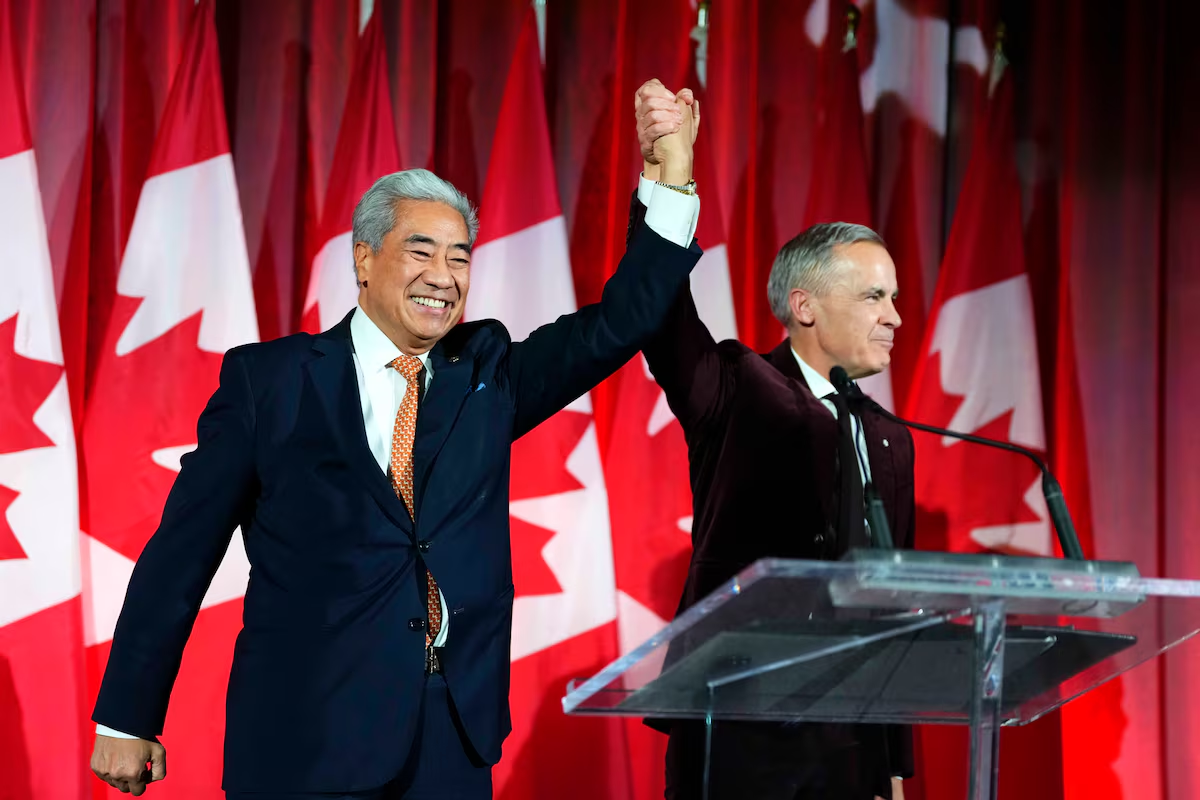
Prime Minister Mark Carney raises the hand of Michael Ma, Member of Parliament for Markham-Unionville, who crossed the floor from the Conservatives to the Liberals on Dec. 11.Justin Tang/The Canadian Press
Hello from the other side
Re “Ontario MP Michael Ma crosses floor to Liberals, putting party one seat short of majority” (Dec. 12): Mark Carney is a right-of-centre leader. If any right-of-centre MPs are dissatisfied with the populist Conservative Leader, they will likely be attracted to Mr. Carney’s government.
Michael Ma isn’t the first MP to be disappointed by the Conservative leadership, and he likely won’t be the last. The party has to do some soul-searching about a leadership change before it’s too late.
A week in politics can be a long time, but with a weak leader it can seem like an eternity.
Douglas Cornish Ottawa
Michael Ma’s decision to reportedly spend an evening commiserating and celebrating with his Conservative caucus colleagues at their holiday party, only to cross the parliamentary floor the next day and join the Liberals, is the kind of conduct I expect from someone lacking a moral compass.
Actions like his are why so many people have lost trust in politicians. He should resign and cover the cost of a by-election.
His constituents deserve far better. Shame on him.
Peter Rozanec Toronto
Known unknowns
Re “Something is wrong with Canadian democracy” (Dec. 10): To borrow from columnist Andrew Coyne’s insightful analysis in his recent book The Crisis of Canadian Democracy, these authoritarian-like problems of massive omnibus bills, Henry VIII powers that allow ministers to override legislation and the trampling on Charter rights would be checked in a functional democracy with effective accountability measures within the legislature.
The judicial branch is increasingly asked to rule on matters that, not so long ago, would likely have been dismissed as non-justiciable. The swift rise of authoritarian impulses within the executive branch of governments in Canada means that courts have quickly become the last stand for democracy in this country.
This is uncharted legal terrain for us. All bets are off on what comes next.
Shaun Fluker Professor of law, University of Calgary
By the book
Re “Trump’s National Security Strategy is more of a MAGA rant than foreign-policy playbook” (Dec. 11): When someone tells us who they are, believe them.
During the 2024 election campaign, a huge number of Americans thought Donald Trump was just bloviating. They dismissed the Project 2025 plan, now being implemented in full force, as being not his real intentions and a document not to be taken seriously.
The Trump administration has already been interfering in European politics, seems on the verge of an invasion of Venezuela and is engaged in a trade war to bring Canada to heel. The policy statement terrifies me.
James Astley Ottawa
The 2025 U.S. National Security Strategy has shaken up Europe to the realization that it is alone, and the United States under the Trump administration is no longer a reliable partner in confronting Russia.
European Union foreign policy chief Kaja Kallas warns that if Vladimir Putin gets what he wants in a peace deal to end the war in Ukraine, it is rewarding aggression that brings more war, not less. Keir Starmer and German foreign minister Johann Wadephul warn that effort in Europe must be put toward readiness for the next Russian aggression.
But there are also European leaders who do not agree, like some on the radical far right. The threat to Europe may not be just Russia, but inertia and internal divisions within the continent.
Reiner Jaakson Oakville, Ont.
What goes around
Re “Canadian fertilizer industry in crosshairs of Trump administration’s price-fixing probe” (Report on Business, Dec. 10): A tariff is just another name for a tax.
We have the classic zero-sum game here: Donald Trump applies tariffs to imports such as potash, raising prices; American farmers pay increased costs for fertilizer; Mr. Trump then uses tariff revenue to distribute “aid” to farmers who provided this revenue in the first place. If Democrats had introduced such a program such, Republicans would be outraged at the lunacy of collecting money simply to give it back again.
Mr. Trump says he wants to develop the U.S. potash industry. What U.S. potash industry?
Saskatchewan is the largest potash producer in the world, the largest exporter and offers the lowest cost product. U.S. resources are minuscule in comparison, and their product would be much more expensive than Saskatchewan potash.
The ultimate losers in this ill-informed venture would be American farmers.
Roy Schneider Regina
Your move
Re “Eby accuses courts of jeopardizing B.C. economy, resource projects” (Dec. 11): David Eby moves to the front of the line of premiers attacking the judiciary. He echoes Danielle Smith’s view that constitutional disputes should not be resolved by our courts.
The courts only consider those matters brought to them by plaintiffs, often governments themselves. Who else should decide? Governments cannot be both judge and jury when the issue concerns their own actions.
Mr. Eby feels aggrieved that a plaintiff challenged his government’s legislation that incorporated the United Nations Declaration on the Rights of Indigenous Peoples. The courts didn’t insert UNDRIP, the government did. The court simply affirmed the law as intended by the government.
Mr. Eby and his government just got hoist with their own petard. The premier can prevent future challenges by doing what is within his jurisdiction: To wit, amend legislation and remove the UNDRIP requirements he once championed.
Greg Schmidt Calgary
David Eby expresses frustration with legal interpretations creating risks to the Canadian economy – yet perhaps the courts are struggling with impractical idealisms of government.
The United Nations Declaration on the Rights of Indigenous Peoples is a non-binding declaration that was not formulated as a blueprint for solutions in any particular country. Incorporating it into legislation, as British Columbia did, may not have been sensible.
This doesn’t mean ignoring history. Clearly Indigenous people have had diminished access to the well-being that Canada can offer, and their nations were drawn into Canada without their explicit consent.
Our Constitution recognizes there are duties owed to them, but perhaps we should consider that building from the foundation of a strong, democratic, inclusive country with reliable laws is the better path to our collective well-being.
Perhaps our idealism should focus less on undoing history and more on a collective path forward that overcomes our history.
David Clarry Toronto
Straight talk
Re “Fight or flight: How to quell air rage before it takes off” (Dec. 10): Regarding the advice to “check behind you before reclining your seat,” seats in cattle class should be welded such that they cannot move. When reclined, the sardine behind can barely read a book or newspaper.
Craig Sims Kingston, Ont.
Letters to the Editor should be exclusive to The Globe and Mail. Include your name, address and daytime phone number. Keep letters to 150 words or fewer. Letters may be edited for length and clarity. To submit a letter by e-mail, click here: letters@globeandmail.com