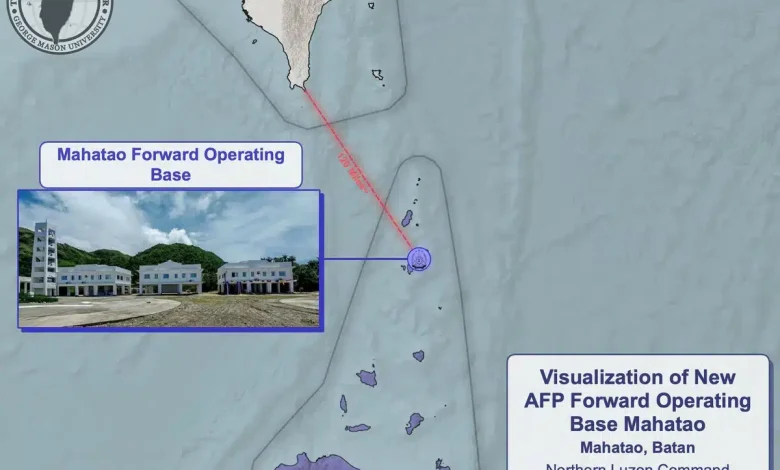
Philippine and American military officers surveyed Manila’s newest base in the Luzon Strait last week for joint defense operations between the two allies in the country’s northern territories near Taiwan.
The commander of Northern Luzon Command (NOLCOM) led a joint Philippine-American delegation of military officers, including the U.S. Air Force Attaché to the Philippines, in a comprehensive site and survey inspection of the recently opened Mahatao forward operating base on Batan Island, Batanes.
According to a NOLCOM release, the joint team “assessed the location’s operational terrain, infrastructure conditions, and strategic viability in support of future joint and interoperable defense activities.”
The Armed Forces of the Philippines described the base as “a platform for territorial defense, maritime domain awareness, and humanitarian assistance and disaster response operations” during its activation ceremony in August.
Analysis of the Mahatao forward operating base from released photos and satellite photos indicate that the facilities could support an increased troop complement in Batanes, which currently hosts a small complement of Philippine security, Coast Guard and Marine units, as well as command and control facilities that can further enhance the island’s maritime domain awareness operations.
A nearby boat ramp has the potential to also support the launch of unmanned surface vessels and Marine Corps patrol coastal watercraft, similar to those currently being utilized by the Philippine Navy in the South China Sea.
American special operations forces were previously seen earlier this year delivering rubber boats to the local Philippine Coast Guard station via Combatant Craft Mediums, a specialized craft with an operational range of 600 nautical miles used by Navy SEALs to insert into contested environments.
U.S. Marines with 3d Littoral Combat Team, 3d Marine Littoral Regiment, 3d Marine Division, and Philippine Marines with Marine Battalion Landing Team 10, conduct bilateral training with a new commercial radar system while participating in the Maritime Key Terrain Security Operations event during Exercise Balikatan 25 on an island in the Batanes in the Luzon Strait. (U.S. Marine Corps photo by Cpl. Malia Sparks)
Located 120 miles south of Taiwan, Mahatao’s location in the Luzon Strait is one of Manila’s largest defense investments in the Province of Batanes to date. Since the deployment of a Marine brigade to the region in 2022, the Philippines has increased troop deployments, military exercises and American access to the strategic island chain.
These increased defense activities came as the Marcos administration raised concerns over the country’s potential involvement in a Chinese invasion of Taiwan, citing the likelihood of the conflict’s spillover to Northern Luzon and the repatriation of Philippine nationals from the island. In April, Philippine military chief Gen. Romeo Brawner told NOLCOM to prepare for operations in the event of a potential Chinese invasion of Taiwan.
Earlier this year, U.S. Marine Corps Naval Strike Missiles touched down on Batan during Balikatan 2025 in a first-ever show of American maritime strike capabilities in the Luzon Strait. From its deployment on Batan, as well as other islands in Batanes, the American anti-ship missiles could threaten vessels transiting out of the first island chain from the southern tip of Taiwan to the northern edges of Luzon.
Previous defense drills have also practiced the airlifting of troops and deployment of High Mobility Rocket Artillery Systems to the islands.
The Strategic Significance of the Luzon Strait
U.S. Marines with 3d Littoral Combat Team, 3d Marine Littoral Regiment conduct a notional fire mission with the Navy-Marine Expeditionary Ship Interdiction System during the Maritime Key Terrain Security Operation as a part of Exercise KAMANDAG 9 in the Philippines. (U.S. Marine Corps photo by Cpl. Malia Sparks)
While Washington and Manila stress that these drills prioritize the defense of Philippine territories and waters, the implications of an enhanced defense posture in Batanes has the potential to complicate any of Beijing’s military actions against Taipei.
A recent Reuters report highlighted the concerns of Philippine defense leadership regarding potential Chinese actions against the country’s northern territories in the event of a cross strait conflict, with a former Armed Forces of the Philippines Chief of Staff claiming that “the invasion of Taiwan is almost impossible if you don’t control the northern Philippines.”
Jaime Ocon, a Research Fellow with Taiwan Security Monitor, explained to Naval News that with the People’s Liberation Army Navy heavily relied on the Bashi Channel in the Luzon Strait to project power into the Western Pacific, any build-up that could deny the waters would severely complicate Chinese planning.
“If the United States were to expand its military presence here, let’s say by building additional ports and runways, that could really complicate potential Taiwan contingency operations for China. Of course, there are other political considerations when using these bases, but what we know with great certainty is that closing off this waterway is critical for China’s A2/AD doctrine,” said Ocon. “They don’t want the United States to have the ability to respond and want to close off this entry point.”
Ocon highlighted that increased U.S. access to the region would likely support improved intelligence, surveillance and reconnaissance operations, which in turn could benefit the operational deployment of joint anti-shipping and long-range strike capabilities.
The Philippine Marine Corps plans to station one of its three Brahmos shore-based anti-ship missile batteries within NOLCOM’s area of operations. Meanwhile, Washington has stepped up the deployment of long-range precision strike systems across the Philippines during numerous drills.
“For now, I think it directly affects a Taiwan contingency by demonstrating to Beijing that the U.S. has an increasing Forward presence, continues to signal that any attack would trigger a wider coalition response, and thereby increases China’s political and military uncertainty,” said Ocon.