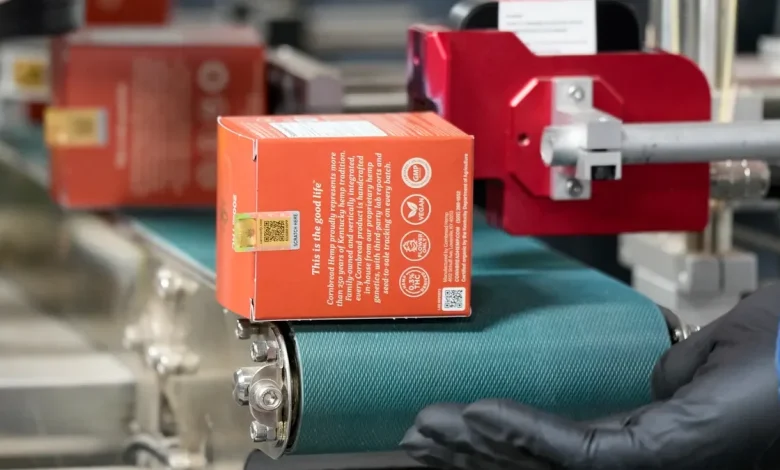
‘Hemp and cannabis is Kentucky’s agricultural future’ says Cornbread Hemp co-founder
Kentucky was once America’s largest hemp producers. Is hemp and cannabis the future cash crop for Kentucky agriculture?
Matt Stone/Courier Journal
- A federal bill signed by President Trump will ban many hemp-based products starting in 2026.
- Despite the looming ban, Louisville-based Cornbread Hemp opened a new retail and tourism facility.
- Sen. Rand Paul opposes the ban and is working on new legislation to make hemp a states’ rights issue.
- The new regulations limit THC in hemp products and ban synthetic hemp like delta-8.
Despite President Donald Trump signing a bill on Nov. 12 that will lead to a federal ban on many hemp-based products as soon as 2026, Cornbread Hemp is moving forward with the grand opening of its new retail and tourism facility in Louisville.
“This is an example of what hundreds of farmers and entrepreneurs have done across the country, putting millions of dollars in investment into communities and into facilities that provide jobs, provide manufacturing and provide products that help people feel better,” Cornbread Hemp co-founder Eric Zipperle said at the facility’s grand opening Dec. 15. “That is what is at risk right now with the language that has been inserted into the government shutdown bill.”
Cornbread Hemp co-founders Jim Higdon and Zipperle were joined by Kentucky Sen. Rand Paul for the facility’s grand opening. Paul has been an advocate for the hemp industry and was a staunch opponent of the language in the government shutdown bill that now leaves hemp businesses in limbo.
For the next 322 days until the ban goes into effect, Cornbread Hemp, Paul and other hemp businesses are in a fight to save the industry.
“To have a crop outside of soybean and corn would be good for our state and then all the ancillary businesses making the products,” Paul said at the grand opening. “This is a great success, and I don’t want government to stifle this.”
Why is hemp getting banned?
The language of the Nov. 12 government shutdown bill, which Kentucky Sen. Mitch McConnell backed, makes several nationwide changes to hemp regulations, including limiting THC in hemp products to 0.4 milligrams, defining “industrial hemp” to clarify it applies to industrial applications or research, and banning synthetic hemp products such as delta-8.
While McConnell has said the language won’t create a total ban on hemp, Higdon argues that all the products his $50 million Kentucky-based company makes, including oils, topicals and gummies containing CBD, a nonintoxicating chemical found in hemp, a type of cannabis plant, as well as gummies and seltzers that are infused with trace amounts of THC derived from hemp, will be banned — which could lead to the demise of a company once dubbed the fastest-growing hemp company in America on the 2024 Inc. 5000 list.
In a Nov. 10 speech, McConnell said, “Unfortunately, companies have exploited a loophole in the 2018 legislation by taking legal amounts of THC from hemp and turning it into intoxicating substances and then marketing it to children in candy-like packaging and selling it in easily accessible places like gas stations and convenience stores across our country. So, children end up being the unknowingly consumers of these poisonous products and being sent to the hospital at an alarming rate… Industrial hemp and CBD will remain legal for industrial applications — such as seed, stock, fiber, grain oil — or used in drug trials. This language merely clarifies the original intent of the 2018 farm bill, rooting out the bad actors and protecting the growing hemp industry. While some may masquerade as advocates for hemp farmers, even sometimes threatening to hold up government funding over this issue, I will continue my work on behalf of Kentucky farmers while protecting our children in the Commonwealth and across the country.”
Higdon and Paul noted that Kentucky already has strict regulations regarding both age to purchase and packaging requirements. In 2022, Gov. Andy Beshear signed an executive order that regulated the packaging and labeling of hemp products and then in 2023 he signed a bill that made it illegal for people under the age of 21 to purchase these products.
Paul notes the “idiocy of this bill” crafted by McConnell, which fundamentally redefined the plant and now causes non-edible purposes for hemp like flooring or clothing to face regulations for THC as well as companies like Cornbread Hemp — which could ultimately tank the entire industry, from farming to production, if not reversed.
“Their opinion is they don’t want any of this. They don’t they don’t want any legalized hemp industry,” Paul said of McConnell and his staff. “They thought it all was going to be hemp clothing and hemp woods. That is part of it. But that’s about 2% of the hemp business, 98% of it is probably the edible business.”
Paul, a Libertarian-leaning politician, believes hemp products should be allowed to exist and the regulations should largely come down to states and points to Kentucky as a prime example of a state that had strong regulations of hemp products, including ensuring children can’t buy them — a key issue McConnell pointed to as a legitimate reason to ban hemp.
“I think you ought to have the right to choose how you seek to fix your problems,” Paul said of adults who use hemp products for things like sleep, anxiety or relaxation. “People take pharmaceuticals. They take Ambien. Is there any reason why they couldn’t take a hemp product at night? It really ought to be your business. Adults should be able to make these decisions.”
Paul said he is currently working alongside other elected officials in Washington, D.C. to present new legislation that would largely make hemp a states’ rights issue. While Paul is hopeful the legislation can come to fruition, the senator acknowledges it won’t be without challenge, noting he’ll need to convince members of his party to change their stance on hemp, discuss how interstate commerce of the products would work, and set a floor for THC levels in products, which right now is hovering around a proposed five milligrams per serving.
Paul also said he would support a one-year extension for the industry before the ban goes into effect as well, which would offer Congress more time to provide regulations, and Higdon signaled support for this proposal.
“It got caught up in the closing of government,” Paul said of the bill’s passage. “I had many people come up to me and said they were open to it afterward … amendments don’t win very often on the floor, but I think we have the nucleus of a group, and I think we can do better.”
What’s next for Cornbread Hemp?
In January, the company which started in 2018, shared plans to usher in a new age of hemp business in the commonwealth by opening a 25,000 square foot facility in Louisville. The plan was to create an experience similar to bourbon distillery tours, but for hemp.
In late November, Cornbread Hemp officially opened a retail shop and launched facility tours at 4612 Schuff Ave., which takes visitors behind-the-scenes to see the gummy making process.
The tours shows off the certified organic hemp the company uses and take visitors through the entire production process, from raw plant material to ready to distribute products, all of which are third party lab tested to ensure products are safe for consumption
Higdon and Zipperle ultimately decided to move forward with the grand opening despite the looming federal ban because they know consumer demand for the products exists and believe their products truly benefit people’s lives. Cornbread Hemp produced 660,000 gummies per day and 93% of all products are shipped to customers outside of Kentucky.
Paul said “big business” like Cornbread Hemp is “good for Louisville,” noting the company employs more than 100 workers and has invested into manufacturing and Kentucky farms.
Cornbread Hemp has already seen a spike in orders as customers gear up for products to possibly disappear in the future, if there is no federal reversal, Higdon previously told The Courier Journal.
“Right now, everyone’s job is secure,” Higdon said. “In the short term, we’re not scaling back anything.”
For now, Cornbread Hemp plans to continue making its USDA certified organic products, welcoming people into its new home and advocating in Washington D.C. for hemp to remain legal.
“I don’t ask you whether you drink bourbon at home, or whether you should be allowed to,” Paul said. “I think these are personal choices.”
This story has been updated with a comment from Sen. Mitch McConnell.
Reporter Lucas Aulbach contributed to this report. Contact business reporter Olivia Evans at oevans@courier-journal.com or on X, the platform formerly known as Twitter at @oliviamevans_.
Take a tour of Cornbread Hemp in Louisville
WHAT: See behind the scenes of how Cornbread Hemp makes its various gummies and products.
WHERE: 4612 Schuff Ave.
WHEN: Tours run Monday to Saturday at 11 a.m., 1 p.m. and 3 p.m. and last roughly one hour. Tickets are $19.99. For those looking for a more in-depth experience, VIP tours can be purchased for $59.99 and are offered Monday to Friday at 9 a.m. and 4 p.m. and last roughly 90 minutes.
MORE INFORMATION: cornbreadhemp.com