News
Artist Catherine Telford Keogh is the inaugural winner of the Jack Galef Visual Arts Award.
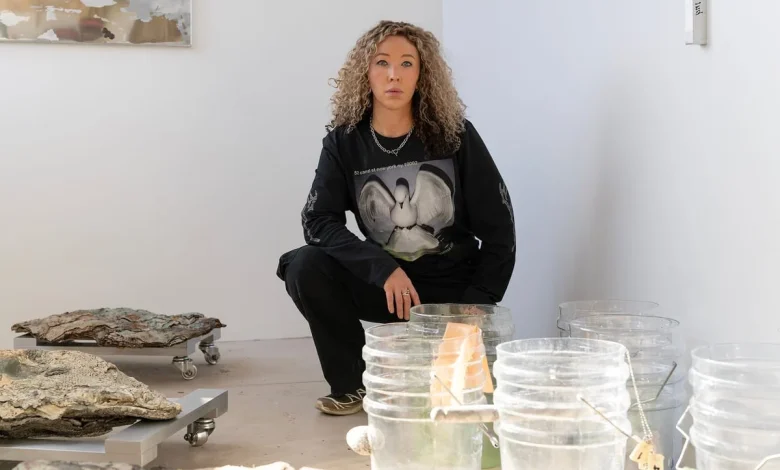
Catherine Telford Keogh (image courtesy the artist)
New York City-based artist Catherine Telford Keogh has been selected as the recipient of the Guggenheim Museum’s inaugural Jack Galef Visual Arts Award. The $50,000 prize is set to be awarded biennially to support and celebrate “artists of exceptional talent whose work demonstrates innovation, depth, and vision.”
Through a gift from the Jack Galef Estate, the award comes three years after the Guggenheim officially pulled the plug on the Hugo Boss Prize, a no-strings-attached $100,000 award for artists across all media that was distributed biennially between 1996 and 2020. In a press statement, Guggenheim Director and CEO said that Telford Keogh “exemplifies the originality and depth this award seeks to champion.”
Telford Keough, who was selected from a juried panel comprised of the museum’s curatorial department, has cultivated a research- and process-driven practice that analyzes assignments of value and waste, as well as behaviors of consumption and persistence, among other concepts tied to biological and commoditized lifecycles. Now based in Brooklyn, the artist was born in Toronto and pursued studio art and gender studies at the University of Waterloo before earning graduate degrees in Sculpture and Women, Gender, and Sexuality studies at Yale University.
“I’m honored to receive this award, and the timing feels significant,” Telford Keogh told Hyperallergic in an email. In conjunction with her practice, she’s also a faculty member at Parsons School of Design within the New School, which recently doled out sweeping faculty and program cuts amid a multimillion-dollar budget deficit and dwindling enrollment. In a restructuring plan, the New School recently offered nearly 40% of the full-time faculty members and all non-unionized staff early retirement or contract buyouts.
Catherine Telford Keogh, “Carriers (Gravity-Fed)” (2024), at the Museum of Contemporary Art Toronto (image courtesy the artist)
“This recognition arrives at a moment when the conditions for making and teaching feel increasingly precarious,” Telford Keogh continued, noting that New School faculty are navigating bureaucratic measures that “threaten the very interdisciplinarity that defines what we do: the porousness between creative practice and critical inquiry that makes our community generative.”
“So receiving support for my practice right now feels both affirming and clarifying: it reminds me why we fight for institutions that can hold complexity, and why that fight matters,” she said.
Telford Keogh intends to use a portion of the prize to further her research into the metabolic relationship between microbial life and industrial contaminants such as petroleum byproducts and heavy metals within the Gowanus Canal Superfund Site, telling Hyperallergic that the forthcoming project “emerges from similar questions about what gets valued, what gets discarded, and what persists anyway”
“I’m interested in how this metabolism functions as a kind of inscription, these organisms writing their survival into the material substrate,” she explained. “The work isn’t about ‘cleaning up.’ It’s about attending to forms of life that thrive in conditions we’ve written off, and asking which forms of life we deem worthy of attention.”