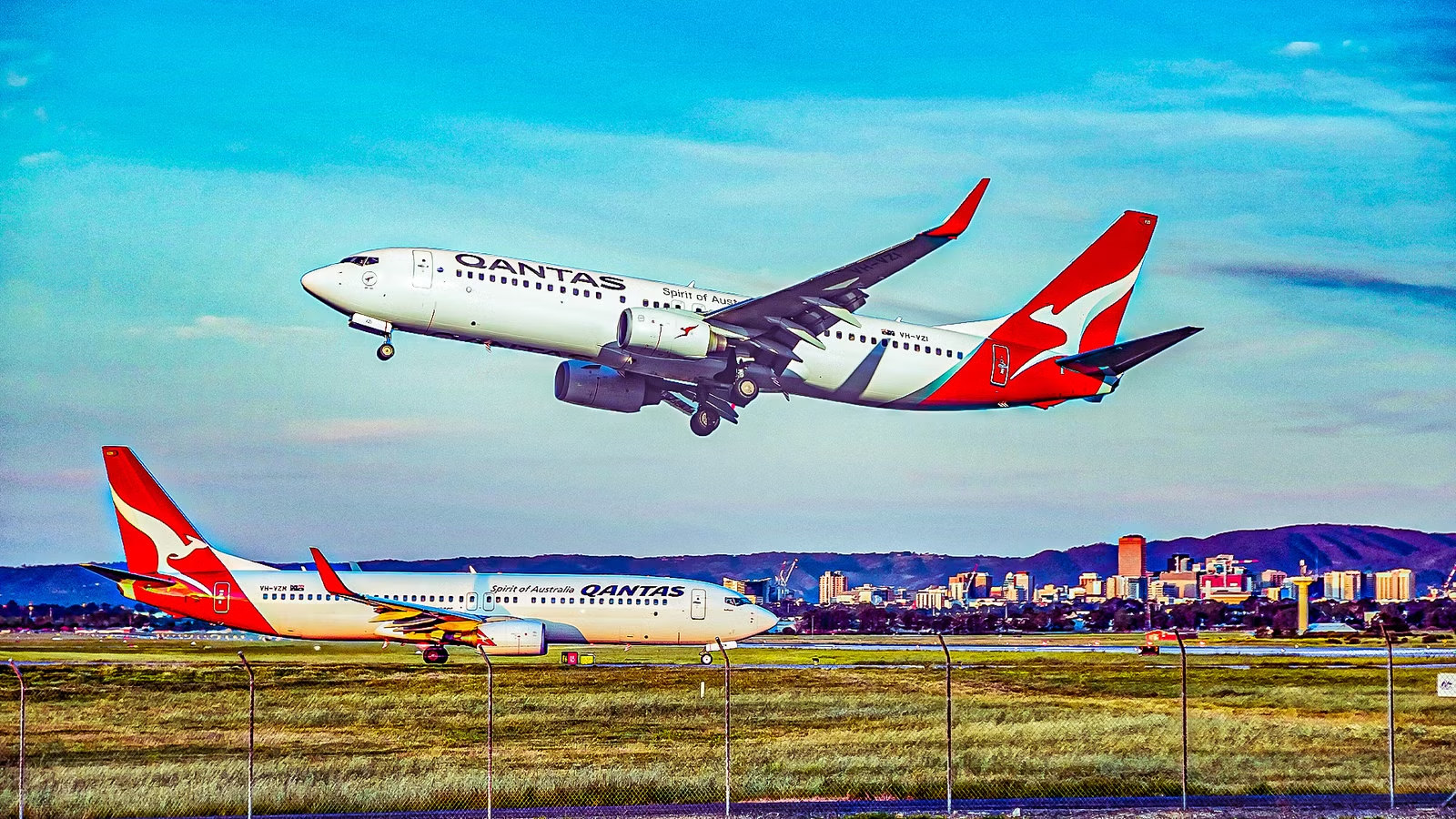
Qantas’ fleet of Boeing 737-800 narrowbody twinjets was recently in the news after one of these aircraft took off with incorrect weight calculations. This model makes up over half of the Australian flag carrier’s fleet, with data from ch-aviation showing that it has 78 examples at its disposal at an average age of 17.4 years old (compared to a fleet-wide mean of 17.1 years). Historically speaking, Qantas has flown another three units of the type.
According to current fleet data made available by aeroLOPA, these popular narrowbodies have 174 seats onboard, with this capacity split between 12 business class recliners in a four-abreast layout and 162 economy seats in a 3-3 configuration. Qantas uses its Boeing 737-800s on a wide variety of routes, with data from Cirium, an aviation analytics company, showing that it has scheduled over 8,000 flights with the type in December 2025.
Bali Is The Type’s Furthest-Flung Destination
Credit: Shutterstock
Of these, the longest are those connecting Melbourne Airport (MEL) with Denpasar International Airport (DPS) in Bali, Indonesia. The latter facility is a popular tourism gateway for Australian guests visiting Southeast Asia, and data from Cirium shows that it is located some 2,718 miles (4,374 km) away from Melbourne. This month, Qantas has penciled in 22 flights each way on this route with its Boeing 737-800s, working out five round trips a week.
These operate on Mondays, Wednesdays, Fridays, Saturdays, and Sundays, giving travelers considerable flexibility with regard to the length of their stay in Bali. The flight from Melbourne to Bali takes six hours and five minutes, leaving at 5:55 pm and landing at 9:00 pm, and the return takes five hours and 45 minutes, leaving at 10:05 pm and landing at 6:50 am the next day. Qantas said at the time of the route’s launch in 2018 that:
“Bali is a very popular holiday destination which caters to different budgets and tastes, and with more services between the two countries, we are able to provide customers with greater choice.”
One Flight A Week To Palau
Credit: Shutterstock
The Australian flag carrier and oneworld founding member also has a second international flight longer than 2,600 miles that it is operating with its Boeing 737-800 narrowbody twinjets this month. The corridor in question originates at Brisbane Airport (BNE), with its destination being Roman Tmetuchl International Airport (ROR) in Palau. This route from Queensland to Micronesia in the western Pacific Ocean only operates once a week.
Flying from Brisbane to Palau, Qantas’s Boeing 737-800s take off on Saturdays, departing at 9:05 am as flight QF165. After a block time of exactly six hours, their arrival in Palau is scheduled to take place at 2:05 pm local time. A day later, QF166 returns to Brisbane, departing at 8:30 am and arriving at 3:25 pm.
Data from Cirium shows that the distance between Brisbane and Palau is 2,693 miles (4,334 km). According to Qantas, these flights commenced in December of 2024, with Palau subsequently recording a 113% increase in visitor arrivals in the first half of 2025 compared to the year before. As a result of this success, the Australian flag carrier confirmed this August that it would be extending its presence on the route for at least another year.
Related
23 Years Later: The 737-800 Is Still The Main Boeing Narrowbody Of This $20 Billion Airline
Qantas still flies over 70 different Boeing 737-800s.
What About Domestic Duties?
Credit: Shutterstock
While Qantas’ longest domestic route with the Boeing 737-800 this month doesn’t quite match the distance of the international sectors that this article has covered, it is still quite a stretch as far as internal flights are concerned. The corridor connects Brisbane with Perth (PER), 2,246 miles (3,615 km) away.
This cross-country domestic route also has a significantly higher frequency of service than Qantas’ two longest international routes with the Boeing 737-800. Indeed, the carrier has scheduled 167 flights with the type from Brisbane to Perth this month, and 166 coming back. This works out at a daily frequency of between four and six flights in each direction, highlighting the need for cross-country capacity in Australia’s huge domestic market.