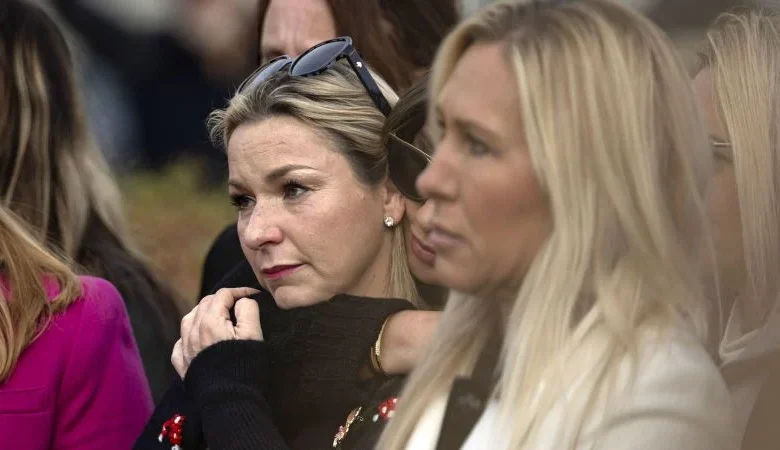
When a cache of photos seized from Jeffrey Epstein’s Gmail account and laptop was made public last week, one in particular stopped Dani Bensky in her tracks. It was a photo of Epstein in his office — a room that held many dark memories for Bensky. She remembered the large mahogany desk and a picture frame — though not the art that was in it. She also found herself looking for signs of a taxidermied tiger that Epstein had kept in that office.
Sharlene Rochard immediately recognized one of the rooms in another batch of photos released earlier this month, taken on Jeffrey Epstein’s private island in the Caribbean. At the same time that Rochard was transported back to the abuse she had suffered on Little Saint James years ago, other more seemingly trivial details stood out to her too, like a table that wasn’t in the same spot as she had remembered.
And for Jess Michaels, seeing Epstein’s infamous 50th birthday book had triggered a disturbing flashback. In it was a drawing of several women massaging various parts of Epstein’s body. It prompted her to remember Epstein telling her in the early 1990s that there are parts of the world where a man can get massaged by three women at a time — one at his head, one at his feet, and one in the middle.
“It brought me right back to that moment when he said that to me,” Michaels said. Looking back, she says she now understands that sexual jokes like that were all a part of Epstein’s strategy of slowly grooming her.
Rochard, Bensky and Michaels are just a handful of the hundreds of women believed to have been abused by Epstein who are bracing for the Justice Department’s expected release of the so-called Epstein files. A bill that President Donald Trump signed into law last month mandates that the DOJ release the files by Friday — a moment that countless Epstein survivors have been advocating for for years.
But the anticipation alone has been immensely challenging for them.
The Epstein survivors who spoke with CNN said that they had gotten no outreach from the DOJ ahead of the files’ release. For now, they are entirely unaware of its timing and the contents, as well as efforts — if any — that the government might be making to ensure that sensitive victims’ information will be handled with caution.
“We are kind of going at this in the dark right now,” Bensky said in a joint interview with several other survivors — a format that the group requested because they said they take great solace in the others’ presence when discussing their trauma. “It’s a little bit tricky because we won’t see the files before they come. We don’t know what time they’re dropping on the 19th. We don’t know.”
The DOJ has not commented publicly on any aspect of its plans to release the Epstein files, and it did not respond to CNN’s request for comment for this story.
The upcoming disclosure is expected to be far more comprehensive and broader in scope than any partial information about Epstein that has been made public to date. The intermittent disclosure of Epstein-related documents and images in recent months — including by congressional committees — has already taken a serious mental toll, and the survivors are preparing for the DOJ’s release to be uniquely tough to navigate.
“Anticipation itself can be triggering. Survivors are bracing for unknown exposure, and that uncertainty can mirror the loss of control central to abuse,” said Dr. Suzan Song, a psychiatrist who advises the federal government on anti-trafficking programs. “Not knowing what might be revealed, how it will be framed publicly, or whether deeply personal details might resurface can keep the nervous system in a prolonged state of threat, even before anything is released.”
Epstein survivors describe flashbacks and triggers from Epstein photos
Epstein survivors describe flashbacks and triggers from Epstein photos
3:34
‘There was a phone. I know I called somebody’
Some survivors also described feeling a sense of hope that there might be new information that could help to validate their own recollections of abuse. It is common for victims of sexual trauma to have lapses in memory; Epstein’s abuse also dates back several decades.
Rochard, who came out publicly with her story for the first time last month, said she distinctly remembered that there had been a phone inside of Epstein’s home on Little Saint James Island but that others who had been there told her they had no recollection of one. When the House Oversight Committee this month released pictures that were taken in and around Epstein’s private island and home, she saw the phone she had remembered all these years later.
“There was a phone. I know I called somebody,” Rochard said. “When I saw the phone, I was like, ‘No, my memory is correct. I am correct.’ So, some things are validating when you see them. And then other things are just actually completely traumatizing.”
According to Song, from a neurobiological perspective, traumatic experiences are encoded differently in the brain, particularly when a person is under extreme stress. Rather than the typical “time-stamped memories,” she said, trauma is often stored as sensory and emotional fragments including images, locations, smells and bodily feelings.
“Because of this, when survivors later encounter cues that resemble aspects of the trauma, those cues can activate the same neural networks that were active during the original harm,” Song said. “The body may respond as if the threat is happening in real time, even when the person knows intellectually that they are safe. This is particularly true in complex trauma, such as human trafficking, where repeated, chronic, interpersonal harm sensitizes the nervous system to detect danger quickly.”
All of the survivors that CNN interviewed said that they support the entirety of the Epstein files being released once and for all, but that redactions must be made to protect Epstein’s victims.
“What is most important to us is that the names of the survivors are handled with care and redacted and that nobody’s personal or identifying information is released, none of the survivors,” said Liz Stein, another Epstein survivor. “However, what we really, really want to see is the names of these perpetrators.”
Jennifer Freeman, a lawyer who represents multiple Epstein survivors, said she has not heard from the DOJ ahead of the expected release of the files. She said the government must be transparent about any files that the government might choose not to make public: “There are a number of exceptions to the release, and the criteria for application for these instructions should be stated. For example, what constitutes national security?”
Gloria Allred, another lawyer who works with Epstein survivors, told CNN the DOJ reached out to ask which of her clients would like their names to be redacted. Attorney Arick Fudali said he received an email from the DOJ within the past few weeks to set up a phone call to discuss possible redactions, but that the department never called.
Epstein survivors on what they hope to see from DOJ’s Epstein files
Epstein survivors on what they hope to see from DOJ’s Epstein files
3:26
The staggering scope of Epstein’s abuse and the immense web of individuals who aided him makes Epstein one of the most well-known sex offenders in recent memory. And his past associations with many of the world’s most powerful and wealthy people — including Trump — coupled with the decades of failure by the justice system to hold him accountable have also made Epstein a prime example of systemic corruption.
Epstein killed himself in a New York City jail cell in 2019 while awaiting trial for federal sex trafficking charges. He had served just 13 months in prison for state prostitution charges involving underaged girls after he was given a highly controversial non-prosecution agreement in 2007. Alex Acosta, the US attorney in Florida who declined to bring federal charges against Epstein at the time, also failed to notify the women who alleged they had been abused by Epstein about the agreement. (Acosta later served as labor secretary during Trump’s first term.)
Freeman, the lawyer who represents Epstein survivor Maria Farmer and others, said she will be particularly interested to see what information might come out about a whistleblower report Farmer filed with the FBI in 1996. Farmer reached out to the FBI again in 2006, Freeman said, and has for years raised concerns about the government’s mishandling of the Epstein case that resulted in the non-prosecution agreement.
The lack of transparency around the decades worth of records that the federal government has amassed about Epstein’s wrongdoings has also prompted an endless stream of conspiracy theories.
Michaels, whose work now focuses on early trauma intervention and educating the public about how to help survivors, said she and many other fellow Epstein survivors are dumbfounded by the DOJ’s continued lack of outreach.
“I hope at some point the DOJ says, ‘Sit down with us. Tell us why these photos matter.’ Because no one’s asking,” she said. “This case shows what happens when warning signs are ignored and when power goes unchecked and when institutions prioritize reputation over protection. Predators don’t thrive because they’re these brilliant men — they thrive because the systems fail.”
Epstein’s survivors said they are certain that if the files are in fact released by Friday, that moment will only be the beginning of a long journey ahead.
“It’s taken almost 30 years just to get to this point, just to get files of our own personal information. And we’ve been called a hoax. We were told that this wasn’t true,” said Rochard. “But our hope is that when they do come out, we will see, the public will see, everything and that we were telling the truth all along.”