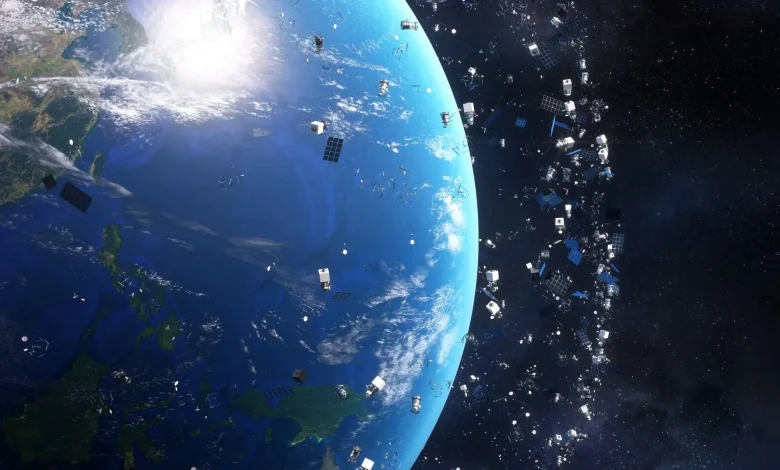
A team of scientists has warned that the space congestion problem is in danger of spiralling out of control, describing our current situation as a “House of Cards”.
Individual satellites within mega-constellations, such as SpaceX’s Starlink, must perform an increasing number of collision-avoidance maneuvers each year.
According to scientists, solar storms could trigger Kessler Syndrome—a scenario in which satellites collide, leading to a cascading, destructive event in Earth’s orbit.
On the edge of Kessler Syndrome
A Federal Communications Commission (FCC) filing in 2023 showed that SpaceX’s Starlink satellites had to make 50,000 collision avoidance maneuvers over the previous four years.
That same year, Hugh Lewis, a professor of astronautics at the University of Southampton in the UK, calculated that, if trends continued, Starlink satellites would have to perform roughly a million maneuvers every six months by 2028.
This leaves little margin for error. Ultimately, space is becoming increasingly congested, and we are edging closer to the cascading destructive scenario known as Kessler Syndrome. This could ultimately prevent spacecraft from reaching orbit, as there would be too great a risk of collision with small space debris.
Now, a team at Princeton University has warned that solar storms could be the tipping point that leads to a Kessler Syndrome scenario. In a pre-print, they explain that solar storms heat the atmosphere, increasing atmospheric drag. This means that more fuel is required to maintain orbits and perform evasive maneuvers.
According to the researchers, the May 2024 “Gannon Storm” led to more than half of all satellites in low Earth orbit (LEO) using up some of their fuel to reposition themselves.
In addition to increasing atmospheric drag, solar storms can also damage the navigational and communication systems of satellites. Ultimately, this could prevent them from performing evasive maneuvers, leading to a catastrophic Kessler Syndrome scenario.
The CRASH Clock
In order to highlight the problem of space congestion, the researchers behind the new paper came up with a new metric—the Collision Realization and Significant Harm (CRASH) Clock. This essentially describes how long it would take for a catastrophic collision to occur if satellite operators suddenly lost communication and their capacity to perform evasive maneuvers.
According to the team’s calculations, as of June 2025, the CRASH Clock is currently sitting at 2.8 days. This has risen significantly in recent years, the scientists warn. In 2018, for example, the CRASH Clock would have sat at 121. This is because SpaceX began lifting its Starlink mega-constellation into orbit in 2019.
Effectively, the 2.8-day CRASH Clock indicates that a powerful solar storm could easily trigger Kessler Syndrome. It would take a matter of days for the house of cards to come crashing down.
The paper was pre-printed on arXiv.