Paul Doyle sentenced to 21 years, six months in prison for attack at Liverpool title parade

A man who ploughed into Liverpool supporters at the club’s Premier League title parade has been sentenced to 21 years and six months in prison.
Paul Doyle, 54, from West Derby, Liverpool sat in the dock wearing glasses, a black suit and grey tie, as the sentence was issued at Liverpool Crown Court.
Doyle was also banned from driving for three years, extended to 16 years and ten months to take into account the period he will spend in custody. He will be required to pass an extended retest before being allowed to drive again.
Judge Andrew Menary KC said the evidence against Doyle was “overwhelming” as he described the footage as “truly shocking”.
Addressing Doyle, Menary continued: “You lost your temper in a rage, determined to force yourself through the crowd regardless of the consequences. You admit that you intended to cause serious harm to achieve that end, even to children.
“It’s almost impossible to think how any right-thinking person could act as you did. The crowd did not cause this incident. They reacted to it, faced with a car driving directly at them and striking multiple people.”
More than 130 people, who were part of crowds that had gathered in Liverpool city centre to celebrate the title win, were injured when Doyle’s Ford Galaxy ploughed into supporters on May 26.
Those injured ranged from a six-month-old baby to a 78-year-old woman.
Fifty people required hospital treatment due to Doyle, according to the prosecution, “using his car as a weapon” and deliberately accelerating through a packed street that had been closed off to motorists.
When Doyle’s car was brought to a stop just after 6pm on Water Street, four people were trapped under the vehicle, including an 11-year-old child.
On the second day of his trial on November 26, Doyle tearfully changed his plea to guilty to the 31 offences he was charged with. They related to 29 victims, eight of whom were children at the time of the incident, including a six- and seven-month-old.
Doyle admitted to dangerous driving, affray, 17 counts of attempting to cause grievous bodily harm, nine of causing grievous bodily harm with intent and three of wounding with intent.
The court was told that Doyle had a number of military and civilian criminal convictions dating back to when he was in his late teens and early twenties. That included biting the ear off of a sailor during a drunken fight in July 1993.
He was convicted of causing grievous bodily harm, along with an offence of using threatening, abusive, insulting words or behaviour and was sentenced to 12 months in prison. The prosecution also said that the evidence reveals there was “no link” between the defendant’s military service and Doyle’s crimes.
During the two-day sentencing hearing, the prosecution outlined that Doyle was “completely sober” and free of drugs when the parade incident occurred. Doyle had claimed, when interviewed by police, that he acted “in a blind panic and in fear of his life” but the prosecution’s position is that the account given to investigators was untrue.
Paul Greaney KC, prosecuting, told the court: “The truth is a simple one. Paul Doyle just lost his temper in his desire to get to where he wanted to get to. In a rage, he drove into the crowd. When he did so, he intended to cause people within the crowd serious harm. He was prepared to cause those in the crowd, even children, serious harm if necessary to achieve his aim of getting through.
In mitigation, Simon Csoka KC of the defence said that Doyle was “horrified” by what he had done and the defendant accepted it was extremely fortunate the consequences were not as grave as they might have been. “He’s remorseful, ashamed and deeply sorry for all those who were hurt or suffered,” Csoka said. “He accepts full responsibility. He expects no sympathy.”
A number of character references described Doyle as a “kind”, “generous” and “selfless” man. Csoka stated it was an “unexpected” act for all those who knew him, as well as Doyle, who took “several months to recognise mentally what he did”.
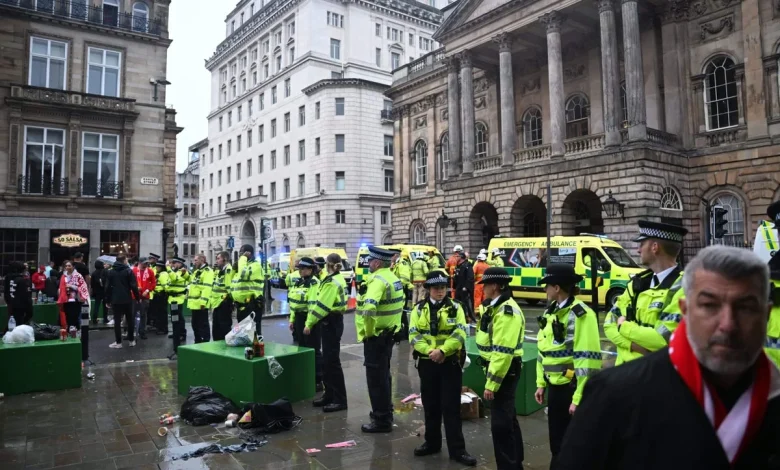
The chaotic aftermath of Paul Doyle’s actions at the Liverpool title parade (Paul Ellis/AFP via Getty Images)
Gasps were heard from the courtroom as the defendant, who had driven the same route earlier in the day when dropping off his friend, was shown via dashcam, CCTV and mobile phone footage ignoring the traffic implementations instructing cars to turn right onto Exchange Street, and accelerating to the left, driving into supporters.
Doyle could be heard shouting and swearing repeatedly including “f*** sake, move, get out of the f****** way” and “f****** hell, move” as he continued forward, hitting multiple people, including a pram containing a six-month-old boy. He also repeatedly used his car horn.
In the immediate aftermath of the incident, officers forced Doyle into a nearby police van, where he told them: “I’ve just ruined my family’s life.”
In a police interview, Doyle had stated “he stopped as soon as he realised he had hit someone”. The prosecution stated that it was only the people under the car and the efforts of former soldier Daniel Barr, who entered the vehicle via a rear passenger door and placed the automatic vehicle into ‘park’ that halted the vehicle. Witnesses stated that even after the car had stopped, the engine could still be heard revving and Doyle’s foot remained on the accelerator.
Dashcam footage from inside Doyle’s car before the incident showed him driving “aggressively” when travelling towards the city centre to pick up his friend and how his driving was “highly dangerous” and frustration was building before hitting anyone when travelling down Dale Street towards the traffic measures in place.
Doyle was interviewed the day after the incident, before he had seen any dashcam or general footage. Doyle described how a gang of men — who he referred to as “drunken loons” — approached him and that one was “armed with a knife”. He said he “really thought he was going to die”, “went into a blind panic” and “blacked out”. The prosecution labelled that account as “false” and “distorted”.
In subsequent interviews, after footage was shown to Doyle, he accepted the discrepancies in his account but maintained his behaviour was motivated by fear. Before veering left at the traffic measures, members of the public did punch and kick Doyle’s car.
The prosecution said: “Even if it is right that the behaviour of the crowd in the area of the traffic implementations disturbed the defendant, or even frightened him, it was his own behaviour that had caused that reaction, by the dangerous way in which he had driven down Dale Street towards those cones.”
The impact on victims
Doyle was in tears frequently as 78 victim statements were read out to the court. All spoke of the physical and psychological impact the incident has had on them and those around them.
Many spoke of experiencing increased anxiety in situations involving large crowds and cars — including crossing the road, driving and hearing a car horn. Many said they continue to suffer from nightmares and flashbacks and some have been diagnosed with depression and post-traumatic stress disorder. It has also impacted people socially and financially, with many unable to work in the aftermath of the event due to the injuries they sustained. It has also affected their support for Liverpool Football Club.
A 12-year-old boy, who remains anonymous for legal reasons, said: “I found myself on the floor having been hit by a car I did not see coming, I have never felt so scared before in my life.”
Sheree Aldridge, the 37-year-old mother of Teddy Eveson, who was the six-month-old in the pram hit by Doyle, thought her son had died. She said: “I felt an overwhelming pain in my leg and looked up to see Teddy’s pushchair on its side further up the road. I thought my Teddy was dead. I thought I was next. I thought my children would grow up without a mother.”
Greaney detailed some of the injuries sustained by the victims from the attack, including Aldridge, who sustained a degloving injury to her left thigh which necessitated an 18-day hospital stay and ongoing drainage until November. Her treatment is ongoing and she is awaiting appointments for plastic surgery.
One woman, aged 77, spent 27 days in hospital after suffering a fractured left forearm, fractured left collar bone, three fractured ribs, a fractured pelvis, a broken nose, as well as multiple abrasions and bruising to her head, knees and back.
A man, aged 52 at the time of the incident, sustained a significant laceration to the back of his head along with four fractured ribs on the right side and abrasions to his right elbow and left leg.