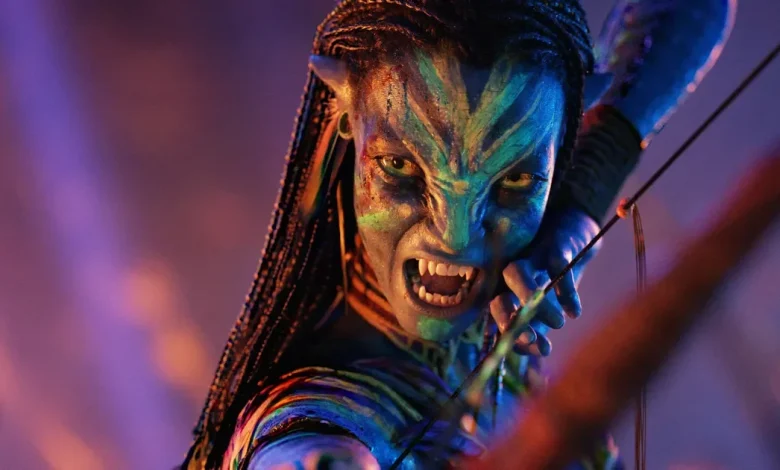
Avatar: Fire and Ash might be the messiest of the Avatar movies, but it’s also the richest, and maybe the craziest.
Photo: 20th Century Studios/Everett Collection
To reiterate: None of this is real. Not the giant blue aliens, or the banshee dragons that they fly around on, or those floating mountains, or the huge, whale-like tulkun. We’ve known for years that the world of the planet Pandora presented in James Cameron’s Avatar films is all motion-capture actors and immersive digital environments, and yet we still need to keep reminding ourselves of this fact, because it’s all so tactile, so vivid, so… real. Early on in Avatar: Fire and Ash, we see the young Lo’ak (Britain Dalton) and his pals joyfully sprinting up the backs of their giant tulkun pals and taking flying leaps into the ocean, and we might as well be jumping in the water right alongside them. It’s a moment of abandon, freedom, and release that Cameron films with such exuberance that it’s hard to grasp that, again, almost none of it actually exists. It’s pretty clear the director can’t believe it himself.
The exacting, obsessive thoroughness with which Cameron has imagined this world is not an end in itself, however. The sheer you-are-thereness of Pandora means that it becomes a compelling canvas for its creator’s own pathologies: The conflict in these films between the ethereal interconnectedness of Pandora’s peace-loving, spear-wielding Na’vi natives and the superior-firepower materialism of the human invaders (a.k.a. the “Sky People”) reflect the warring sides of Cameron’s own soul. And if the ecological action epic of 2022’s Avatar: The Way of Water allowed the flower child side to dominate the auteur’s inner grunt, now the macho warrior re-emerges, hungry and determined and surprisingly virile.
This series’ chief villain, the tough-talking badass Colonel Miles Quaritch (Stephen Lang), killed at the end of Avatar but resurrected in Na’vi form in the second film (long story), has since become both a visual and spiritual foil for Jake Sully (Sam Worthington), our ostensible hero. Quaritch has a bigger part in Fire and Ash, as his pursuit of Jake, combined with his desire to lure his own human son Spider (Jack Champion) back to the dark side, results in his forging some surprising alliances. Jake seems to be collapsing under the weight of his domestic obligations — the patchwork family he’s put together with Neytiri (Zoe Saldaña) is currently in a deep state of mourning, following the death of their oldest son Neteyam (Jamie Flatters) — while the wandering Quaritch gets to be a free radical, loose and volatile and even horny. The film’s most exciting new character, Varang (a marvelous Oona Chaplin), the ash-covered, red-tinted leader of a renegade tribe of fire-worshipping, nihilistic Na’vi marauders, strikes a bond with the bad colonel, enticed by all his guns. As Quaritch trains her in how to use a rifle, we get a classic Cameronian mating ritual (as previously seen in Aliens): a man and a woman intimately bonding over how to handle a giant piece of weaponry. Quaritch even slips an ammunition belt around Varang as if it were a wedding band. Their dance of martial desire is the farthest the director has ever gone with this sort of thing, so much that it begins to feel like we’re intruding on a private, queasy fantasy. James Cameron wishes he could be Jake Sully, but when the lights are off and he’s alone with thoughts, he probably knows that he’s secretly Miles Quaritch.
With indulgence also comes guilt, however, and a deep sense of shame runs throughout Fire and Ash. At the start of the film, it seems that nearly every member of Jake’s family blames him or herself for Neteyam’s death. But the regret and humiliation don’t stop there. “Everything I touch gets ruined,” mourns Lo’ak, who dreams about his brother and holds himself directly responsible for what happened. Neytiri grieves the loss of her home and her tribe and resents Jake for it. Sigourney Weaver’s Kiri (a teenage Na’vi with mysterious powers, born from the dead body of a human character in the fi — oh never mind) learns more about her origins and begins to feel a deep sense of inadequacy. Spider, the human, is scorned by Neytiri and feels anguish over his own identity. Jake even regrets his final, mythic triumph from the first Avatar: riding the giant flying apex predator known as toruk and uniting the planet’s species against the human invaders. (“When you ride the beast, you become the beast,” he now says, vowing never to do so again.) Our heroes’ overwhelming repentance and bloodguilt make a fine, sharp contrast with Quaritch, Varang, and the humans’ flagrant brazenness, their constant refusal to admit defeat or express doubt or show mercy or even, frankly, die.
If Cameron lets his freak flag fly in Fire and Ash, it’s just a measure of how much this made-up world of a million pixels has liberated him. The freewheeling earnestness of the Avatar films redeems their derivativeness, their potboiler plots and simple-minded dialogue; the director and his cast have clearly bought into all of it, and they believe everything they’re saying. Just as he did with Way of Water, Cameron remixes a lot of his favorite motifs in Fire and Ash: There’s bits of Aliens, Terminator: Judgment Day, and The Abyss in here, and a whole lot of Titanic (again). There’s also quite a bit of Way of Water in here, too, which may feel to some like a franchise cannibalizing itself, but at least Cameron is still stealing from the best: himself. Plus, it’s all so expertly realized — so beautifully shot and suspensefully put together — that it never feels manufactured, lazy, or cheap. And when Kiri finally gets to yell a variation of Weaver’s famous “Get away from her, you bitch!” from Aliens, it elicits cheers, not groans.
As might be apparent by now, there’s enough for several movies in here, and a couple of scenes go by so quickly that it’s hard not to assume there’s a much longer cut out there somewhere. (Hilariously, Cameron says he initially intended for The Way of Water and Fire and Ash to be one single film.) The movie runs 197 minutes long, but it’s never boring. Cameron makes marathon-length pictures, but he sprints through them, throwing in ideas and images with fanatic fervor. In any other film, a small army of giant, tentacle-faced purple slugs that serve as airships for a group of “wind traders” would probably be the main attraction; here, it’s just one small part of the first act. In any other movie, the spectacle of a space whale being put on trial would be cause for ridicule, but here, it’s just one emotional beat of many, and a surprisingly powerful one at that. The cascading narrative crescendos and action climaxes reinforce the idea that the director now feels so free in this imaginary world that he can go anywhere: follow any tangent, explore any character, introduce any new conflict. Fire and Ash is in some ways the messiest of the three Avatar movies, but it’s also the richest, the one in which we most lose ourselves, the one that makes us wonder about these characters and constantly peer into those rapturous backgrounds, trying to see forever. Then the credits roll and remind us all over again that, astonishingly, it was all just a dream.