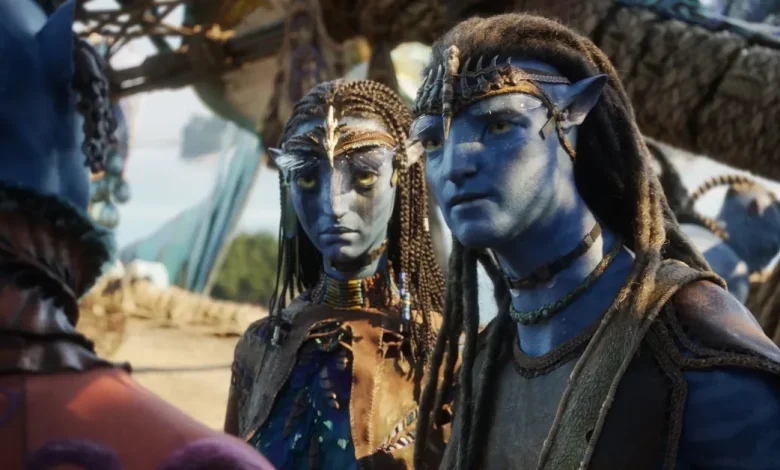
The selling point of James Cameron’s Avatar films is that they allegedly invite us into a world of wonder, a universe that’s fanciful yet artfully constructed to feel more real than our own. Avatar: Fire and Ash is the third Avatar film, and if you enjoyed the first two, you’re in luck, because this one offers much more of the same. More sky battles, more reef dwellers riding the waves on the backs of sleek sea creatures, more white Earthlings seeking to colonize new worlds because they’ve destroyed their own, more plugging of ponytails into cosmic sources, more ’90s craft-fair necklaces. If you’ve found yourself pining for the world of the Na’vi—and for dialogue like “The fire of hate is only the ash of grief” and “We do not suck on the breast of weakness!”—Avatar: Fire and Ash is for you.
Fire and Ash picks up where 2022’s Avatar: The Way of Water left off. Or at least, I think so—essentially, it feels like the same movie with a hazily different plot. Over on the planet Pandora, Lo’ak (Britain Dalton) is mourning the death of his brother, killed in the previous movie. Lo’ak’s mother, Neytiri (Zoe Saldaña), is understandably also in mourning; she sits quietly, in a moony state, fingering a strand of beads. Jake (Sam Worthington) is sad too, but in a more stalwart, manly way. Meanwhile, Jake and Neytiri’s adopted daughter, Kiri (Sigourney Weaver), re-enacts The Blue Lagoon with her possible potential sweetheart, Jake and Netytiri’s adopted son Spike (Jack Champion), the white kid with locs who needs special breathing apparatus to survive in Pandora’s atmosphere.
Varang (Oona Chaplin) in injects some new life into the franchise’s third installment Courtesy of 20th Century Studios
Elsewhere, there is treachery afoot: White Earthlings scheme to take over Pandora, with the help of macho soldier, and sworn enemy of Jake, Colonel Miles Quaritch (Stephen Lang), who also happens to be Spike’s biological dad. A bossy general lady (Edie Falco) struts around importantly, barking orders. A gentle scientist type (Jemaine Clement) pleads with the white Earthlings to not kill Pandora’s sensitive, whale-type animals. Midway through the film, a new villain appears, and Fire and Ash briefly sparks to life: Oona Chaplin’s silky-nasty Varang is the warrior leader of the Na’vi Mangkwan clan (A.K.A. the Ash People), and she weaves a spell around Quaritch to make him do her bidding, kind of the way Jill Saint John hypnotized Adam West into doing the Batusi after giving him drugged orange juice.
Avatar: Fire and Ash is an extended metaphor, you see: It tells us that white people, with their greed, ruin everything. (Sadly, this is true.) Humans are destroying the Earth. Our children are the hope for the future. These comprise the basic themes of the Avatar series, and presumably they’ll be reiterated in future Avatar movies (there are plans for two more), so if you haven’t quite grasped them, you’ll have lots of other chances.
The Na’vi look the same as before, with their elongated blue zero-body-fat bodies, their faces adorned with cute glitter freckles, their pointed ears moving to and fro expressively as they speak. Cameron, at great cost, has made a 3 hour and 17 minute epic, the whole thing capped off with an elaborate battle sequence that’s ostensibly supposed to look like nothing you’ve ever seen before, though in the end it’s pretty much exactly the thing you expect. Cameron’s supposedly leading technology gives us images that look strangely flat, somehow bland and sparkly at the same time. Even three movies in, the effect may still be thrilling for some. But if you find it soporific, you’re not alone.
When Cameron released the first Avatar film, in 2009, he presented it as a revolutionary new way of watching movies. Now, a decade and a half later, that new way of watching movies is an old one. Cameron has perfected the art of presenting audiences with a world of manufactured wonder. He and his army of technicians clearly hope to impart the feeling of being transported, but the overworked visual universe they’re presenting has the opposite effect. Avatar: Fire and Ash never lets you forget you’re looking at a screen, especially as hour three starts ticking by. Cameron’s vision is no longer the future, but a nostalgia trip, a very expensive form of deja vu. Movie magic can take many forms, but rarely is it as calculated as this, confusing awe with stupor.