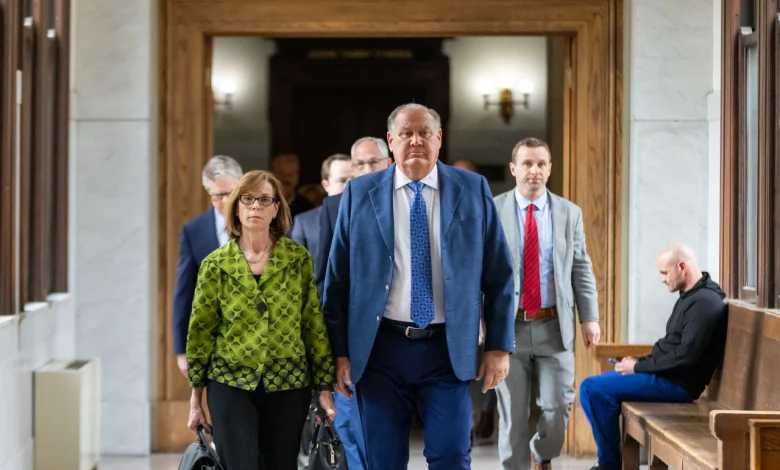
AKRON – Two former executives at FirstEnergy Corp., weeks before their long-anticipated bribery trial, asked a judge Friday to stifle testimony from the company’s top accountant.
Specifically, they want to block testimony related to his 2020 conclusion that the company’s $4.3 million payment to a soon-to-be public official “could be related to an unlawful activity.”
FirstEnergy’s chief accounting officer, Jason Lisowski, personally helped process and book that $4.3 million payment, he previously said in a sworn deposition.
He also co-authored a memorandum in 2020 that, five years later, serves as a road map to the ongoing state and federal prosecutions of ex-FirstEnergy CEO Chuck Jones and former Senior Vice President Mike Dowling.
State prosecutors have already acknowledged that the memorandum itself is non-admissible hearsay evidence, but defense attorneys want to block all related testimony from Lisowski at the trial, scheduled to begin in late January 2026.
The effort is part of a broader pattern from the 19 defense attorneys representing Jones and Dowling of pressuring Summit County Common Pleas Judge Susan Baker Ross to limit the evidence allowed at a trial prosecutors have called the biggest corruption scandal in state history. Their requests have included suppressing evidence about Jones’ salary, Dowling’s vacation home, guilty pleas and other admissions from relevant parties and state investigations into the scandal.
Jones and Dowling ordered the $4.3 million payment – the alleged bribe – to Sam Randazzo in January 2019, weeks before Gov. Mike DeWine appointed Randazzo to lead the Public Utilities Commission of Ohio. The PUCO regulates utilities like FirstEnergy and sets the prices they charge customers.
Lisowski helped process and book the Randazzo payment at the behest of Jones and Dowling, he said at his deposition. There, he recounted what happened after a reporter questioned the company about the financial relationship between FirstEnergy and Randazzo. Lisowski said he directed company auditors to research the issue. The payments added up to $19.8 million between 2010 and 2019, company emails show, including the $4.3 million.
The information – detailing millions of dollars flowing from the company to the state’s senior-most utility regulator – was kept under wraps. The company didn’t answer the reporter’s question. Randazzo never clearly reported the money from FirstEnergy on state ethics forms. DeWine would later say he didn’t hear about the transaction for more than a year.
FirstEnergy’s lawyers dictated the memo, defense lawyers say
At the Summit County courthouse on Friday, Jones and Dowling’s attorneys said that talk of the Lisowski memo shouldn’t come anywhere near their trial. They said the Nov. 6, 2020 “Tone at the Top Control Deficiency” memo was drafted at the behest of company lawyers, based on private emails obtained from Jones and Dowling’s phones and other devices. The defense attorneys framed Lisowski’s writing as a facsimile of FirstEnergy’s lawyers’ position and not Lisowski’s personal conclusions. The board had terminated Jones and Dowling several days before it was authored.
“Mr. Lisowski knows this information because lawyers told him this information,” said Steven Grimes, an attorney representing Dowling. “Mr. Lisowski is not a detective, and he didn’t conduct an investigation. FirstEnergy’s lawyers conducted an investigation, and they told Mr. Lisowski … what they found in their investigation.”
Drew Wood, a state prosecutor, disagreed. He said it should be left to a jury to weigh whether Lisowski has any credible firsthand information about the allegations against Jones and Dowling. Plus, jurors would want to hear what Lisowski thought about the emails and texts between Jones and Dowling referencing the $4.3 million.
“Coming upon evidence after the fact and viewing it gives personal knowledge of that evidence. If Jason Lisowski viewed these things and gained personal knowledge, these documents, he’s allowed to testify about them,” Wood said.
Plus, as Matt Meyer, the state’s lead prosecutor said, Lisowski wasn’t some lowly accountant. Producing memos like this was part of his job, which triggers exceptions to rules against hearsay evidence in court.
Ross hasn’t yet ruled on the defense motion. The trial is scheduled to begin Jan. 26.
Memo made searing claims that prosecutors echoed
Lisowski’s memo is full of claims that, if proven at trial, would be damning for Jones and Dowling.
For instance, while the defendants have insisted the $4.3 million was a legally binding closeout payment of a legal settlement, Lisowski’s memo found “there is no apparent legal obligation for FirstEnergy” to pay Randazzo. This would mean Jones and Dowling chose to pay Randazzo the money, as opposed to being forced to do so as a term of a contract.
The memo also references an episode, later highlighted by federal prosecutors, that led the company to fire another senior vice president, Dennis Chack, alongside Jones and Dowling. Chack, company documents show, lied to FirstEnergy investigators about a consulting contract with Tony George, a Cleveland restaurateur who made millions from FirstEnergy via advertising, consulting and other services. Chack also attempted to backdate a copy of a forged company contract with George, according to the documents.
Meanwhile, Chack failed to disclose to the company a $500,000 contract playing out at the same time between George and Chack’s daughter, according to FirstEnergy. Chack admitted at a deposition he received an emailed copy of that contract, but said it was never executed.
The memo also accuses both Jones and Chack of directing the company to guarantee or forgive loans to their personal friends, engaging Randazzo as an unregistered lobbyist, and other improprieties.
Memo preceded firings, prosecutions
The memo Lisowski authored preceded several major developments in the scandal. The misconduct the document alleges went on to appear in charging documents, regulatory findings and other investigative records.
Two days after the memo’s marked date, the company “separated” from its two top lawyers, Robert Reffner and Ebony Yeboah-Amankwah, due to conduct the board of directors found “was influenced by the improper tone at the top.” Both those lawyers helped facilitate the payment to Randazzo, company emails show.
Lisowski’s memo states that both lawyers “appear to have not taken expected action” given the nature of the payment.
About two weeks after the date on the memo, FBI agents swarmed Randazzo’s Columbus brownstone. That was the first public indication of Randazzo’s connection to an unfurling scandal.
The federal government charged Larry Householder, then Ohio’s House speaker, in July 2020 for taking a separate, related bribe from Jones and Dowling. Householder was convicted in 2023. Jones and Dowling weren’t charged at the time. Three others have pleaded guilty or been convicted in the scandal.
Federal prosecutors indicted Randazzo in December 2023. State prosecutors charged Jones, Dowling and Randazzo in February 2024. The cases against Randazzo were dropped after he died by suicide in April 2024.
It wasn’t until the final days of President Joe Biden’s term that the federal prosecutors charged Jones and Dowling. Their federal trial hasn’t yet been scheduled.