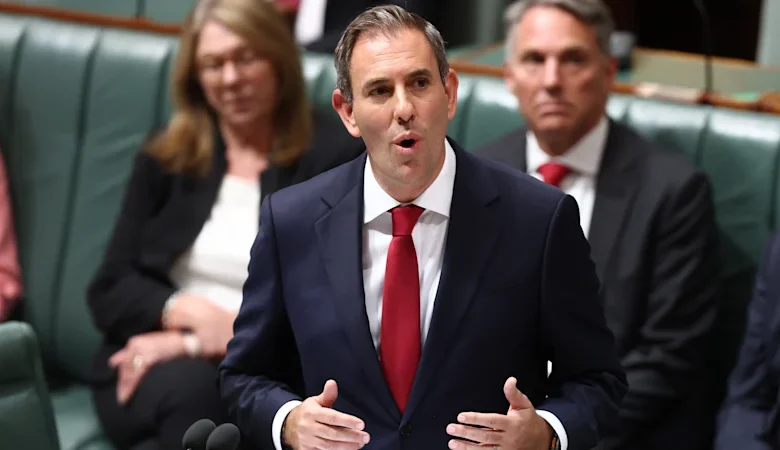
Before the release of the budget details, Chalmers said the nation’s finances were improving due to government action.
“Despite all the pressures we’ve had to accommodate in the budget, the bottom line is better in every year over the forwards thanks to our efforts,” he said.
“It builds on the biggest improvement in the budget in a single parliamentary term and is a powerful demonstration of Labor’s responsible approach to the nation’s finances.”
The smaller deficits will help reduce overall gross government debt.
The 2024-25 financial year finished with gross debt at $928.6 billion, after being forecast to be more than $1.1 trillion in Chalmers’ first budget in 2022-23.
This year, the government was expecting gross debt to reach $1.02 trillion. With a little over six months to go this financial year, gross debt is currently $957.4 billion, suggesting Chalmers may avoid crossing the $1 trillion mark in 2025-26.
Despite the expected improvement in the budget deficit, it is still a $26.8 billion increase on the deficit recorded in the 2024-25 financial year, prompting concerns that government spending is adding to the nation’s inflation pressures.
The Reserve Bank last week held official interest rates steady at 3.6 per cent, with financial markets expecting one-quarter percentage point increase by August next year.
But economists at both the NAB and Commonwealth Bank on Tuesday said they believe the RBA will take the cash rate back to 3.85 per cent at its first meeting of 2026, due for February 2 and 3.
NAB group chief economist Sally Auld said the economy was already running at near its capacity with spending across the private sector starting to pick up.
Loading
“When viewed in the context of a central bank that has expressed concern about upside risks to inflation and uncertainty around the stance of policy at present, we think the RBA will need to make a modest recalibration of monetary policy in the first half of this year,” she said.
“Half a percentage point of tightening should see the real cash rate align to a more appropriate level, taking monetary policy to a setting better able to sustain an economy growing at trend but no stronger.”
The Commonwealth Bank’s head of Australian economics, Belinda Allen, said household spending was increasing just as inflation pressures were lifting and economic growth was accelerating.
She noted that there had been, on average, nine months on past occasions between the Reserve Bank switching from rate cuts to increases. An increase in February would be six months from the RBA’s most recent cut in August.
“The risk is that the RBA will not stop with one rate hike. The shallow cutting cycle through 2025 and our view of an economy just above its speed limit, suggests only fine-tuning is required,” she said.
“We could be wrong. It could take an additional hike to bring the economy back into balance and inflation back to the midpoint.”
Cut through the noise of federal politics with news, views and expert analysis. Subscribers can sign up to our weekly Inside Politics newsletter.