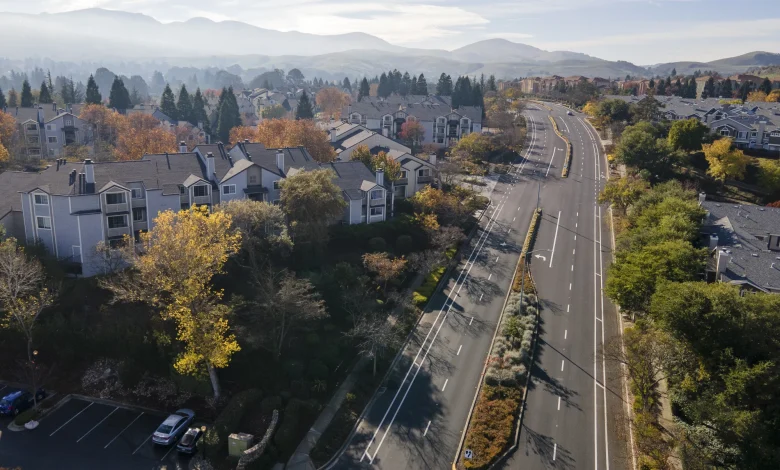
San Ramon sits over a complex geologic environment, which is one theory, Williamson said, for why the area gets swarms every few years. The Calaveras Fault runs underneath the city in a transition zone.
It is part of the San Andreas Fault system and is capable of a magnitude 6.7 earthquake. To the east, the Mount Diablo Thrust Fault begins.
“All these earthquakes happen in that transition area,” Williamson said. “Any small changes kind of cause that area to preferentially get more earthquakes.”
The last big quake the Calaveras Fault produced was in 1984 in Morgan Hill with a magnitude of 6.2. But if the Hayward Fault and the Calaveras Fault, which UC Berkeley scientists found are connected, rock simultaneously, that could result in a magnitude 7.3 earthquake.
Faults contain liquid that lubricates the earth, making it easier to move and causing earthquakes. Similar to a person wetting their hands and sliding them together, the fluid reduces the friction, and the rock “can slide more freely,” Williamson said.
Williamson said the liquid is usually a mix of water and minerals, and that there isn’t a “great model” to say exactly how it moves through cracks within the fault system. That movement can cause the quakes.
Williamson said the “constant rattle” should serve as a reminder that Bay Area residents live in a “really seismically active area.” She recommended preparing a go bag with clothes, food and water.
A sign for apartments on Deerwood Road in San Ramon on Dec. 15, 2025. The area sits near the Calaveras Fault, an active fault that runs underground through the East Bay. (Beth LaBerge/KQED)
Epstein, who is retired, said she’s started to prepare for a larger earthquake, collecting masks, gloves, water, tools, and canned food — although she needs to double-check the expiration dates to make sure the food is still good to eat.
“I’m not to the point where I’m gonna sleep with my shoes on or anything,” Epstein said. “I just hope if the worst happens that I can get to the bag in the closet.”
Heys, who works as a server in Danville, on the other hand, is very prepared. She has a supply of perishable food, flashlights, portable chargers that also act as flashlights, mini candles, gallons of water and a case of water in her car.
She’s talked with her friends and neighbors about the quakes and how they’ve prepared, but they don’t seem as concerned.
“Nobody really has any major concerns as of now,” Heys said. “I think that’s because none of us has experienced a huge one yet.”