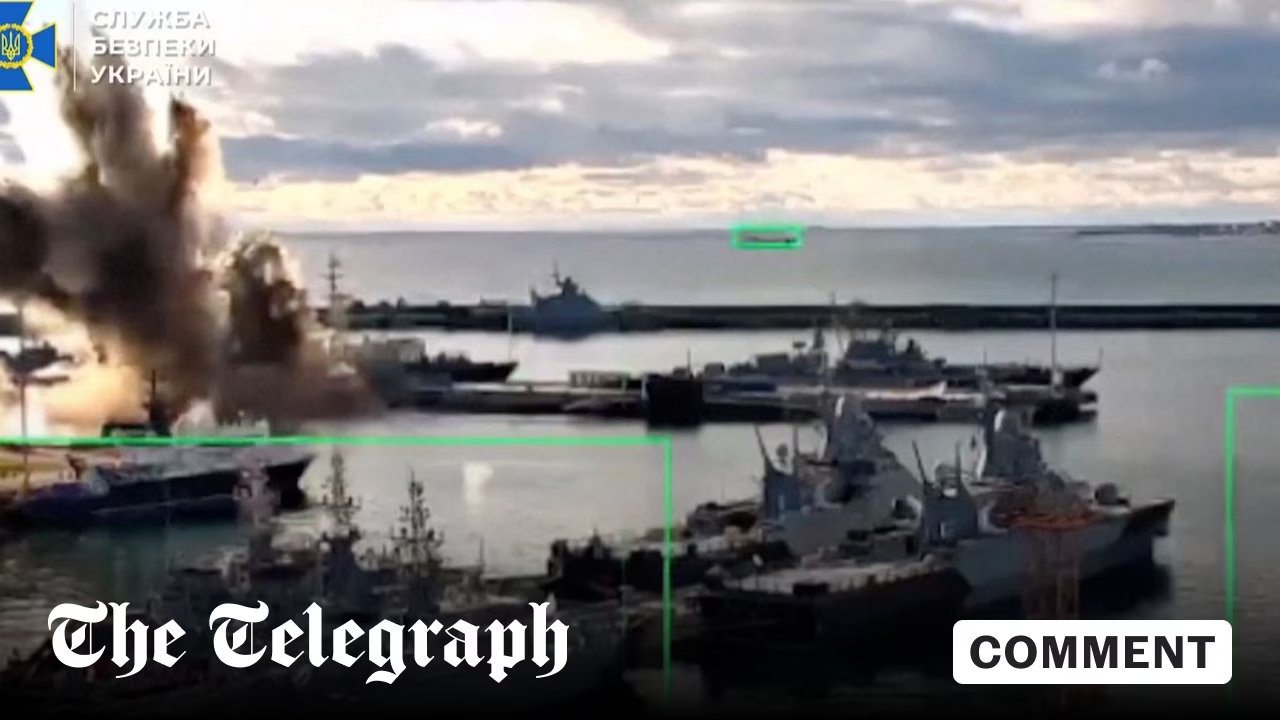
On Dec 15, Ukraine’s Security Service (SBU) special forces, operating with the nation’s navy, delivered yet another heavy blow to Russia’s Black Sea Fleet. They claimed the first-ever successful strike on a submarine using an unmanned underwater vehicle (UUV). The “Sub Sea Baby” kamikaze drone struck a £300m Improved Kilo-class submarine alongside in Novorossiysk.
Russia denies significant damage but footage of the explosion says otherwise. We await a full assessment but for now, a strike that takes out a valuable submarine – and the jetty it is moored on – is a double win for Ukraine. And it is worth remembering that the Russian navy took refuge in Novorossiysk after previously being driven out of its prized Crimean base at Sevastopol. At this rate there will be no safety for Russian warships anywhere in the Black Sea. The Russian army may be making grinding progress on land, but the Russian navy is in full retreat.
Quite apart from the big picture, this individual loss is a significant one for the Black Sea Fleet. Two of the Fleet’s Kalibr cruise missile submarines have now been lost: perhaps only three remain. The Improved Kilos were a key capability for long-range strikes on Ukrainian cities. This loss has severely blunted Russia’s sea-based bombardment capability and its ability to challenge commercial shipping undetected.
Drones are often credited with changing the face of warfare today. This certainly appears to be true on land but over the sea the aerial drones seen so far are just slow, easily-defeated missiles. This has been shown repeatedly in the Red Sea. The Black Sea has seen major Russian warships – and now a submarine – taken out by surface and now subsurface drones but not everyone has realised that in most cases the ships have been anchored or tied up alongside, greatly simplifying the drone operator’s task. The limited distances of the Black Sea mean that the Russian bases and anchorages are under threat, not just their area of operations. This is equally true of the Ukrainians but they have no major warships and so present limited target opportunities.
Another factor not always realised is that the Ukrainian surface drones are simply fast suicide attack craft, just without a crew. The fast small boat threat has been present in the Middle East for many years, and in fact if warships are in open water, under way, alert and properly trained that threat can be dealt with. Not many “fast” boats – crewed or uncrewed – can keep up with a frigate or a destroyer, particularly in rougher weather and not many can make it past properly organised warship gunfire. The Royal Navy practised for years against the Iranian fast attack craft threat and we were good at it. Ukraine’s surface drone strike rate has been as much to do with Russia’s inability to defend properly as the excellence of the weapon.
How did they do it?
Getting into an enemy harbour underwater and unmanned, however, as we have just seen – that is by no means simple. This new “Sub Sea Baby” appears to be a highly capable piece of equipment. How exactly this one was deployed and controlled are not clear.
The long transit from Ukrainian-held territory might have been made with the drone on the surface or semi-submerged in the fashion of drug smuggling vessels: alternatively it might have been deployed from a mothership, conceivably a seemingly harmless merchant vessel.
Once near Novorossiysk, the UUV would probably have had to submerge fully, at which point it would, in all likelihood, lose all communications – the only exception would be if it trailed a wire behind it to the possible mothership (or to a small anchored satcomms buoy on the surface outside the harbour) as it went in. This would permit remote operators to maintain control: if this was not done the drone would have to control itself autonomously.
Regardless of whether a human operator or an autonomous piece of software was controlling the drone at this stage, both would face the same problem: how to know where the drone was so as to find its way to the target location. Satellite navigation – such as GPS – doesn’t work underwater.
Inertial navigation is one possibility here: it’s used in full-size manned subs but smaller versions that would go in a drone might not be accurate enough, even starting from a sat-nav fix before submerging outside the harbour. Alternatively some special forces divers and small UUVs are equipped with doppler navigation sonar. This isn’t like a normal imaging sonar: instead it projects short-range sonic beams on to the seabed beneath it and the returns indicate quite precisely what path is being followed over the ground.
Yet another plan would be to use active imaging sonar and find the submarine based on knowledge of the harbour layout, though this would run a greatly increased risk of setting off Russian passive sensors if any were in place and it would be much more error-prone – especially for an autonomous system.
However the Ukrainians did it, I hope our intelligence services are working hard to find out how (or that they already know – ideally because the West had a hand in developing the technology) because it’s an achievement we need to know how to emulate.
Defending against something like this takes some doing. One obvious solution is a First World War-style anti-submarine boom and net but that is an unglamorous and time-consuming method. In any case the drone could wait until the boom was open, lift off the sea bed and strike.
A more modern method is the use of short-range, high resolution active sonar deployed from the jetty or the moored vessel. This can detect divers or drones approaching but it needs to be combined with a method of doing something about them in a timely fashion. Divers with limpet mines can often be dealt with quite simply by such methods as dropping 1lb demolition charges into the harbour from a boat, but in the case of a drone carrying a 1000lb warhead you need to stop the threat while still outside the port.
Perhaps the best defence against something like this, however, is to be at sea. Here the UUV is less capable than a torpedo that is fast enough to chase you down. The Sub Sea Baby probably can’t do that, at least not yet.
It’s now four years into the war and the Russians’ maritime complacency regarding Ukrainian innovation still astounds. They seem almost incapable of putting in place the most basic layers when it comes to self-defence.