Under a UN treaty, all ships above a certain tonnage must have an onboard tracker called an Automatic Identification System (AIS). These trackers broadcast information about the ships, including their location, and can be followed on websites like MarineTraffic.
But there is an incomplete and misleading public record of the Skipper’s movements. According to MarineTraffic, the Skipper’s last known port call was at Soroosh in Iran on 9 July, where it arrived after stopping in Iraq and the UAE.
But Kpler suggests that this is part of a pattern of misleading entries by the Skipper. Analysts at the firm said the ship had previously loaded crude oil from Venezuela and Iran, while falsifying its position via its onboard tracker, a process known as spoofing.
Venezuela has some of the world’s largest reserves of oil, but exports were placed under sanctions in 2019 by the US in a bid to force the transition of power from President Nicholas Maduro’s administration, which has been widely accused of election rigging.
The firm noted that while its AIS showed the ship at Iraq’s Basrah Oil Terminal on 7 and 8 July, terminal reports showed no record of the vessel there. Instead, the Skipper loaded crude oil at Kharg Island in Iran, Kpler said.
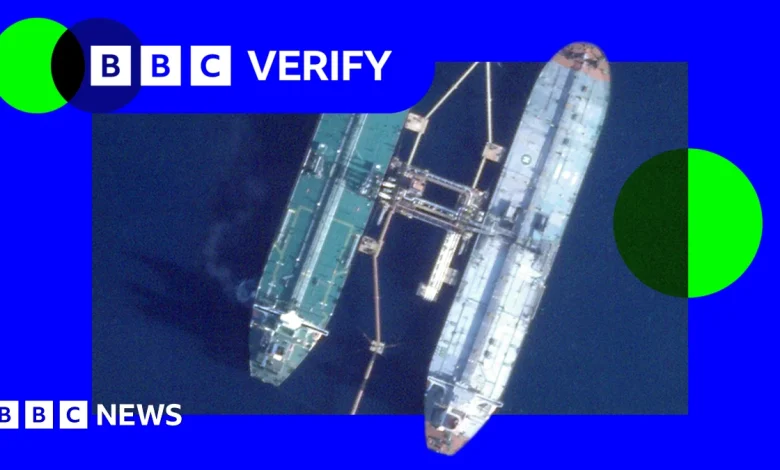
The Skipper then sailed east, tracking data shows, where Kpler suggested it conducted a ship-to-ship transfer between 11 and 13 August. The cargo was later unloaded in China, where Kpler said it was “falsely declared”.
It returned via Iran and sailed towards the Caribbean. The Skipper last declared its position on 7 November, several miles off the coast of Guyana. Its location only reappeared on 10 December, after the US raid.