PORTSMOUTH — Portsmouth Housing Authority Executive Director Craig Welch outlined the two phases of the Sherburne School redevelopment project — including a potential change to Phase 2 — during a recent city meeting.
“Financial constraints have forced us to split the whole development into two projects,” he told the city’s Housing Committee during a recent meeting.
The city is partnering with the Portsmouth Housing Authority (PHA) to convert the 5.3-acre former elementary school site at 35 Sherburne Road into below-market-rate housing.
A total of 127 workforce units have been permitted for the site, Welch told the committee.
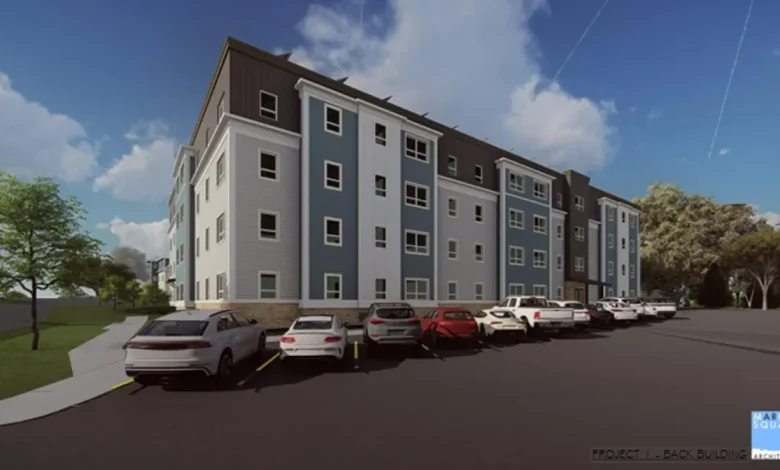
Phase 1 of the project will focus on the construction of a 90-unit building at the back of the former school property, Welch said.
“That’s what we got the tax credit award for,” Welch added during the Dec. 11 meeting held in City Hall. “That’s what we’re moving toward construction, subsequently we’ll be pursing to a next phase that includes the school and the area around the school.”
Priority to finish maximum number of units quickly
Phase 1 features the construction of the new four-story building, including parking access, the access road around the site, a playground and landscaping, according to project documents and comments made by members of PHA’s development team.
“The reason for starting with this first 90-unit phase is to achieve the policy goals the city has set out for us to build the maximum amount of units in the shortest amount of time,” Welch told the committee.
He estimated Phase 1 of the housing project will cost between $30 million to $35 million.
But he acknowledged the final price won’t be known “until all the bidding is done and we sign a construction contract.”
The former Sherburne School most recently served as the Robert J. Lister Academy, Portsmouth’s alternative high school, before that was moved to Community Campus.
Artist live/work space could go in former school
The plan for Phase 2 initially called for the construction of a middle 29-unit building located between the historic school and the Phase 1 building, according to previously filed project documents and statements made by project team members.
Phase 2 also called for the renovation of the school building to create eight residential units, while demolishing the existing school gym and cafeteria, according to project documents and team members.
Phase 2 also features the creation of a courtyard between the new 29-unit middle building and the school, according to project documents.
But Welch told the Housing Committee “after the first of the year we’re starting a design process for the school. We really feel like it’s important to come up with another design option that would include preserving the whole school, less the gym/cafeteria space in the middle.”
He added, “We might end up in that scenario sacrificing a few of these units” planned for the historic school building.
The one-story school is approximately 17,000-square-foot and includes a “really huge” attic.
“We think there’s some potential for two stories in the building” and potentially an addition, Welch said.
“My preference is to go for a new kind of plan there,” Welch told the committee.
He stated PHA staff have heard from the city’s Arts and Cultural Commission, who have advocated for some kind of artist live/work space on site.
“We fully endorse and support that idea,” Welch said. “We think that would be a really awesome thing to do.”
Housing Committee member raises concerns
Housing Committee member John O’Leary stated “this whole phasing thing has created some consternation with regards to how the project that was originally presented goes forward. … The concern is once you get that done, what happens to the school?”
Once the first 90 units are completed, O’Leary said, the project could stop.
“Secondly you say now it’s not cost effective to do the school, so either we’re going to demolish it and use the land to build another building, of if the city really wants to keep the school, the city is going to have to belly up to the table with some real money,” O’Leary said.
Welch responded, “All those scenarios are possible, to be straightforward.” But, he added, “our goal, our intent, is to fulfill our obligations to the city.”
Welch said construction on Phase 1 could start in the summer of 2026, with Phase 2 starting the summer of 2027, with the potential to “have the whole thing placed in service and occupied by the end of 2028.”
Financing issues described by Welch
In terms of financing, he reported the multi-family working group at New Hampshire Housing Finance Authority selected the Sherburne redevelopment as one of its recommended projects for 2026.
The board’s vote is expected to take place this week, he added.
But he cautioned that “despite this success we are continuing to battle against some really strong headwinds.”
“Since the new administration took office in January of this year, we experienced a lot of erratic and conflicting policy changes at the federal level,” Welch said.
In addition, he acknowledged they are “seeking another source of funds for an additional $500,000’ in offsite water and sewer costs needed for the project.
He pointed out the “state only funded the statutory minimum to the state Housing Trust Fund, which is $5 million despite the request for $30 million, and the fact New Hampshire is in a housing crisis.”
Before any potential changes, plans call for the proposed three-story 29-unit building in the center of the site to include 13 one-bedroom units, 11 two-bedroom units and five three-bedroom units, according to project documents.
The four-story, 90-unit building at the rear of the property is planned to include 51 one-bedroom units, 31 two-bedroom units and eight three-bedroom units, according to project documents.