For most businesses, 2025 has proven to be another challenging year. The global cost of living crisis, tariffs, geopolitical turmoil and regulatory upheaval have wreaked havoc on bottom lines.
Coca-Cola has not been immune to the pressures, but has nonetheless managed to exceed Wall Street expectations. Its latest trading update showed a company in remarkably robust health as net sales rose 5% to $12.46bn, while organic revenue increased 6%.
And its brand performance has been equally strong. According to Kantar, Coca-Cola is consistently one of the most valuable brands in the world, finding new ways to grow in a very mature category with strong headwinds. In recent years, Coke has been able to grow its meaningfulness and salience in the USA, leading to stronger pricing power as well as the ability to surpass Pepsi. BrandZ data shows how consistently the brand has both created demand (it’s ranked number one in the soft drinks category in 90% of markets) and made it available to consume (accessible to over 50% of drinkers in every market). Today, Coke ranks alongside Nike and Red Bull for the quality of its advertising on a globally weighted basis, largely thanks to the consistency of its executions.
That comes at a cost. Recently, Coca-Cola revealed its global ad spend stood at $5.146bn in 2024, an all-time high. That was up 2.7% from $5.01bn in 2023.
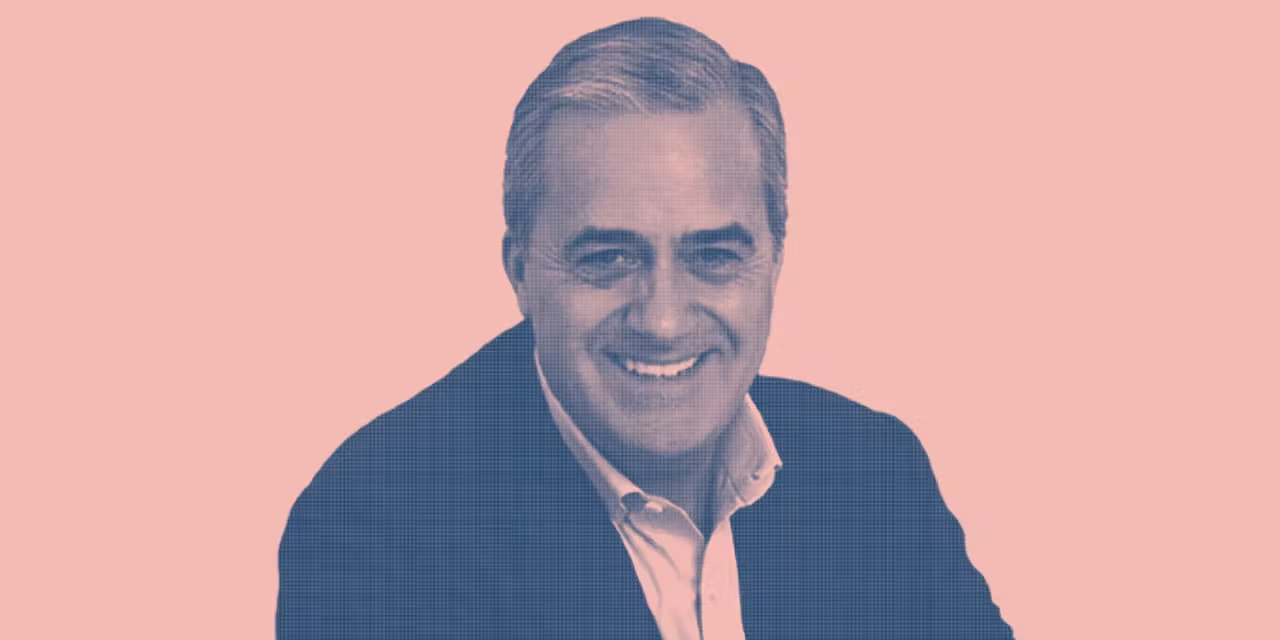
Fueling that performance is a marketing organization that has undergone a complete overhaul over the past four years. And at the center of the transformation is EVP and global chief marketing officer Manuel ‘Manolo’ Arroyo, a nearly 30-year veteran of Coca-Cola who has overseen the restructuring of agency relationships, media strategy and creative output.
“The market is recognizing that we are definitely at the top in terms of performance,” he says. “We’re managing to drive revenue, volume and transactions. Obviously, marketing and innovation are the major drivers of the growth of our company. Our company is a marketing company. It’s pretty much the heart and the soul.”
From fragmentation to focus
When Arroyo set out to modernize the function in 2021, Coca-Cola’s marketing ecosystem was sprawling and complex. The business was working with approximately 6,000 agency partners globally, while the majority of its multi-billion-dollar media budget was allocated to traditional channels. Arroyo wanted fewer partners, deeper integration and a shift towards digital-first execution at scale.
That ambition led to the consolidation of Coca-Cola’s global advertising account into WPP and the creation of Open X, a bespoke unit designed to manage the brand across markets and disciplines. Nine studios were established in key regions, housing a mix of Coca-Cola employees, WPP staff and specialist partners.
“It’s a marketing factory,” says Arroyo. “There are more than 2,000 employees of Coca-Cola and more than 2,000 employees of WPP […] and ultimately it’s enabled us to move from a company that in 2019 was investing close to 75% of our paid media on traditional TV, to a company that’s going to end up this year putting 70% of all our paid media on digital, particularly social and influencer led, marketing. For us, it’s our new TV.”
WPP’s stewardship of the global business has coincided with a period of intense pressure on holding companies. WPP has felt that most acutely, with its share price tumbling amid client losses and significant restructuring. Arroyo also made the decision to move Coca-Cola’s North American media business out of WPP to Publicis earlier this year, which only heightened scrutiny.
The turmoil ultimately led to a leadership shake-up. CEO Mark Read departed in September to make way for Cindy Rose, a former Microsoft executive.
From Arroyo’s perspective, proximity to WPP staffers in its nine studios has bred a level of understanding and given his teams a sympathetic view of the pressures facing the ad industry, from margin compression to accelerating technological change. Despite the introduction of rival Publicis into the mix, Arroyo is unequivocal in his support for WPP’s direction under new leadership and optimistic about the work it will continue to deliver.
“WPP is very bullish and I’m a huge advocate and supporter of the direction that [Cindy Rose] is taking in the industry. We’re really happy with the partnership. They are deploying for us right now the next iteration in media.”
A new modern media approach
Consolidation has also delivered significant efficiency gains. Advertising productivity has become a central pillar of Coca-Cola’s growth strategy, enabling the company to achieve even more with its record levels of spending.
Arroyo is now looking at what the coming years will deliver. He calls the next phase of that evolution a “modern media” approach, which builds on the structural changes of the past four years and pushes the organization further towards data-led, highly segmented execution.
It will be deployed in its top 40 markets globally at the end of this year and in more than 76 markets by the end of the first quarter next year.
For a business that was not born digital and does not sell direct to consumers, the complexity is immense. Coca-Cola operates across more than 50 distinct channels, from supermarkets and convenience stores to airlines, cinemas, stadiums and beach kiosks.
Modern media, as Arroyo defines it, brings together consumer, shopper, retailer, media, content, creator and e-commerce data into a single environment. This includes first, second and third-party data, geolocation, transactions, loyalty cards and content signals from platforms and creators around the world.
Want to go deeper? Ask The Drum
“Think about a massive, big boiling pot where you put all of that together in one place,” he says. The goal is to move from broad, one-size-fits-all plans to ultra-segmented growth audiences, defined down to postcode level but executed at a global scale. For a company selling 2.3bn beverages a day across 30m outlets in 200 countries, this represents a step change in how growth is driven.
“This modern media approach starts with data at the scale and allows us to bring all of those multiple data sets in one single place for one given country. And then think about a design of growth audiences, whereby going to see that we move from one plan for any given brand to an ultra-segmented plan that really goes to those consumer groups and consumer cards and segments that matter,” he explains. “We’ll understand the drivers of consumption, the motivations, the triggers of consumption moving forward, not only from a media investment standpoint but also bringing the content, the alternatives of content, in a contextual, relevant way that will drive the conversion into transactions.”
Coca-Cola has already been pushing the boundaries of what hyper-personalized communication, at scale, looks like. Take the return of ‘Share a Coke.’ More than a decade after its original launch, it was activated across more than 10bn bottles and cans in 120 countries, featuring over 30,000 locally relevant names.
The campaign contributed to single-serve transaction growth and helped Coca-Cola Zero Sugar deliver its fourth consecutive quarter of double-digit volume growth.
“It has accelerated five times the growth of our single-serve packages. Single-serve packages are very important because that’s where most of the consumer engagement, particularly with Gen Z, happens,” he says. “It’s the highest growth in the last five years.”
Beyond sales, the data dividend is equally significant. “Just that initiative added to our database 20m first-party data points around the world,” Arroyo adds.
On embracing AI
Artificial intelligence underpins much of this transformation, but Arroyo is careful to frame its role clearly. “It’s very clear that AI has phenomenal, fantastic applications in the whole marketing process, end to end, from insights to creation to production to media planning to media buying to performance tracking.”
Within Coca-Cola’s marketing organisation, adoption is already widespread. Through a combination of formal training and on-the-job learning, 85% of the company’s 2,000 global marketers now regularly use ChatGPT. That figure increases when you consider various other AI tools on its roster.
“You can help our teams do way better and faster marketing if they are really able to leverage the power of human genius and human creativity and AI capability at the same time.”
For Arroyo, the emphasis is firmly on augmentation rather than replacement. “It’s about the ‘and’ as opposed to the ‘or’ and we’re only at the beginning of that journey.”
AI’s ability to surface psychological, sociological and emotional insights at speed, for example, is reshaping how creative effectiveness is understood. But Arroyo sees an enduring role for human judgment. The quality of outcomes, Arroyo insists, still depends on the quality of human thinking, from prompting to interpretation and critical judgment.
“I don’t see a world without the human playing a significant role in crafting, in creating, in curating the output.”
Despite these assurances on the value of the human touch, Coca-Cola’s use of AI has not been without controversy, particularly around its Christmas campaign. From criticism that its use produced a clunky and inconsistent ad to more extreme calls for a boycott of the brand over its experiments with the tech, Coke has been on the sharp end of backlash. But Arroyo is dismissive of claims that the work underperformed.
“We got a 5.9 point score in System1 [for our Christmas ad], which is extremely high,” he says in defense. “And Kantar disclosed that this year it’s the second-best ad in Christmas across all categories.”
For him, the debate doesn’t make him question AI’s use in creative executions, but it does reinforce the importance of transparency, ethics and trust. “We continue to build on our journey of learning, learning and developing our capabilities on AI.”
As one of the most influential marketers in the world, Arroyo sees part of his role as encouraging peers to embrace technology responsibly. Trust, ethics and integrity remain non-negotiable.
“I see my role in encouraging my own peers to embrace technology, including AI, but doing that in a responsible and transparent way.”
Manolo Arroyo has been nominated for The Drum and the World Federation of Advertisers’ Global Marketer of the Year Award 2025. Find out more about the accolade and this year’s nominees.
Previous winners of the award include Asmita Dubey, chief digital and marketing officer at L’Oréal, who won for 2023, and Marcel Marcondes, global chief marketing officer at AB InBev, who won for 2024.