Open this photo in gallery:
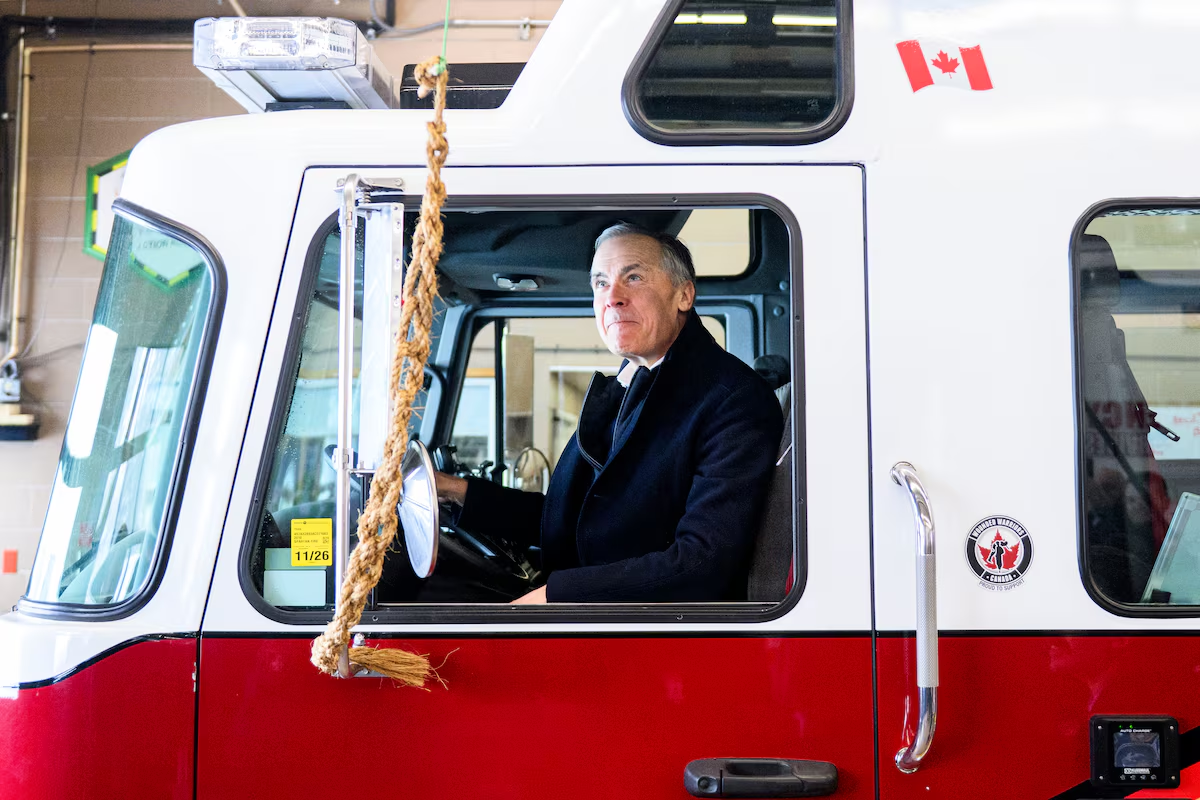
Prime Minister Mark Carney during a tour of Ottawa Fire Station 44 in his Nepean riding on Saturday.Spencer Colby/The Canadian Press
Laurence B. Mussio is chair of the Long Run Institute and fellow of the Royal Historical Society.
Politics is the art of postponing decisions until they are no longer relevant. – Henri Queuille
Prime Minister Mark Carney’s budget survived its final confidence vote in November – narrowly. The parliamentary arithmetic that keeps whips awake at night highlights a dangerous irony: Mr. Carney, shaped by decades at central banks, operates on 20-year horizons. Yet he commands a federal machinery designed for stasis, flanked by a cabinet discovering firefighting zeal after a decade of playing with matches. His praetorians – skilled at political evisceration, not project delivery – have perfected the political quick-kill over economic transformation.
The test is whether this long-game architect can build while his crew remains addicted to the quick fix. We are witnessing Canada’s eternal bargain: grand visions compromised by immediate political necessity and the persistent gap between policy ambition and procurement reality that has plagued successive governments.
This reveals a deeper problem: a deficit in Canada’s “mnemonic capital” – our collective institutional memory. We are programmed for managing difference, not driving transformation. Every structural reform triggers veto points that have been perfected over the course of 150 years. The Phoenix pay system, for example, took four years to implement and its problems still plague the public service. If Ottawa cannot implement basic payroll, how can it deliver complex infrastructure? Mr. Carney must reprogram this institutional DNA while racing against time.
His Major Projects Office (MPO), launched in August under Dawn Farrell – the former TransAlta CEO, who brings private-sector discipline – promises revolutionary change. The MPO is enforcing a rigid operational discipline to compress the bloated regulatory cycle, targeting a reduction in effective approval timelines from the historical three-year average to a strict 24-month execution window. It also implements “one project, one review” principles, and aims to unlock $60-billion in stranded capital. These aren’t incremental adjustments; they’re attempts at C.D. Howe-era acceleration.
Conservatives criticize Major Projects Office’s approach to private-sector recruitment
Major Projects Office rankles Bay Street with recruitment, compensation demands for junior staff
The MPO has identified 11 projects for immediate review. LNG Canada Phase 2 promises 35-per-cent lower emissions than global averages, allowing Mr. Carney to market fossil fuel expansion as green transition. Darlington’s small modular reactor will make Canada the first G7 country with operational SMRs, powering 300,000 homes per unit. The Contrecoeur terminal expansion adds 60 per cent more capacity to Montreal’s port, directly addressing Eastern bottlenecks. But execution remains the chronic vulnerability. These remain plans until shovels hit ground – and currently, Ottawa is better at drafting press releases than digging holes.
The productivity crisis exposes deeper tensions. Canadian labour productivity sits 30-per-cent lower than U.S. levels – a widening structural gap. Conservative Leader Pierre Poilievre offers a radical downsizing of the federal regulatory state and its administrative overhead as the answer; it’s coherent in its rejection of bureaucracy but incomplete in its strategy. Markets recognize that Canada’s productivity problems require competent state capacity alongside fiscal discipline, not merely the absence of government.
The government’s Indigenous strategy reveals evolution. The Indigenous Loan Guarantee Program expansion from $5-billion to $10-billion enables equity ownership rather than Ottawa’s traditional buy-acquiescence model. By guaranteeing prime-rate loans for project stakes, Indigenous communities can become partners with vested completion interests. Yet the Assembly of First Nations’ unanimous vote this week demanding withdrawal of the Alberta pipeline MOU may be less principled opposition than strategic leverage: co-operation on major projects may well be contingent on Ottawa delivering clean drinking water legislation and progress on the infrastructure gap.
Yet provincial absences threaten everything. The Alto High-Speed Rail project promises Toronto-to-Quebec City connections in four rather than eight years, creating 51,000 jobs. Without buy-in from Ontario and Quebec, however, it risks becoming an “infrastructure orphan” – federally announced but locally blocked through permits, zoning and political resistance. The provinces may hold ultimate vetoes through land access and grid connections.
History shows Canada’s leaps – Confederation, the Canada Pacific Railway, the St. Lawrence Seaway – required vision plus tactical flexibility. Today’s challenge is whether inclusive nation-building can match global competition’s pace.
Mr. Carney’s technocratic credibility offers hope. The MPO’s concrete targets are not merely bureaucratic metrics but the realization of massive physical assets: tens of thousands of jobs, lower emissions and homes lit by nuclear power. The projects under consideration provide the clear scorecards for Ms. Farrell’s success
Markets are watching whether institutional innovations mature before capture by the forces that compromised Phoenix, ArriveCAN, and countless federal initiatives. Without actual shovels in the ground within 12 months, Ottawa’s gravitational inertia will collapse these initiatives back into Canada’s eternal bargain.
The budget’s narrow survival suggests tentative possibility, but Thomas Edison warned us long ago: “Vision without execution is hallucination.” If expansive ambition can triumph over the elegant stagnation that has become Ottawa’s signature, it would be genuinely revolutionary.